
(Bloomberg) —
Four governments opposed to handouts for the European Union countries hardest hit by coronavirus are set to release their own plan to fund the economic recovery as soon as Wednesday.
In a challenge to the proposal set out by Germany and France on Monday, Austria, the Netherlands, Denmark and Sweden expect to publish their framework some point after 3 p.m. Brussels time, according to two European officials familiar with their plans.
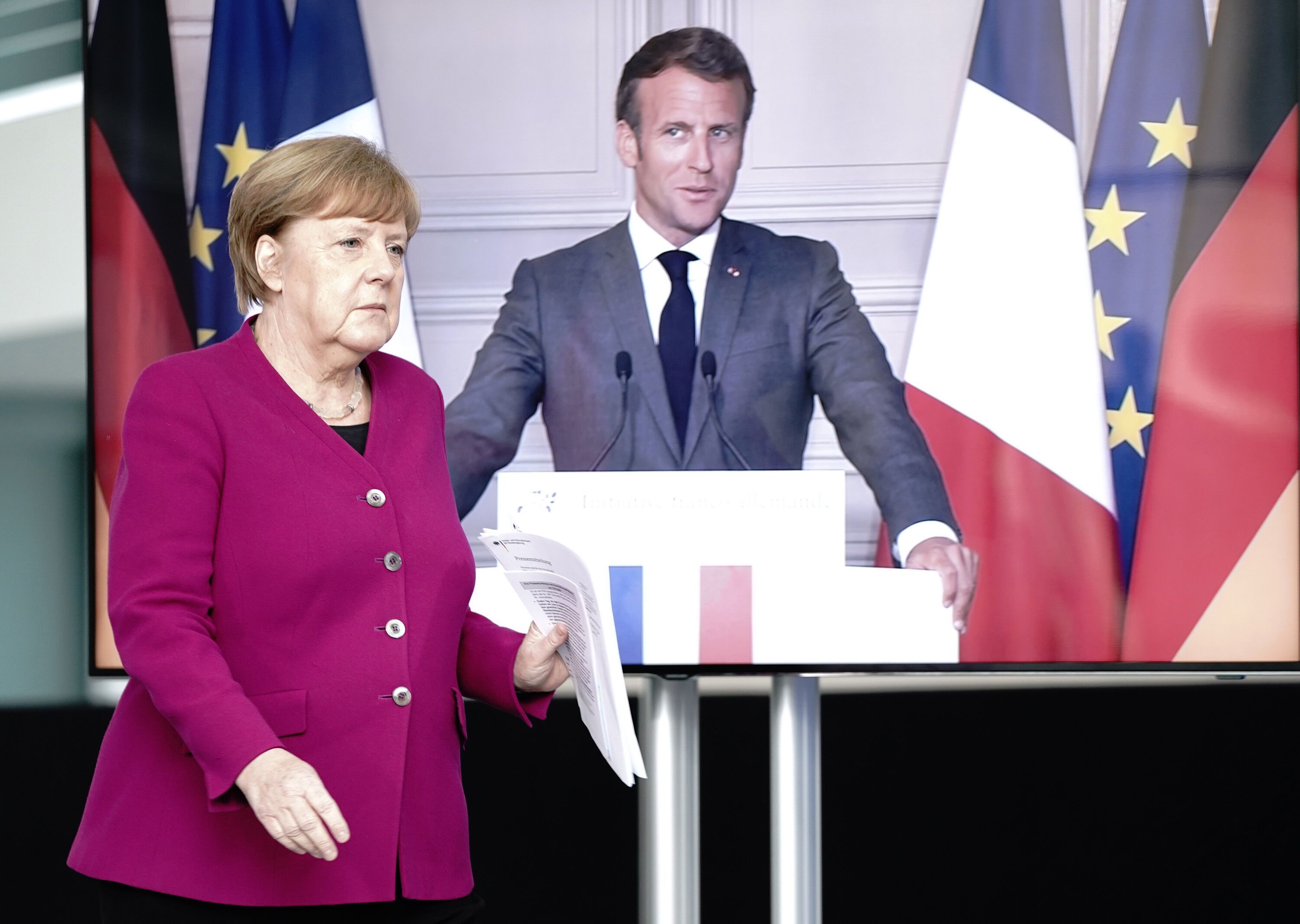
German Chancellor Angela Merkel and French President Emmanuel Macron on Monday threw their weight behind a plan to allow the EU’s executive arm to issue 500 billion euros ($548 billion) of bonds, with the proceeds going to help member states affected most by the pandemic.
Controversially, recipients of the funds won’t need to pay the EU back and the securities would be financed collectively. That means richer countries, like Germany, as well as the plan’s four critics, would be bankrolling poorer ones.
The plan represents a remarkable about-face for Germany, and the proposal, which needs unanimous approval by all 27 members of the EU, faces stiff headwinds from the bloc’s more frugal members.
“We still have to convince other member states, four in particular: Austria, Denmark, Sweden and the Netherlands,” French Finance Minister Bruno Le Maire said on Tuesday. “And we mustn’t hide the fact that it will be difficult.”
Austrian Chancellor Sebastian Kurz threw cold water on the Franco-German plan on Tuesday, saying that all four countries remain opposed to any direct handouts.
Eastern EU members are also unsure about the proposal — concerned that their subsidies may be diverted to help countries hardest hit by the pandemic.
After a video conference Tuesday between Merkel and members of the so-called Visegrad Four — Poland, Slovakia, the Czech Republic and Hungary — Czech Prime Minister Andrej Babis said he still had “many questions” about the proposal.
Warsaw indicated that it had serious doubts and would need to hold more discussions, according to an official familiar with the discussions.
While Polish Prime Minister Mateusz Morawiecki believes that the proposal is a move in the right direction, more negotiations are needed to iron out the issue of how the funds would be divided among the countries, said the official, who asked not to be identified because the talks were private.
“Poland could play hardball,” said Daniel Gros, director of the Brussels-based Centre for European Policy Studies.
New member states, which joined the EU in 2004 and 2007, are “the only ones who can still derail an agreement.”
The northern states can only “nibble at the edges, making eligibility more stringent,” he said.
For more articles like this, please visit us at bloomberg.com
©2020 Bloomberg L. P.