
Australia’s Cooler Prices Bolster Case to Extend Rate Pause
(Bloomberg) — Australia’s inflation rate slowed more than expected in the three months through June, reflecting global trends and bolstering the case for the Reserve Bank to pause again at next week’s policy meeting.
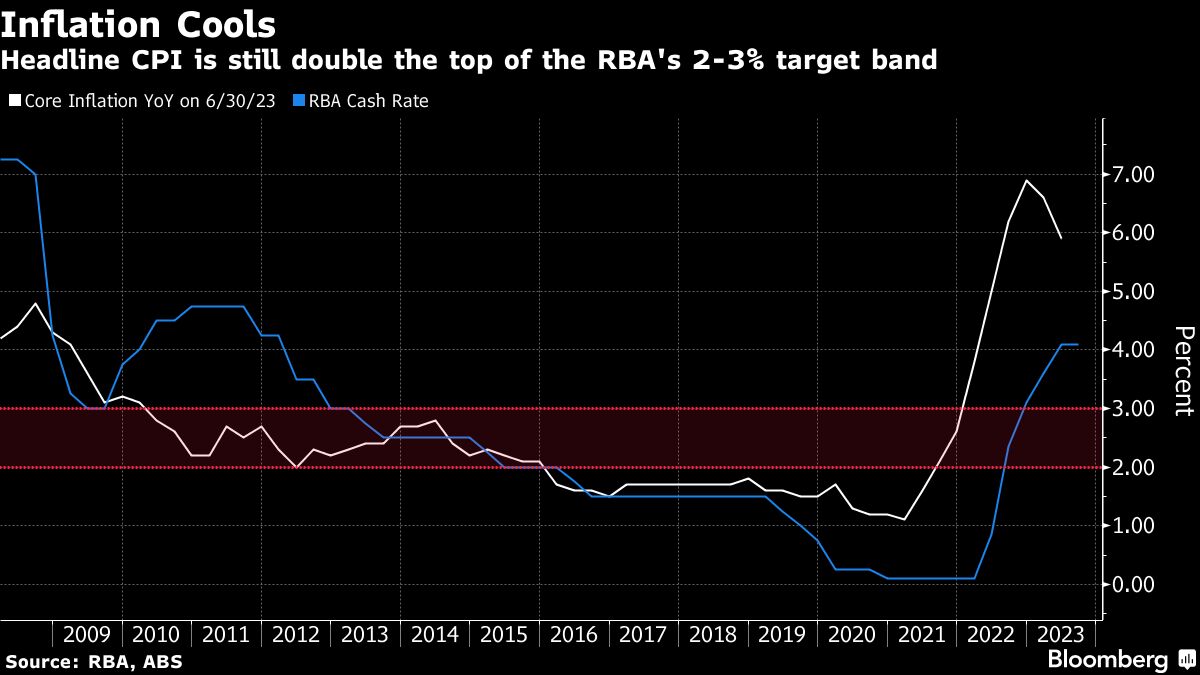
The consumer price index advanced 6% in the second quarter from a year earlier, less than economists’ estimate of 6.2%, Australian Bureau of Statistics data showed Wednesday.
The result was the second consecutive decline in the pace and the RBA currently expects inflation to return to the top of its 2-3% target by mid-2025.
The easing in prices will be welcomed by Governor Philip Lowe who says the central bank is now in data-dependent mode after raising interest rates 12 times over the past 15 months. Expectations that the result will allow the RBA to stand pat on Tuesday saw the Australian dollar extend losses and the yield on policy-sensitive three-year bonds fall, while stocks rose.
“The case for an imminent RBA hike next week has been diminished,” said Rodrigo Catril, a strategist at National Australia Bank Ltd. “But services inflation remains elevated and given expectations for further increase in wages growth plus a resilient labor market we still expect the data to eventually force the RBA to hike again.
But that is story for coming months.”
Wednesday’s data comes after US consumer prices decelerated to a more than two-year low in June, with key measures of underlying inflation coming in below forecasts. Australia’s CPI reading follows reports suggesting its economy remains resilient, putting the central bank on track to engineer a soft landing while cooling prices.
Traders now see about a 20% chance of a rate hike at the RBA’s Aug. 1 meeting, down from a roughly 50-50 probability prior to the release.
“The pace of inflation has peaked and is moderating quickly, wage growth is not excessive and medium-term inflation expectations are not rising,” said Stephen Smith, partner at Deloitte Access Economics. “In that context there should be no further interest rate increases in Australia.”
The RBA has moved at a more cautious pace than global counterparts, having raised rates by 4 percentage points compared with 5.25 by nearby New Zealand and 5 points by the US.
Federal Reserve policymakers are poised to hike rates to the highest level in 22 years at this week’s meeting.
Wednesday’s report showed the annual trimmed-mean gauge — that smooths volatile items and is closely monitored by the RBA — rose 5.9% last quarter from a year earlier, down from 6.6% in the first three months of the year.
Annual inflation for services rose to 6.3%, the highest since 2001, and the first time since September 2021 that services inflation has outpaced goods, Michelle Marquardt, ABS head of prices statistics, said in a statement.
The data showed that price increases for a range of services like rents, dining out, child-care and insurance fueled inflationary pressures.
“Higher prices in some of the heavy-weight components like food and housing increases the risk of inflation remaining above the RBA’s target band for longer,” said Antony George, a strategist at NatWest Markets Plc, who expects a 25-basis-point rate increase next week “despite the moderation in the latest CPI data.”
The RBA paused this month to assess the impact of its tightening campaign amid a mixed economic picture — consumers are downbeat while corporate confidence is holding up.
Australians with mortgages are battening down the hatches as they are forced to allocate a rising proportion of their incomes to repayments. Retail sales data due on Friday are expected to show household spending stagnated last month.
On the flip side, the labor market persists in defying the RBA’s rate hikes with hiring staying strong and the jobless rate holding at a downwardly revised 3.5% last month.
Still, unemployment is typically a lagging economic indicator.
Today’s quarterly CPI report also showed:
- The most significant contributors to the annual increase in the second quarter were new dwellings, jumping 7.8%; rents, up 6.7%; and domestic holiday travel and accommodation, surging 13.9%
- On a quarterly basis, rents recorded the strongest rise since 1988, reflecting low vacancy rates amid a tight rental market
- International travel costs also rose from the first three months of the year, driven by higher demand, particularly to Europe with the start of the summer peak season
- Partly offsetting those quarterly gains were falls in domestic holiday travel and accommodation, down 7.2%; electricity slid 1.8%; clothing accessories fell 2.2%; and automotive fuel was 0.7% lower
–With assistance from Tomoko Sato and Matthew Burgess.
(Adds comments from economists.)
More stories like this are available on bloomberg.com
©2023 Bloomberg L.
P.