
Global Equities Trend Lower on China, Fed Concerns: Markets Wrap
(Bloomberg) — Risk assets from Asian stocks and US and European equity futures to cryptocurrencies fell on Friday as worries about China and higher global interest rates sapped sentiment.
A gauge of Asia’s shares fell for a sixth session, on pace for its worst week in eight, with equity benchmarks for Japan, China and South Korea all lower.
The pain was keenly felt in tech stocks, with the Hang Seng tech index dropping as much as 3.1%, erasing gains of the prior day, as Li Auto Inc., JD.com Inc. and Trip.com Group Ltd. all registered declines of around 3% or more.
Contracts for the continent-wide Euro Stoxx 50 benchmark fell, as the index faced its third weekly drop.
Contracts for the Nasdaq 100 fell, after the index notched its worst three-day slide since February. Futures for the S&P 500 were flat after the index declined 0.8%, also its third daily decline.
Markets are seeing a brief respite on Friday from this week’s relentless gains in Treasury yields and the dollar. Yields on the bonds inched lower across the curve after those on the 10-year note on Thursday came close to the October peak, which was the highest since 2007.
The Bloomberg dollar index also fell.
This week’s broad risk-off direction follows Wednesday’s publication of minutes from the last Federal Reserve meeting that suggested officials are considering tighter policy, slamming hopes that the central bank was done raising rates.
In China, there were growing signs that policymakers are trying to limit the selloff. The People’s Bank of China delivered its strongest ever pushback against a weaker yuan via its daily reference rate, helping to support the currency.
This followed news Chinese authorities had told state-owned banks to step up support for the yuan.
State-owned developers warned of widespread losses, adding to concerns that the housing crisis is expanding from the private sector to companies with government backing. There are signs of contagion, with Australian miners on track for their worst week in five months, given how reliant they are on Chinese demand.
“We have a lot of uncertainty about the Chinese economy,” Hebe Chen, an analyst for IG Markets, said on Bloomberg Television. “The market is now standing at a crossroads about whether or not we can continue to talk about the Chinese recovery story or should we shift the narrative to China slowing down or even entering a recession.”
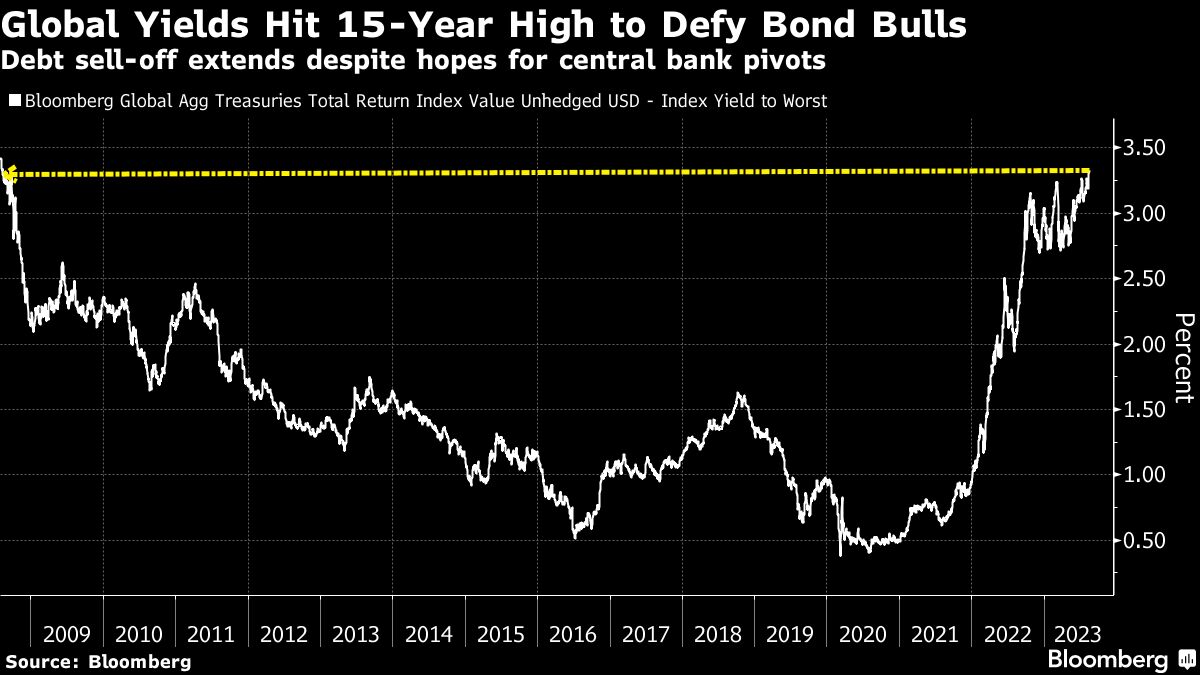
Read More: Global Yields Reach 15-Year Highs as Rate-Hike Worries Build
The slump in stocks comes as investors must decide whether to roll over about $2.2 trillion of longer-dated options contracts tied to stocks and indexes that are scheduled to mature on Friday.
That has led Goldman Sachs Group Inc. to warn that the activity is fueling the recent market selloff.
Tom Garretson, a senior portfolio strategist with RBC Wealth Management, said so far the stock slump has been more muted than during similar eras of elevated real rates.
“Tech stocks — and certainly equities broadly — are feeling the weight of rising real yields, but thus far not to the extent that we have seen during past episodes of rising yields,” Garretson said in an interview. “During past periods over the last three years of similar rises in real yields, we have seen tech pull back by about 7% to 15%.”
Data from before the US market opened showed the labor market remains healthy, doing little to change the narrative that more tightening from Fed officials may be in store.
“This week’s data hasn’t given them any reason to let their guard down,” said Mike Loewengart at Morgan Stanley Global Investment Office. “With housing starts, retail sales, and jobless claims all reinforcing the picture of a robust economy, another rate hike can’t be ruled out, even if the Fed remains on hold next month.”
Wall Street’s fear gauge, the Cboe Volatility Index or VIX, closed at 17.89, its highest level since May.
The VIX hasn’t reached above 30 — a level considered a sign of heightened volatility — since a series of bank failures rocked the market in March.
Investors will soon be turning to next week’s gathering of policymakers at Jackson Hole in Wyoming to gauge Fed sentiment.
Then yen gained after Japan’s consumer inflation slowed, offering support for the Bank of Japan’s stimulative policy stance.
Bitcoin was hit by the risk-off mood, extending this week’s decline on Friday.
Elon Musk’s SpaceX has sold Bitcoin, according to The Wall Street Journal, adding to the selling pressure.
Crude was set to notch its first weekly drop — ending a run of seven advances — as traders weighed signs of tightening supplies against concerns about the Chinese economy and US monetary policy.
Key events this week
- Eurozone CPI, Friday
Some of the main moves in markets:
Stocks
- S&P 500 futures were little changed as of 2:36 p.m.
Tokyo time. The S&P 500 fell 0.8%
- Nasdaq 100 futures fell 0.2%. The Nasdaq 100 fell 1.1%
- Japan’s Topix fell 1%
- Australia’s S&P/ASX 200 was little changed
- Hong Kong’s Hang Seng fell 1.6%
- The Shanghai Composite fell 0.4%
- Euro Stoxx 50 futures fell 0.4%
Currencies
- The Bloomberg Dollar Spot Index was little changed
- The euro was little changed at $1.0879
- The Japanese yen rose 0.3% to 145.37 per dollar
- The offshore yuan was little changed at 7.3050 per dollar
Cryptocurrencies
- Bitcoin fell 4.2% to $26,475.07
- Ether fell 2.2% to $1,678.67
Bonds
- The yield on 10-year Treasuries declined four basis points to 4.24%
- Japan’s 10-year yield declined two basis points to 0.630%
- Australia’s 10-year yield declined nine basis points to 4.23%
Commodities
- West Texas Intermediate crude was little changed
- Spot gold rose 0.2% to $1,892.83 an ounce
This story was produced with the assistance of Bloomberg Automation.
More stories like this are available on bloomberg.com
©2023 Bloomberg L.
P.