
Mexico’s Economic Growth Revised Lower From Preliminary Estimate
(Bloomberg) — Mexico’s economy expanded at a slightly slower pace than the preliminary estimate in the second quarter, even as the country benefited from the strength of its trade with the US and its own robust labor market.
Gross domestic product expanded 0.8% from the previous three months, below the 1% median estimate by economists in a Bloomberg survey and the 0.9% preliminary reading reported last month.
From the same period a year ago, GDP grew 3.6%, less than the preliminary 3.7% print, according to final data released by Mexico’s national statistics institute Tuesday.
“We expect robust domestic demand to drive activity ahead, even though growth could be much higher with better government policies. A potential recession in the US is the main risk,” Felipe Hernandez of Bloomberg Economics wrote in a research note before the report was released.
High employment and wage growth have put more money in circulation.
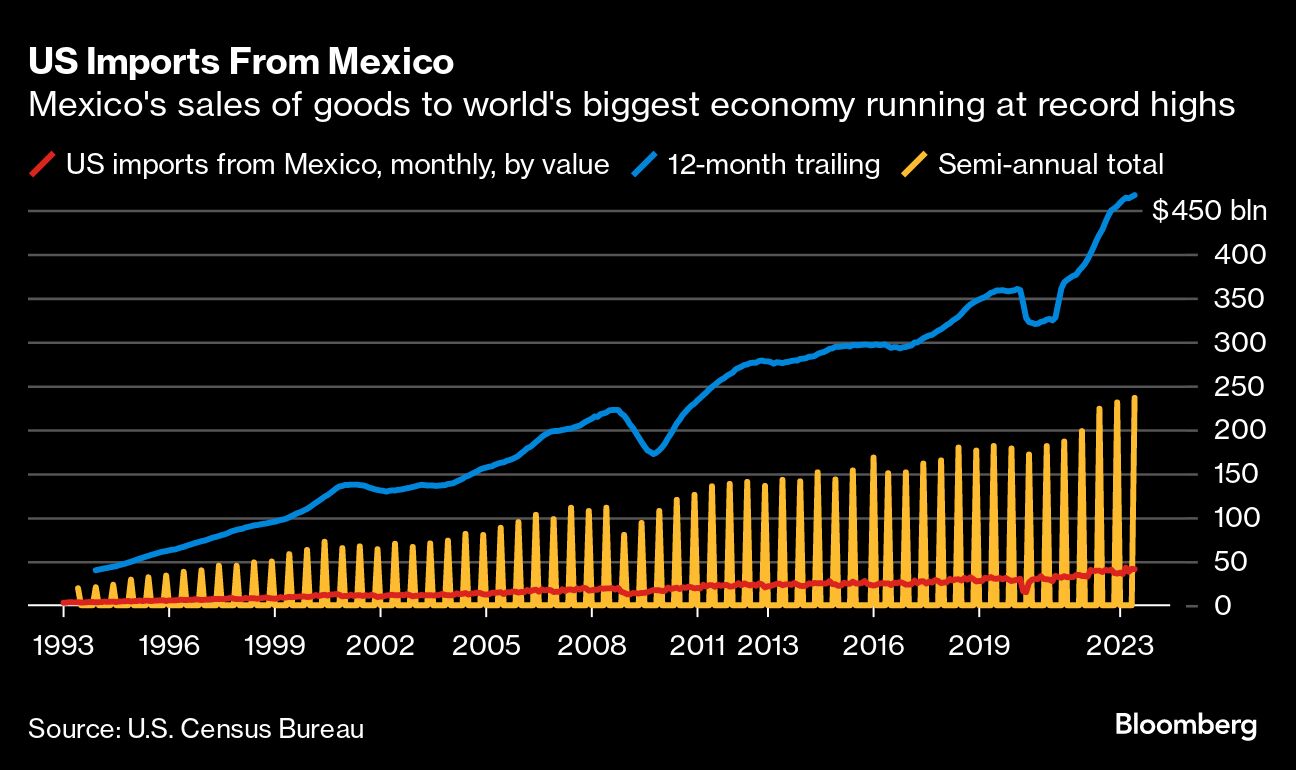
Latin America’s second-largest economy has also been helped by US demand for its exports, with the country posting a trade surplus in June amid a fall in the value of oil imports. The recovery of the services sector from its pandemic slump has also been a boon.
Summer spending, on vacations and restaurants — as customers help drive domestic demand — has also been a key element behind sustained consumer price increases in recent months.
Headline inflation stood at 4.67% in early August in the government’s most recent measurement. That’s down from the cycle peak of 8.77% posted a year prior, well above the central bank’s target of 3%, plus or minus one percentage point.
Analysts in a Citi survey published last week said that they expected the economy to grow 2.9% this year, up from a forecast of 2% in early June. Economists in a Bloomberg survey in August see Mexico’s growth at the end of the year at 3%.
“Economic activity in Mexico has been much better than expected this year,” said Carlos Capistran, the head of Mexico and Canada economics at Bank of America, before the revised data was released. “There are three main reasons: the US has also surprised to the upside in a big way, nearshoring and public construction.”
President Andres Manuel Lopez Obrador has sought to finish projects including a train through Mexico’s southeast and a major refinery before the end of his term in 2024, explaining part of the boost in construction in recent months.
The unofficial presidential candidate for his party is expected to be announced Sept. 6.
The investment of companies in Mexico to continue to sell to North American markets, the process known as nearshoring, has also supported expectations for sustained growth. Infrastructure problems and the tight labor market are concerns for some, which economists say has meant not all firms considering Mexico will finalize their deals.
“Obviously the countries that want to come to Mexico are worried because payroll is a significant part of their costs, and on top of that there’s the risk of a labor shortage,” said Gabriela Siller, economic analyst at Grupo Financiero Base, at an event in August.
The country received $29 billion in foreign direct investment in the first half of 2023, with much of that money coming from the US.
The US also is the No. 1 buyer of Mexico’s goods.
–With assistance from Rafael Gayol.
More stories like this are available on bloomberg.com
©2023 Bloomberg L. P.