
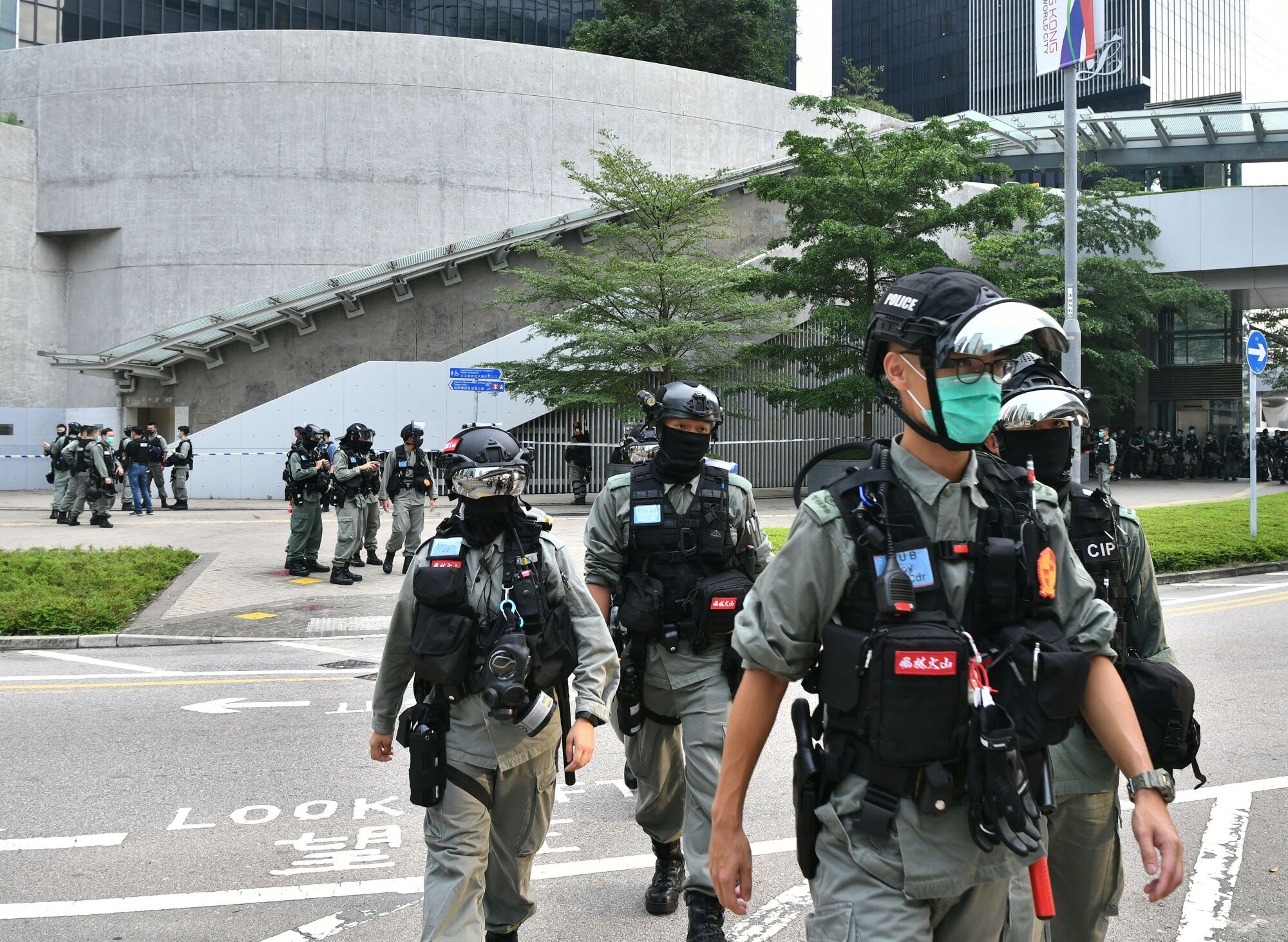
(Bloomberg) — Small groups of Hong Kong protesters hit the streets on Wednesday to oppose China’s increasing control over the city in the face of a heavy police presence.
The morning commute was largely unfettered, with Hong Kong police deploying a large number of officers downtown to deter demonstrations. Student groups and trade unions had called for protests to oppose several pieces of China-backed legislation, including a bill that would criminalize disrespect toward the Chinese national anthem and Beijing’s plan to impose sweeping new national security measures.
What Are the New Laws China Is Pushing for Hong Kong?: QuickTake
Key Developments:
- City’s No. 2 official says he hopes for progress on anthem bill
- Tycoon Li Ka-shing defends security law
- Police clear roadblocks set up in early-morning hours
- Demonstrations planned near LegCo
Here’s the latest (all times local):
Cheung says he hopes progress will be made on anthem bill (11:30 a.m.)
Ahead of a meeting of the city’s Legislative Council, Hong Kong’s No. 2 official, Chief Secretary Matthew Cheung, told reporters he hopes progress will be made on the national anthem bill today, saying the bill has nothing to do with freedoms or human rights.
Meanwhile, after being largely shut out from the Legco area by a police security cordon around the city’s legislature, protesters have taken to the Hysan Place shopping mall in Causeway Bay, shouting slogans including “Hong Kong independence, the only way out!”
Li Ka-shing defends security legislation (11:19 a.m.)
Billionaire Li Ka-shing, Hong Kong’s wealthiest tycoon, has defended China’s dramatic move to implement new national security legislation in Hong Kong.
“It is within each and every nation’s sovereign right to address its national security concerns,” he said in a statement. “We probably need not over-interpret it.
Hopefully the proposed new law can allay concerns the central government has in Hong Kong and give rise to a positive outlook from there.”
He said there’s no need to overthink the legislation, and that the Hong Kong government must try and maintain trust in the “one country, two systems” principle under which China governs the former British colony.
Hong Kong stocks slowly decline in morning trading (11 a.m.)
Hong Kong stocks steadily, but slowly, declined in the opening hour of trading as nearly half of Tuesday’s rebound has gotten erased.
The Hang Seng Index was down 0.6% at 10:50 a.m. after starting with a slight gain. The Hong Kong dollar is essentially flat at 7.7528 per U. S. dollar, remaining near the strong end of its trading band.
Chief Executive Carrie Lam said Tuesday that the city’s stock bounce following Friday’s heavy selling on the security proposal shows a law could bolster business confidence.
Beijing ‘wants to start a precedent,’ Martin Lee says (9:25 a.m.)
The move to impose a national security law is part of a broader attempt to establish a legal precedent that would allow Beijing to force more laws on Hong Kong in the future, Martin Lee, a prominent pro-democracy figure who helped draft the city’s constitution, told Bloomberg Television in an interview.
That could even include reviving the extradition bill that sparked protests last year, allowing Beijing to take people from Hong Kong and try them in mainland China’s Communist Party-controlled courts, he said.
“Beijing wants to legislate for Hong Kong and start a precedent,” he said. “The next thing they could legislate is the extradition bill. Once that is passed, they could come to our courts and present some documents, present some trumped up charges, and we’d be transferred to Beijing.” Lee added that he hoped the international community would take action.
“I call this the rape of Hong Kong.
They are raping the Hong Kong system,” Lee said.
Ex-justice secretary defends China’s move (9:09 a.m.)
Elsie Leung, a former Hong Kong justice secretary, defended China’s move to impose the national security legislation as a necessary reaction to the violent unrest last year.
“When investors and businesspeople consider where to put their investments, they need stable conditions, a stable society,” she said on Bloomberg TV. “Since 2019, there have been riots, demonstrations, rioters throwing petrol bombs, destroying MTR machines and so on – that is not a good business environment.
We hope with the enactment of this new law, which Hong Kong cannot do by itself, the environment for doing business and investments will be improved.”
Protesters say they’ll go on despite police presence (8:30 a.m.)
Demonstrators called for an 8:30 a.m. rally at downtown Alexandra House in a Telegram channel popular with activists.
The rally’s organizers had held a 2 a.m. poll in the same channel on whether to cancel or go ahead with Wednesday’s events after seeing an “unprecedented” police presence readying the previous night.
Some 61% of more than 1,680 people surveyed voted to continue, while 39% wanted to hold off. The organizers vowed not to cancel as they didn’t want to anger protesters.
Officers get rid of roadblocks (7:28 a.m.)
Officers were clearing roadblocks in multiple areas after a group of “thugs” sought to disrupt traffic with nails and other debris, police said in a statement posted to Facebook, warning commuters to check traffic conditions before heading out.
Hong Kong’s main thoroughfares were largely fine.
“The police warn the mob to stop illegal activities immediately, otherwise they will be arrested,” it said. The force said on its page that it would be providing regular updates on the situation in Hong Kong.
For more articles like this, please visit us at bloomberg.com
©2020 Bloomberg L.
P.