
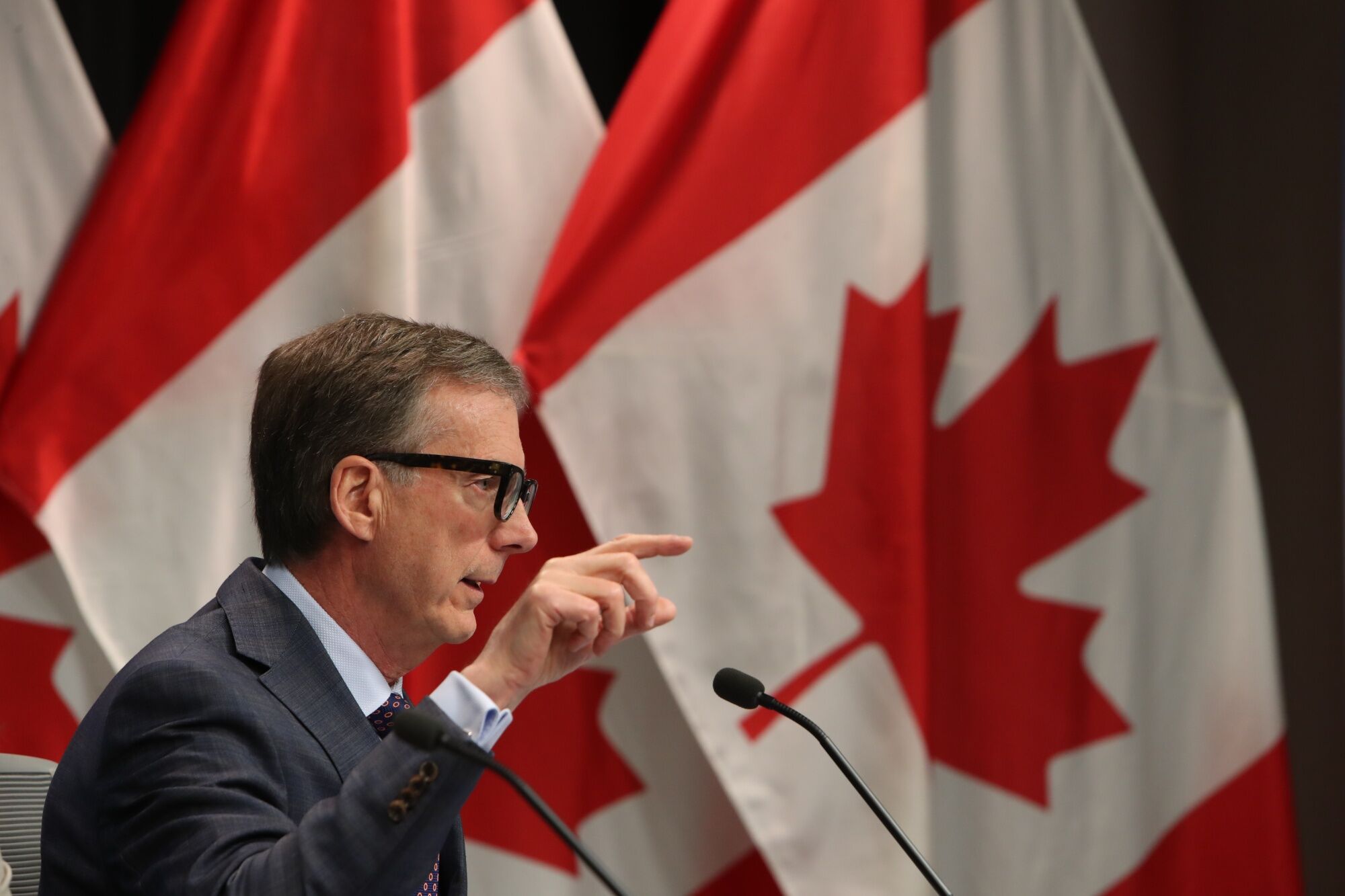
Macklem Says Rates May Be ‘Sufficiently Restrictive’ After Pause
(Bloomberg) — The Bank of Canada governor said recent evidence shows higher interest rates are working to slow the economy, and policy may be tight enough bring inflation to heel.
“With past interest rate increases still working their way through the economy, monetary policy may be sufficiently restrictive to restore price stability,” Governor Tiff Macklem said in a speech to the Calgary Chamber of Commerce a day after officials held the benchmark borrowing rate steady at 5%.
Still, policymakers are worried about the persistence and breadth of inflation.
While they see Canada’s job market loosening, wage pressures aren’t yet moderating. And though officials say excess demand has “diminished substantially” and corporate price-setting behavior is normalizing, Macklem maintained a hawkish stance, saying the bank is “prepared to take further action.”
Macklem’s comments — combined with Wednesday’s pause — suggest policymakers may be nearing or at their terminal point for rates, reinforcing the views of many economists that the Bank of Canada’s historic tightening cycle is at its likely endpoint, and that its next move will be a cut by the middle of next year.
“Just as it took longer to see clearer evidence that higher interest rates were moderating demand in the economy, it may now be taking longer for this to translate into lower inflationary pressures,” he said.
Macklem reiterated that policymakers are trying to balance the risks of under- and over-tightening.
Although inflation reaccelerated to 3.3% in July, the governor said officials are encouraged by the progress they’ve made so far and the 2% target is “now in sight.” He expects the moderating economy to help achieve that goal.
“For inflation to continue to decline, we need demand to continue to grow more slowly than supply for a period of time,” he said. “That will relieve price pressures, slow increases in labor costs and restore normal price-setting behavior.
And that’s what will bring inflation sustainably back to target.”
The central bank estimates excess demand peaked in the first half of last year and eased gradually since then.
Canada’s economy shrank at a 0.2% annualized pace in the second quarter, which means growth has averaged a little less than 1% over the last three quarters, while the economy’s productive capacity grew at a rate of a little over 2%.
“The cumulative effect is that the excess demand in the economy has diminished substantially.
This should reduce price pressures, leading to lower inflation,” he said.
Macklem pushed back against a common argument that the bank’s rate increases were a key contributor to inflation, which is now close to 2.5% if mortgage interest costs were excluded.
“It’s true that if we hadn’t raised interest rates, mortgage costs might be lower today, but inflation throughout the economy would be a much bigger problem for everyone,” he said.
In his comments, Macklem also reiterated the primacy of the central bank’s 2% target, saying it has “served Canadians well” and getting there is “eminently achievable.”
More stories like this are available on bloomberg.com
©2023 Bloomberg L.
P.