
(Bloomberg) —
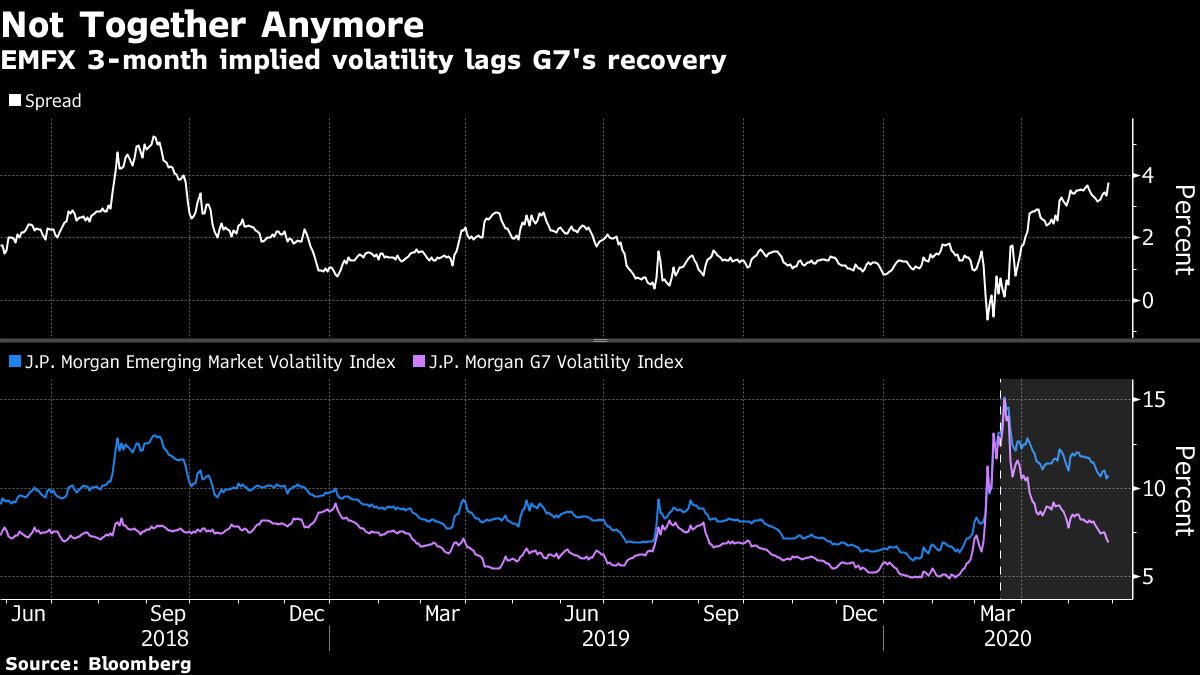
The cost of options to protect against Group of Seven currency fluctuations is falling faster than a gauge for less-developed nations, signaling that investor appetite for risk has far from recovered even as pandemic concern eases.
The spread between an index tracking G-7 currency fluctuations and a gauge for less-developed nations now stands at 3.8%, a two-year high, according to JPMorgan Chase & Co.
“Market participants are becoming more confident that developed currencies are going to stabilize or appreciate at a quicker pace than emerging markets currencies” said Brendan McKenna, a foreign-exchange strategist at Wells Fargo & Co. in New York. “Developed markets are typically better positioned to recover after a crisis and don’t usually face the same kinds of issues that emerging-market countries may face.”
While both gauges show volatility cooling around the globe amid expectations that the worst of the coronavirus crisis may be over, investors have been quicker to trust a rebound in the developed world.
Financial assets in the U. S., U. K. and Japan have rebounded as lockdown measures ease and economies begin to reopen.
It’s taking longer in the developing world, where some nations are still a hotbed of new virus outbreaks. That’s the case in Brazil, where infections are rising as leaders recoil from strict lockdown rules. Brazil’s real is the worst-performing of 143 currencies tracked by Bloomberg this year, even after paring losses this week as risk appetite recovered.
In Russia, home to the third-largest number of confirmed cases after Brazil and the U.
S., the ruble is the worst emerging-market European currency this year. More than 150,000 people have also tested positive in India, where the rupee has lost 5.7% this year.
Money managers have instead flocked to perceived havens such as the U. S. dollar. The Bloomberg Dollar Spot Index, which tracks the greenback against a basket of global currencies, has hovered near multiyear highs for most of the past two months and gained about 4% this year.
“Implied volatility is like insurance,” said Bipan Rai, head of foreign-exchange strategy at Canadian Imperial Bank of Commerce in Toronto. “If the market is worried about the virus proliferating in emerging markets, then it’ll demand more insurance and implied volatility will rise.”
At the same time, though, “the decline in implied volatility for both is because the market is becoming less concerned on risks relative to before,” Rai said. “It’s difficult to delineate between the two in this environment”
Demand to hedge emerging-market currency depreciation is also slowing.
Three-month risk reversals, which represent the premium investors are willing to pay to buy a dollar-call versus a dollar-put, are dropping alongside implied volatility. While the slowdown doesn’t necessarily mean that further currency losses are impossible, it flags a shift away from losses as the most common scenario.
For more articles like this, please visit us at bloomberg.com
©2020 Bloomberg L.
P.