
Indonesia Is Set to Extend Rate Pause as Risks Build Up for Rupiah
(Bloomberg) — Indonesia’s central bank will probably leave its benchmark interest rate unchanged, as policymakers look set to act to support the rupiah only when volatility from global uncertainties become excessive.
Thirty of the 31 economists surveyed by Bloomberg expect Bank Indonesia to keep its seven-day reverse repurchase rate at 5.75% for a ninth straight meeting on Thursday.
That is in line with the latest signal from Governor Perry Warjiyo, who in an Oct. 6 interview underlined the need to hold the rate “for a while” while keeping an eye on global spillovers and signs of volatility.
As Warjiyo’s comments were made before the Israel-Hamas war caused jitters in the global financial markets, one economist sees the possibility of a quarter-point hike to help stabilize the currency.
Here’s what to watch for at Thursday’s policy rate briefing from 2 p.m. in Jakarta:
Currency Woes
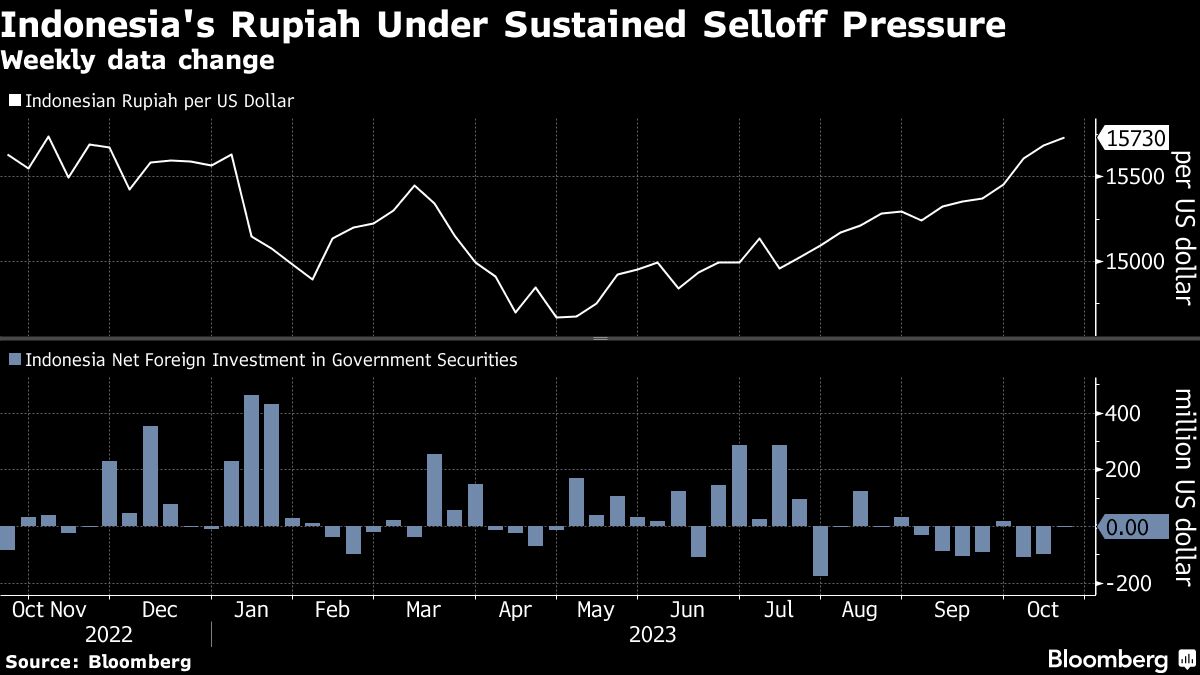
The rupiah has been this month’s worst-performer among 12 Asian currencies tracked by Bloomberg, as investors flee riskier assets and alarm grows about the conflict spreading in the region.
Expectations of a narrowing rate differential with the US is also eroding a key support for the currency
Without moving the policy rate, “capital flow management measures are likely to be the main port of call to boost the reserves buffer and bolster its defenses against external uncertainties,” said Radhika Rao, an economist with DBS Group Holdings Ltd.
However, market enthusiasm for Bank Indonesia’s rupiah-denominated securities, or SRBI, as well as its term deposit facility for exporters’ dollar, has been waning.
The central bank had to step up its interventions by buying bonds in the market again for the first time since last year.
The intense moves stripped foreign exchange reserves by more than $2 billion in September.
“BI’s continued preference for FX interventions over rate hikes puts the economy at risk of experiencing ‘twin liquidity deficits’ caused by contractions in both USD and IDR money supply,” according to PT Bahana Sekuritas economist Satria Sambijantoro, the lone analyst to predict a hike.
Another 25-50 basis points of rate hike shouldn’t hurt the economy as much as a liquidity shortage would, he wrote in a report.
Slowing Economy
While Southeast Asia’s largest economy has managed to maintain a trade surplus this year, it was more due to a longer slump in imports, flashing signs of a weakening economy.
The nation’s outbound shipments fell for four straight months through September, “indicating weakness on global slowdown impacting the domestic economy,” said chief economist at PT Bank Mandiri Andry Asmoro.
The contraction has been mainly driven by declining raw material and capital goods imports.
On the domestic front, optimism dimmed among consumers with the index tracking their confidence falling to a nine-month low. Policymakers have taken precautions over rising prices of staple foods such as rice and sugar due to prolonged El Nino, which risks fanning inflation further and, in turn, hurting purchasing power.
Consumer prices rose more than expected at 2.28% annually in September, driven by higher rice inflation that surpassed 18% year-on-year.
Core inflation — a gauge closely watched by the monetary authority — remained low at 2%.
–With assistance from Tomoko Sato.
More stories like this are available on bloomberg.com
©2023 Bloomberg L. P.