
(Bloomberg) — When it comes to U. S.-China friction, Asia’s loss is becoming Latin America’s gain.
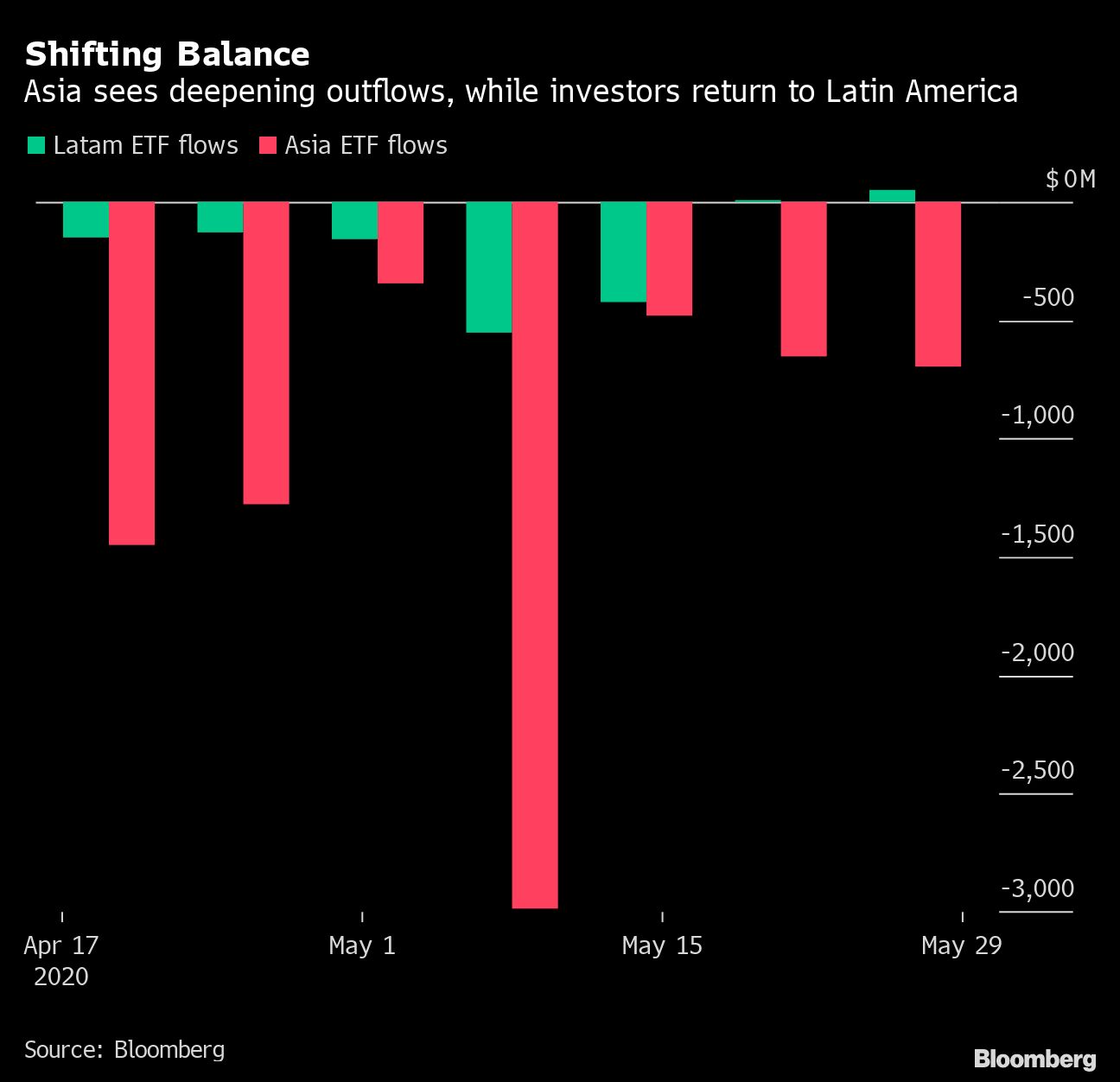
Exchange-traded funds listed in the U. S. that invest in Asian bonds and stocks have suffered net sales of $1.4 billion in the past two weeks through May 29, extending a streak of outflows that started in February. Similar ETFs investing in Latin America have attracted about $60 million of funds over the two-week period, despite the region becoming the new coronavirus hot spot.
The shift also comes after the outperformance of Asian assets since the depth of the coronavirus sell-off.
A gauge of equities in the region is now only down about 6% this year. Latin American shares have still lost more than 30%.
As Asian assets face the risk of being caught in the crossfire of a deteriorating relationship between the world’s two biggest economies, those in Latin America are starting to see a number of positives. Prices are recovering for commodities such as oil and copper, which are among the region’s major exports, while valuations are seen as relatively attractive after the region lagged behind the rest of its global peers.
Read more: Latin American Unrest Hot Spot Becomes Market Darling on Virus
“You could see it in the context of a leadership hand-off from Northeast Asia, which has had the most success defeating the virus, to Latin America, which hasn’t yet brought cases down so much, but is already seeing activity improvements,” said Morgan Harting, who helps manage $1.2 billion in AllianceBernstein’s EM multi-asset fund in New York. “Investors seem very focused on activity data.”
The green shoots of a recovery in Latin America are still threatened by the worsening virus outbreak.
Even as some parts of Brazil, including epicenter Sao Paulo, have begun reopening after lockdowns, the country reported a record number of daily deaths from Covid-19 Wednesday. Mexico saw its first daily rise of more than 1,000 deaths.
Here’s a roundup of comments from investors about the contrasting outlook for the two regions:
Mark Mobius, co-founder of Mobius Capital Founders:
- The impact of the virus in Latin America will not be as great due to the younger population.
The situation may be exaggerated as death counts may also be inaccurate and could include deaths from other causes
- Emerging-market assets are on a strong uptrend, and this likely will continue amid a V-shaped recovery
- U. S.-China tensions have been largely priced in, though the continued shutdown policies, which are causing unemployment, and could lead to increased violence, pose the biggest risk
- China stocks are expected to continue rising, but the increase won’t be as great as other emerging markets
Greg Lesko, a money manager at Deltec Asset Management in New York:
- China massively outperformed the rest of EM in the first quarter
- The rally in Asia has led investors to look elsewhere
- As the U.
S. opens and recovers, Latin America should benefit
Jean-Charles Sambor, head of emerging markets fixed income at BNP Paribas Asset Management in London:
- From a macro standpoint, Asia looks to be in better shape as China’s economy recovers and this will have a positive impact on neighboring countries. Latam is still struggling with the virus and commodity prices are still low
- From a valuation standpoint, there are opportunities in Latam such as in investment-grade dollar bonds in Mexico, or in low-yield local currency debt like Peru
- China high yield continues to look attractive, especially property developers that will benefit even amid U.
S.-China tensions as Beijing will boost stimulus
- Tensions will unlikely create a big crisis in the short term, but there might be more concerns as the U. S. elections near
Ian Beattie, co-chief investment officer and head of emerging markets at NS Partners in London:
- The firm is adjusting its EM portfolio strategy to reflect recent monetary developments, increasing exposure to cyclical markets, sectors and stocks
- We had a good performance in China year to date and now we’re thinking of reducing our allocation there to increase in Brazil and elsewhere.
We have also made good money in Taiwan year-to-date, and have taken some profits there as well
- Excess liquidity in the global economy is the greatest since the end of the global financial crisis. This is expected to drive a V-shaped economic rebound as pandemic containment measures are eased with associated strong performance of cyclical assets, including emerging-market equities
Nader Naeimi, head of dynamic investing at AMP Capital Investors in Sydney:
- “I’m going to markets with most cyclical upside and that’s often Latin America”
- The biggest tail risk is U.
S.-China tensions, and for that, having hedges is appropriate
- The firm is buying high-yielding currencies in Latin America, while selling low yielders in Asia, both as a hedge against the yuan depreciation led by trade tensions, as well as to profit from carry trades
- The recovery in global demand and turn in the commodity demand cycle will likely offset the worsening outbreak in Latin America
- Manufacturing-heavy parts of EM will lead the recovery as global demands picks up
For more articles like this, please visit us at bloomberg.com
©2020 Bloomberg L.
P.