
(Bloomberg) — China is offering employees of some large state-run companies intending to travel overseas the option to be inoculated with two vaccines currently in development. The European Union plans a “gradual and partial” easing of a ban on most travel to the bloc as of July 1, while blaming China and Russia for spewing out misleading information about Covid-19.
The Organization for Economic Co-operation and Development forecast a global economic slump of 6% this year and Starbucks expects the pandemic to reduce sales this quarter by as much as $3.2 billion, highlighting the challenges for customer-facing businesses.
Anthony Fauci, the director of the U.
S. National Institute of Allergy and Infectious Diseases, said the pandemic is his “worst nightmare” and warned that the deadly outbreak is far from over even as U. S. infections rose at the slowest daily pace since March.
Key Developments:
- Virus Tracker: Cases pass 7.2 million; deaths exceed 411,800
- How London transport is preparing for life after lockdown
- In Africa, virus fall out threatens debt crisis
- Pandemic has everyone ditching coal — except Asia
- Virus pushes nations to solve global food problem
- The $1,000 haircut is alive and well as NYC reopens
Subscribe to a daily update on the virus from Bloomberg’s Prognosis team here.
Click VRUS on the terminal for news and data on the coronavirus. For a look back at this week’s top stories from QuickTake, click here.
Starbucks Sees Potential $3.2 Billion Sales Hit From Virus (8:42 a.m. NY)
Starbucks Corp. expects the pandemic to reduce sales this quarter by as much as $3.2 billion, dragging down the coffee chain’s performance as it sees a recovery stretching into next year.
The company, which like other restaurants has had a difficult time offering guidance, said Wednesday it expects to report an adjusted loss of 55 to 70 cents a share when it next releases earnings.
The guidance underscores the depth of the challenges for customer-facing businesses.
Tokyo Olympics Committee to Scale Back Games (8:08 a.m. NY)
The 2021 Olympic Games in Tokyo will be scaled back, with plans to limit staff and the size of ceremonies, but not athletes and spectators, according to the event’s organizing committee in Tokyo.
The committee will be reviewing program details until before the games as the Covid-19 situation is changing, Tokyo 2020 CEO Toshiro Muto said.
HIV Raises Covid Death Risk, South African Data Shows (7:43 a.m. NY)
People with HIV are almost three times more likely to die if they contract the coronavirus than those with no co-morbidities, irrespective of whether they are taking anti-AIDS drugs, an analysis of South African data shows.
The finding was made by the Western Cape Department of Health, which oversees medical services in the province with about two thirds of South Africa’s almost 53,000 confirmed coronavirus infections.
It considered almost 13,000 cases, including 435 deaths, to produce what it says is the first analysis of the interplay between HIV and Covid-19.
Still, the impact HIV had on mortality was less than expected and well below that of other co-morbidities such as diabetes, although it was higher than tuberculosis, the department said in a presentation. South Africa has the world’s biggest HIV epidemic.
Pictet Sees 80% Chance of Vaccine Before Year-End (6:38 a.m.
NY)
Pictet Wealth Management is betting that a vaccine for the coronavirus will arrive this year, with the asset manager’s base case for the global economy to bounce back by almost 6% next year, after contracting by about 4% this year.
“Our central scenario today is that with 80% probability there will be a vaccine by year-end by the likes of Pfizer or someone like that,” Chief Investment Officer Cesar Perez Ruiz said on a conference call.
Travel to Europe Will Be Allowed Again Starting July 1 (6:34 a.m.
NY)
The EU plans a “gradual and partial” easing of a ban on most travel to the bloc as of July 1, the EU’s foreign-policy chief Josep Borrell told reporters on Wednesday in Brussels.
A curb on non-essential travel to the EU is due to lapse on June 15 after being introduced in mid-March for 30 days and extended twice as Europe stepped up the fight against the coronavirus pandemic.
China Offers Experimental Vaccine to Workers Going Abroad (6:16 a.m.
NY)
China is offering workers at some large state-run companies the option of being inoculated with two coronavirus vaccines currently in development, illustrating how quickly authorities are moving to test the viability of the shots.
Employees intending to travel overseas for work can volunteer to be administered shots developed by China National Biotec Group Co. or CNBG, a subsidiary of Beijing-based Sinopharm Group Co., according to people familiar with the matter who asked not to be identified as the offer hasn’t been made public.
The proposal was relayed to state-owned companies by the government body that oversees them, the people said.
EU Points Finger at China, Russia for Disinformation (6:01 a.m. NY)
China and Russia were blamed for spewing out false and misleading online information about Covid-19 in a European Commission report that seeks to stem the “unprecedented” spread of fake news amid the pandemic.
The two nations are among “foreign actors” that sought to “undermine democratic debate” and enhance their own image through “targeted influence operations and disinformation campaigns around Covid-19 in the EU,” the European Union’s executive authority said in the report, published on Wednesday.
South Africa Business Confidence Drops to Record Low (6:00 a.m.
NY)
South African business confidence plunged to the lowest level in 45 years because of the impact of the pandemic.
A quarterly gauge measuring business confidence fell to 5 in the second quarter from 18 in the previous three months, FirstRand Ltd.’s Rand Merchant Bank unit and Stellenbosch University’s Bureau for Economic Research said in a statement Wednesday.
Austria to Drop Travel Restrictions From 31 Countries (5:59 p.m.
HK)
Austria is lifting the health-related requirements for entering the country to most European nations. Arrivals from 31 more countries won’t need a negative coronavirus tests or else go into a 2-week self-isolation from June 16. Those restrictions will remain in place only for Sweden, Spain, Portugal and the U. K., Foreign Minister Alexander Schallenberg told journalists in Vienna.
Among the borders opened next week is that to Italy, the only Austrian neighbor country to which they were still closed.
A travel warning for the Lombardy region remains in place.
Schallenberg warned that despite the travel easing, the fight against the virus wasn’t open and tourists still needed to be careful.“When you pack your bags, don’t forget your common sense,” Schallenberg said.
Iran Warns Public on Letting Guard Down (5:59 p.m. HK)
Iran’s health ministry warned the public against letting their guard down after a government assessment showed only 22% of the country’s population observed social distancing rules by June 4, down from 77% last month.
In Tehran, the city of over 12 million people, adherence to anti-virus measures fell to 10% by last week from 56% in May, Mohsen Farhadi, a deputy health minister, said on state TV.
Iran reported 81 deaths from the virus and 2,011 new cases in the past 24 hours, raising the total death toll to 8,506 in 177,938 infections so far.
China’s Credit Growth Gained in May (5:42 p.m.
HK)
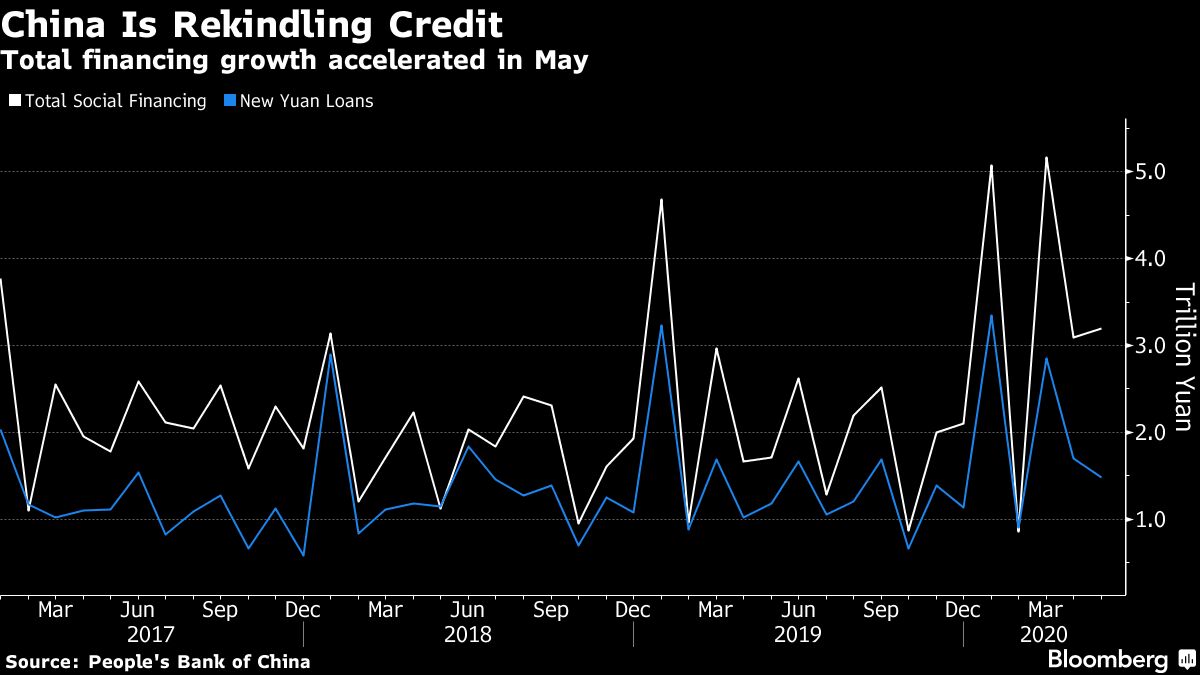
China’s credit growth picked up last month amid continued policy support as the government tries to nurture a gradual economic recovery from the first quarter slump.
Aggregate financing was 3.2 trillion yuan ($451 billion), the People’s Bank of China said Wednesday. That compares to 3.09 trillion yuan in April and 1.7 trillion yuan in the same month last year. The median estimate of economists was 3.1 trillion yuan.
U.
S. Plans Three Studies of Experimental Vaccines (5:32 p.m. HK)
The U. S. government plans to fund and conduct studies of three experimental coronavirus vaccines starting this summer, The Wall Street Journal reported, citing John Mascola, director of the vaccine research center at the National Institute of Allergy and Infectious Diseases.
Moderna Inc.’s vaccine is set to be first, starting in July, followed in August by one co-developed by Oxford University and AstraZeneca Plc and in September by Johnson & Johnson’s, Mascola told the WSJ.
Paris Club Debt Relief at $1.1 Billion (4:53 p.m.
HK)
The Paris Club suspended debt payments for four more countries, bringing the total waivers to help battle the human and economic toll of the coronavirus pandemic to $1.1 billion for 12 nations.
The club, which groups 22 mostly wealthy country creditors, announced a suspension in payments for Pakistan and Ethiopia, the two biggest economies to get relief so far, as well as Chad and the Republic of Congo on Tuesday.
Of the 73 eligible countries, 30 have so far applied for the suspension as part of the agreement by the Group of 20 leading economies to help the world’s poorest countries struggling with the virus.
Zara Owner to Invest $3 Billion (4:52 p.m.
HK)
Inditex SA plans to invest 2.7 billion euros ($3 billion) to boost e-commerce operations of chains like Zara and Bershka and expand store space to gain an edge on rivals as the pandemic snarls the clothing-retail industry.
The Spanish retailer aims to get more than a quarter of its sales from the web by 2022 after online growth helped mitigate a 44% drop in first-quarter sales. Inditex delayed a special bonus dividend after reporting its first quarterly loss since it went public two decades ago.
Frankie and Benny’s Owner to Close Restaurants (4:14 p.m.
HK)
Restaurant Group Plc, operator of the U. K.’s Frankie and Benny’s Italian-American themed restaurants, plans to close about 125 sites and renegotiate its rent terms at another 85 outlets.
The restaurant owner said it’s pursuing a restructuring process called a company voluntary arrangement. A series of troubled retailers and hospitality companies in Britain have done the same as the retail crisis is exacerbated by coronavirus-related shutdowns.
Covid Pandemic is ‘Worst Nightmare,’ Fauci Says (4:02 p.m.
HK)
The top U. S. infectious disease specialist called the coronavirus pandemic his “worst nightmare” and warned that the deadly outbreak is far from over. In just four months, Covid-19 has devastated countries around the world, Anthony Fauci, director of the National Institute of Allergy and Infectious Diseases, said Tuesday in an online address to the Biotechnology Innovation Organization, an industry group.
OECD Forecasts World Economy Will Shrink 6% in 2020 (4:00 p.m.
HK)
The OECD sees a 6% global economic slump this year and warned that the impact of the coronavirus pandemic on businesses and the most vulnerable will require extraordinary government action, it said in its quarterly outlook. That’s based on a scenario of the virus continuing to recede. A second wave, which the OECD said is an equally likely scenario, could mean a 7.6% contraction.
“By the end of 2021, the loss of income exceeds that of any previous recession over the last 100 years outside wartime, with dire and long-lasting consequences,” OECD Chief Economist Laurence Boone said. “The pandemic has accelerated the shift from ‘great integration’ to ‘great fragmentation.’”
Russia Nears 500,000 Cases, Moscow Infections Declining (3:47 p.m.
HK)
Russia reported 8,404 new confirmed coronavirus infections, a 1.7% increase, in the past day, according to data from the Russian government’s virus response center.
Moscow reported 1,195 cases, or 14% of total, the lowest number since April 11.
Indonesia Eyes Rebound After Easing Distance Rules (3:00 p.m. HK)
Indonesia says it may post 0.5%-1% growth in the third quarter, rebounding from an estimated 2%-3% contraction in the preceding three months, after gradually easing social distancing rules amid a record surge in infections.
Growth may further accelerate to 3% in the fourth quarter for a full-year expansion of 1%-1.5%, National Planning Minister Suharso Monoarfa said in a phone interview. “We are already in the transition phase to the new normal,” Monoarfa said.
Virus Wipes $383 Million from Landlord’s Value (2:34 p.m.
HK)
Shaftesbury Plc, the landlord that owns chunks of London’s trendy Soho district, has written down the value of its portfolio by more than 300 million pounds ($383 million), after the coronavirus pandemic forced its stores and restaurants to close.
The company’s portfolio fell by 7.9% in the six months through March to 3.5 billion pounds, according to a statement on Wednesday.
Sweden to Drop Daily Briefings Amid Furor (2:20 p.m.
HK)
Sweden’s top health authority will stop holding daily briefings on the country’s Covid-19 infection rate and death toll.
The decision comes amid a furor over Sweden’s strategy to fight the pandemic, after state epidemiologist Anders Tegnell acknowledged his approach was flawed. Instead of every day, updates for the press will now be provided only on Tuesdays and Thursdays.
Sweden’s softer lockdown has resulted in one of the world’s highest death rates relative to its population.
But both Tegnell and Prime Minister Stefan Lofven have insisted there’s no need to change strategy. The controversy had turned the briefings into public grillings during which Tegnell was increasingly pressed to explain himself.
Singapore to Start Trials on Potential Treatment
Singapore is set to start human clinical trials on Potenti on a potential treatment for Covid-19 next week, the Straits Times reported on Wednesday.
Phase 1 trials on 23 healthy individuals will take about six weeks and will be conducted by the SingHealth Investigational Medicine Unit, the newspaper reported.
Developed by Singapore-based biotechnology company Tychan, a monoclonal antibody or immune system protein called TY027 that targets the virus causing Covid-19, called Sars-CoV-2, will be tested, the report states, citing a statement issued by the company.
Germany’s New Cases Hold Far Below Crisis Peak (1:30 p.m.
HK)
Germany’s new cases held steady, remaining far below the thousands seen at the height of the crisis just over two months ago.
There were 397 new coronavirus cases confirmed in the 24 hours through Wednesday morning, bringing the total to 186,506, according to data from Johns Hopkins University. That compares with 359 the previous day and almost 7,000 at the peak of the pandemic in late March.
Fatalities increased by 41 to 8,736.
The daily death toll has remained well below 100 since mid-May. Meanwhile, the reproduction factor of the virus, known as R-naught, rose to 1.11 on Monday from 1.05 the day before, according to the latest estimate from the Robert Koch Institute. The RKI didn’t publish a daily report on Tuesday.
The government is trying to keep the figure below 1.0 to prevent exponential growth in the number of cases and a second wave of infections.
For more articles like this, please visit us at bloomberg.com
©2020 Bloomberg L.
P.