
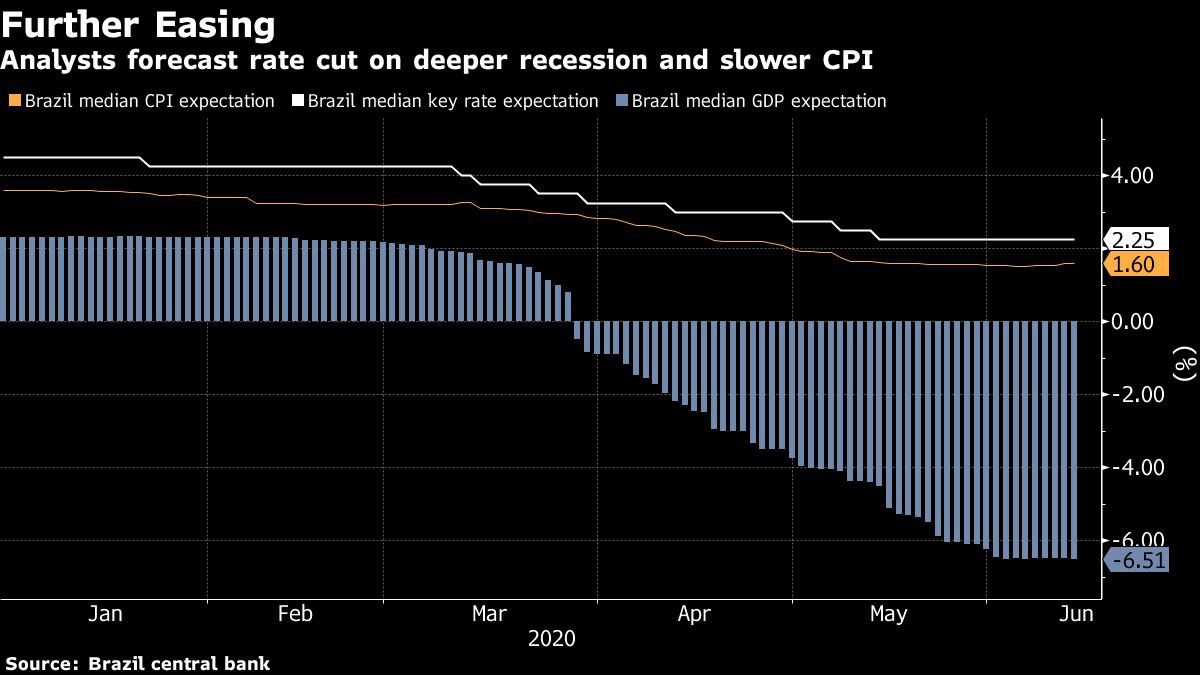
(Bloomberg) — Brazil’s central bank is expected to cut its benchmark interest rate to an all-time low as Latin America’s largest economy grapples with declines in activity and inflation forecasts due to the coronavirus.
What comes next is a source of growing suspense in financial markets.
For now, the central bank is set to reduce the Selic by 75 basis points for the second straight meeting, to 2.25%, as expected by nearly all analysts in a Bloomberg survey.
Central bank President Roberto Campos Neto is joining peers from Colombia to Mexico by pumping stimulus to blunt the shock from the pandemic.
After delivering a total of 350 basis points in rate cuts since July, the bank board has indicated it is running out of room for further reductions. Still, traders and some economists bet a weak economy will force more easing in the future.
The decision will be published on the central bank’s website after 6:00 p.m. local time in Brasilia along with a statement from the institution’s board.
Here’s what to watch out for:
Lower Bound
In the minutes to their May meeting, most board members agreed they were nearing the floor for the policy rate, and warned of financial instability if borrowing costs fell past that lower bound.
The remarks were interpreted as a sign that June’s rate reduction would be the last in the cycle. But given the rapid deterioration of the economy, analysts will be looking for clues of additional cuts. “If the bank board shows it’s open to more easing, it would be a sign that their views on the effective lower bound have changed,” said Adriana Dupita, Latin America economist at Bloomberg Economics.
Economic Recovery
Campos Neto has said an economic recovery will start in the third quarter following a strong hit to confidence and activity in the previous three-month period.
Still, that outlook has not stopped analysts surveyed by the monetary authority from lowering their 2020 growth expectations for 18 straight weeks as sectors from industry to retail post record drops. Investors will scour the central bank’s statement for the latest insight on the timing, strength and characteristics of an eventual up-tick in Latin America’s largest economy. On the other hand, expectations of a weaker recovery may pose more significant deflationary risks ahead.
Inflation Forecasts
The central bank has already shifted its focus to next year’s inflation expectations, which are currently running below the 2021 target of 3.75%.
While policy makers have continued efforts to stimulate the economy, demand from consumers and companies remains very weak. At the same time, the currency has rebounded from the record low it touched last month, possibly alleviating some future price pressures. “You still need stimulus to bring inflation to target in a relevant horizon for monetary policy,” said Newton Rosa, chief economist at Sul America Investimentos Dtvm. “Having the Selic at 2.25% would be highly stimulative.
The bank would be able to hold rates at that level to monitor the outlook while not closing the door to future cuts.”
For more articles like this, please visit us at bloomberg.com
©2020 Bloomberg L. P.