
(Bloomberg) — Coronavirus cases may peak in Argentina sometime between the end of June and beginning of July despite cases and virus-related deaths increasing at a faster pace, according to Health Minister Gines Gonzalez Garcia.
“We believe those weeks could be the weeks with the most cases,” Gonzalez told Bloomberg News in an interview Thursday, referring to the last week of June and first of July.
He cautioned that it’s difficult to make any projections.
That timeline comes as Argentina recorded 35 Covid-related deaths Thursday, matching the one-day record since the pandemic began. New cases rose to a record 1,958, growing at a faster pace in part because the virus has reached densely-populated, low-income neighborhoods in the metro area of Buenos Aires.
President Alberto Fernandez’s government implemented one of the earliest and strictest lockdowns on March 20 and initially projected that cases would peak in May.
The quarantine is expected to go until at least June 28, and the government late Wednesday tightened restrictions to limit circulation on public transit in the Buenos Aires area.
Gonzalez stands by the government’s decision to act aggressively and early, though in looking back can see that the government, like many worldwide, made mistakes without going into details.
“The success we’ve had in the number of cases has to do with how quickly we thought about the quarantine,” Gonzalez said.
Globally, “we’re all making and learning from our mistakes and the mistakes abroad. That’s been the question for Argentina, looking at everyone and trying to make sure it goes less worse here than in the rest of the world.”
Why the World Worries About a Covid-19 ‘Second Wave’: QuickTake
Argentina ranks 34th worldwide in Covid-19 cases with 37,510 confirmed ill, considerably lower than regional peers such as Mexico and Brazil, according to Johns Hopkins University’s Covid-19 database.
Those two nations adopted much less restrictive containment measures and have become new epicenters for the pandemic.
Fernandez earned praise in March for implementing a strict lockdown despite steep economic costs. The Organization for Economic Co-operation and Development forecasts Argentina’s economy will contract 10% this year, one of the steepest plunges worldwide.
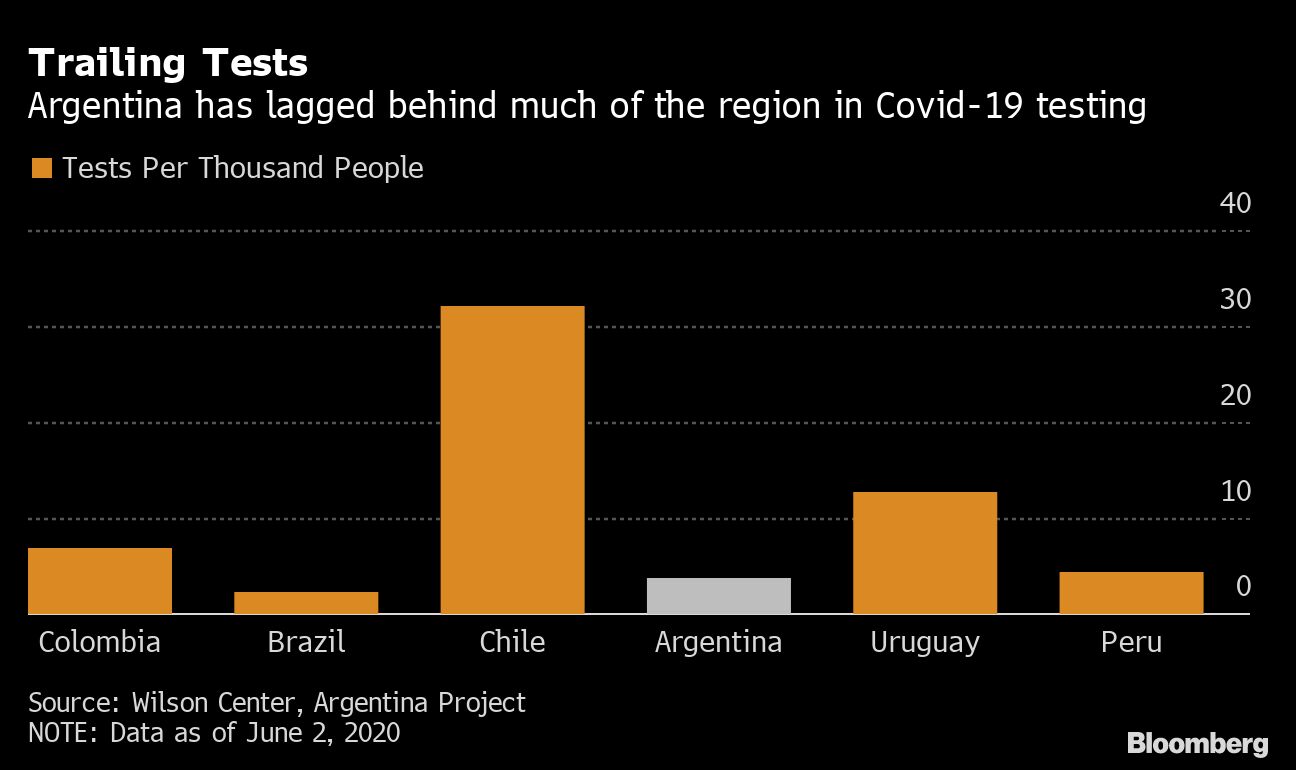
But Fernandez’s administration has been criticized for a relatively low level of virus testing.
Argentina ranks in the bottom half of South American nations in tests per 1,000 people with 3.75 on average. Neighboring nations Chile, Uruguay and Paraguay are conducting more tests per 1,000 than Argentina, according to data compiled by the Wilson Center in Washington. Gonzalez downplayed the need for large-scale testing.
“I think there’s an overemphasis on the tests,” Gonzalez said. “I don’t understand this idea of ‘how many tests’ as if it’s an indicator of efficiency, because the countries that have done a lot of tests aren’t doing well.”
He added: “We believe we’ve done the necessary tests.”
Gonzalez noted that within the last 80 days, Argentina has increased the number of intensive care unit beds by 35%, faces no shortage of respirators and 40% of all hospital beds remain available.
The minister also dismissed any notion that the rare political unity Argentina witnessed in March is beginning to fade, even though Fernandez has criticized the city government, controlled by the opposition party, for allowing residents to go running at night.
Gonzalez says he still meets two to four times a week with health minister from different levels of government.
“Political unity has been a part of the success because it’s meant unified action,” Gonzalez said.
(Updates latest Covid-19 cases and death numbers in 3rd paragraph)
For more articles like this, please visit us at bloomberg.com
©2020 Bloomberg L.
P.