
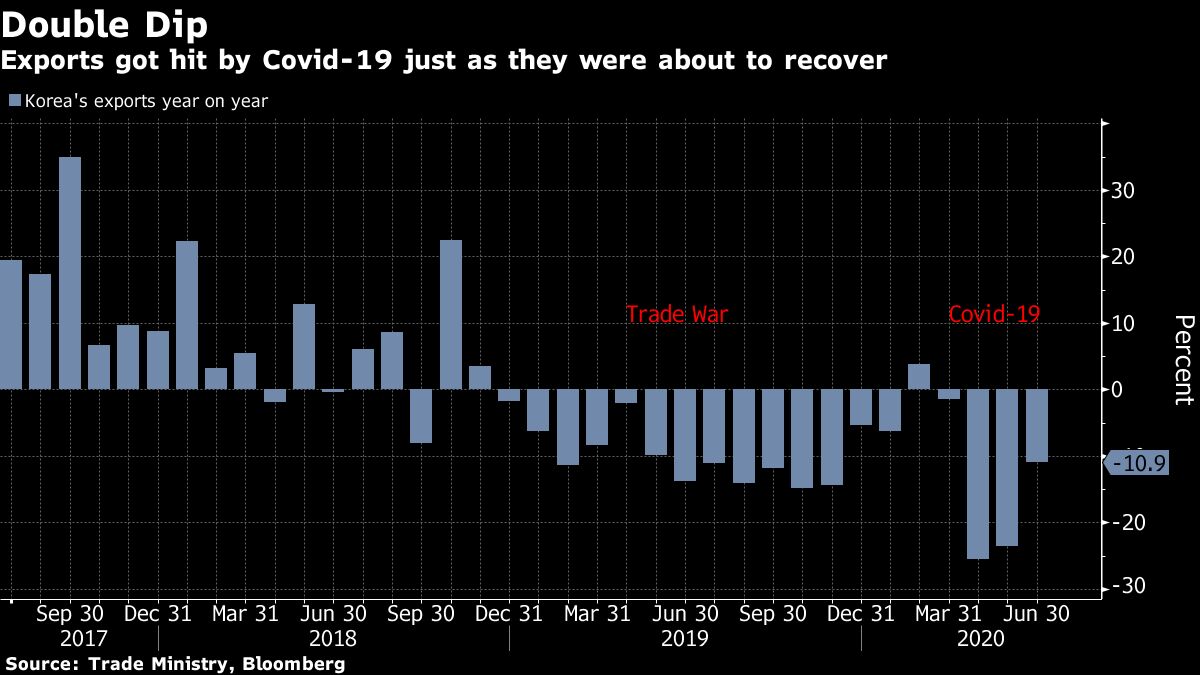
(Bloomberg) — South Korea’s exports fell at a slower pace in June as economies emerged from lockdowns, offering a sign that the worst of a slump in overseas demand may be over, though economists warned a recovery would likely be slow.
The value of overseas shipments fell 11% from a year earlier, according to trade ministry data released Wednesday, improving from declines in excess of 20% in the previous two months.
Economists had forecast a 9.1% contraction. The snapshot of Korean export health was complicated by extra working days in June that likely masked some weakness.
Exports to China, Korea’s biggest overseas market, rose 9.5% while semiconductor shipments were barely changed from a year ago.
South Korea releases its trade report earlier than most countries, helping investors gauge the robustness of global commerce.
While the smaller drop in South Korean exports points to a possible bottoming out of the world’s trade woes, the outlook remains uncertain with the virus still spreading and hurting economies.
Two more more working days in June this year compared with 2019 helped boost the headline numbers. South Korea’s average daily shipments, an alternative measure of trade that accounts for the difference in the number of working days, dropped 19% in June, compared with a 18% fall in May.
The deteriorating daily average “means the economy isn’t recovering at full speed,” said Daniel Yoo, global strategist at Yuanta Securities Korea. “Expectations that exports are going to rebound within this year are turning into doubts.
Still, it’s important to note the export falls are easing.”
Key Insights
- South Korea’s export recovery hinges on the strength of purchases from China and global tech demand. A gauge of China’s manufacturing activity improved in June, signaling the country’s gradual recovery from the coronavirus slump remains on track.
- South Korea has benefited from a surge in demand for high-tech gadgets as the pandemic accelerated a shift toward a more contact-less society across the globe.
Such demand could weaken in the second half as semiconductor inventory builds up and if a potential second wave of outbreaks hits major economies.
- South Korea’s economy is heavily reliant on exports and the government forecasts they will fall 8% this year. Such weakness has led analysts to estimate a 0.5% contraction for the broader economy, which would be the first decline since the Asian financial crisis over two decades ago.
Get More
- Imports fell 11% in June from a year earlier, leaving a trade surplus of $3.7 billion.
- Automobile shipments decreased 33%, while exports of petrochemical products fell 12%.
The sales of wireless products, such as handsets, declined 12% and display shipments decreased 16%.
- Computer sales rose 92% and healthcare exports rose 53%. The sales of rechargeable batteries also increased 1.4%.
- Overall exports to the U. S. fell 8.3%, while those to the European Union slumped 17%.
(Adds more details, economist comment)
For more articles like this, please visit us at bloomberg.com
©2020 Bloomberg L.
P.