
(Bloomberg) —
Pubs, bars and restaurants in England are opening their doors today, putting a million people back to work, in the biggest loosening yet of the lockdown the U. K. imposed in late March.
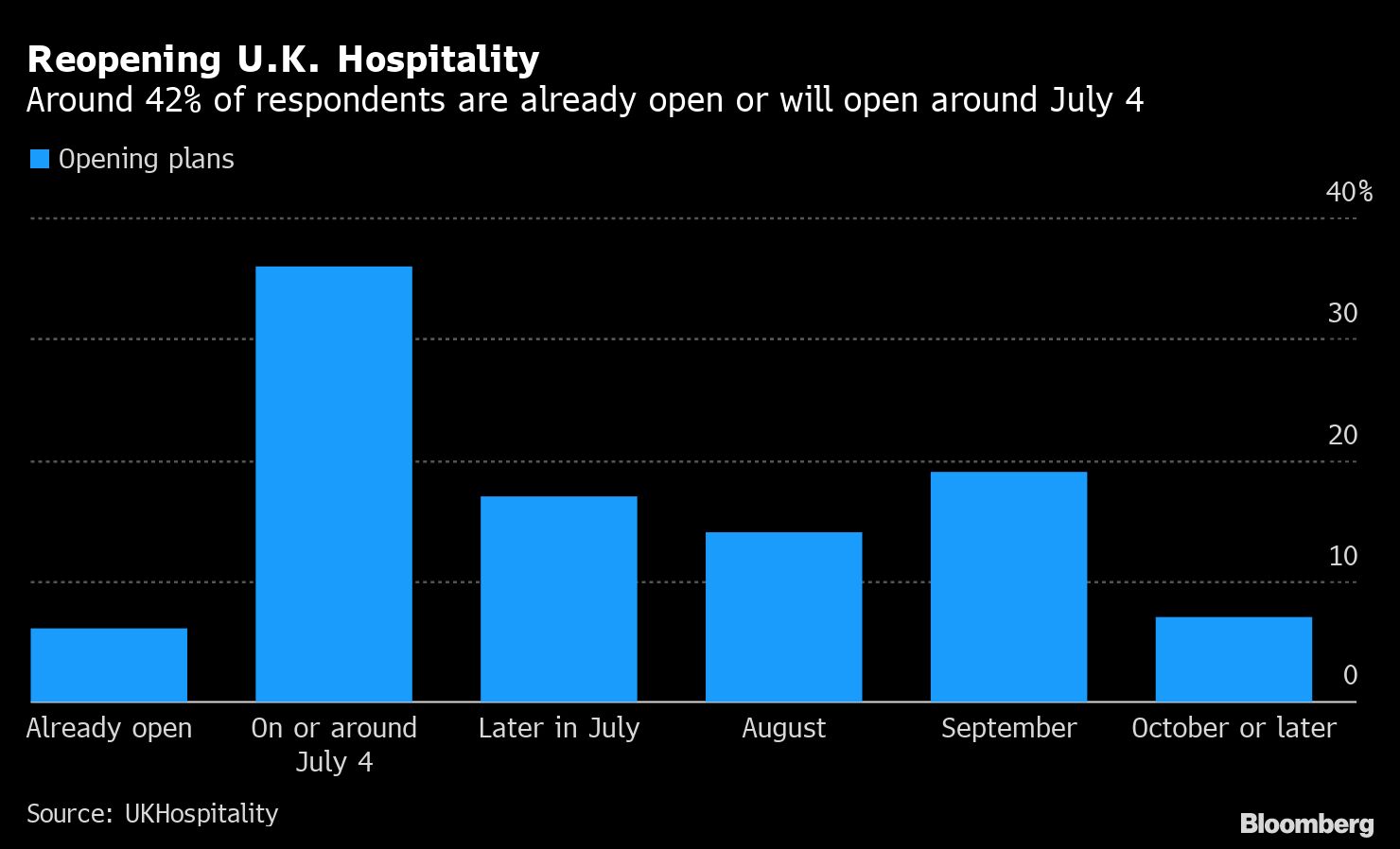
More than half of food and drink businesses plan to open on what’s been dubbed “Super Saturday,” but just 19% of consumers say they’re planning to go out on the first day.
That will help prevent overcrowding, Kate Nicholls, chief executive officer of UKHospitality told Bloomberg Television Friday.
“We are expecting a phased and gradual reopening throughout July,” she said. “We think it will be broadly manageable.”
Hospitality represents 5% of the U. K.’s economic output and employs 10% of all workers, the trade group said. The sector generates about 38 billion pounds ($47 billion) of tax for the government a year, and is the country’s third-largest private sector employer, double the size of financial services and bigger than automotive, pharmaceuticals and aerospace combined.
Boris Johnson urged Britons to act responsibly and sensibly as hotels, cinemas and hairdressers also reopen.
The prime minister warned “we are not out of the woods yet,” in remarks on Friday. The U. K. has suffered one of the deadliest outbreaks of the pandemic with more than 44,000 deaths and more than 285,000 confirmed cases.
“I do want people to feel it is safe to enjoy themselves and enjoy hospitality.,” Johnson said. “But it has got to be done in responsible way.”
The reopening is a cautious one.
At the same time as Johnson was urging Britons to return to pubs, the government was imposing a new lockdown on the city of Leicester in north England, where cases have been on the rise.
The pubs that do reopen will face higher costs for everything from staffing to technology. The New Inn in North Yorkshire expects to lose between 35% and 40% of capacity due to requirements that customers stay at least 1 meter (3.3 feet) from other groups.
Staff costs are “massively increasing” said Tom Ledsham, 26, who took over the pub and hotel with his parents in February.
An average Monday shift which ordinarily would only have required one employee will now need three.
Getting a Table Is No Longer the Problem at London’s Restaurants
Staff will wear protective gear and have their temperatures checked daily and plastic screens have been installed around cash registers. The pub is also using disinfectant fogging machines, more often seen in airplanes and hospitals, to clean its 18 bedrooms and the pub area more quickly and cost-effectively.
“We are number crunching constantly because before you know it, you can have spent 5,000 pounds overnight,” Ledsham said. “It is going to be challenging but we need to start bringing some revenue in.”
Guests will have to provide their names and phone numbers upon arrival, in case an infection emerges and they need to be contacted about possible exposure.
Many places are asking people to book ahead. That’s adding costs too, Ledsham said.
“We have just been quoted 3,000 pounds to have our Wi-Fi revamped,” he said. “It is a lot of money for us and we are a big venue, for a smaller operator they may not be able to invest in that.”
Pub and restaurant owners are counting on pent-up demand to drive a rebound. The combination of billions of pounds in government support for furloughed workers, coupled with a drop in spending during the lockdown has underpinned the savings rate could support consumption, writes Dan Hanson of Bloomberg Economics.
The government aid has replaced about 57% of the hit to take home pay caused by the job losses during the lockdown, while savings jumped to 21% of disposable income in the second quarter, compared with 8.4% in the previous three months, Hanson estimates.
James Watt, the co-founder and CEO of BrewDog Plc, is counting on patrons to return to newly opened bars for pints of its Punk IPA and burgers.
The craft beer maker and pub-chain operator instantly lost 70% of its revenue when it had to shutter its 52 bars in the U. K. Watt is hopeful revenue will rebound to between 50% and 60% of its normal level over the next six months.
Reopening will be a fragile process, he said. It isn’t just new outbreaks or lockdowns that have him worried — it’s how an industry that’s predicated on drinking and socializing responds to a crisis that isn’t going away.
“We need to build up consumer confidence and show that it’s a safe environment, but if some places don’t behave responsibly and there’s a backlash that won’t just shake confidence in one business but across the entire sector,” Watt said.
For more articles like this, please visit us at bloomberg.com
©2020 Bloomberg L.
P.