
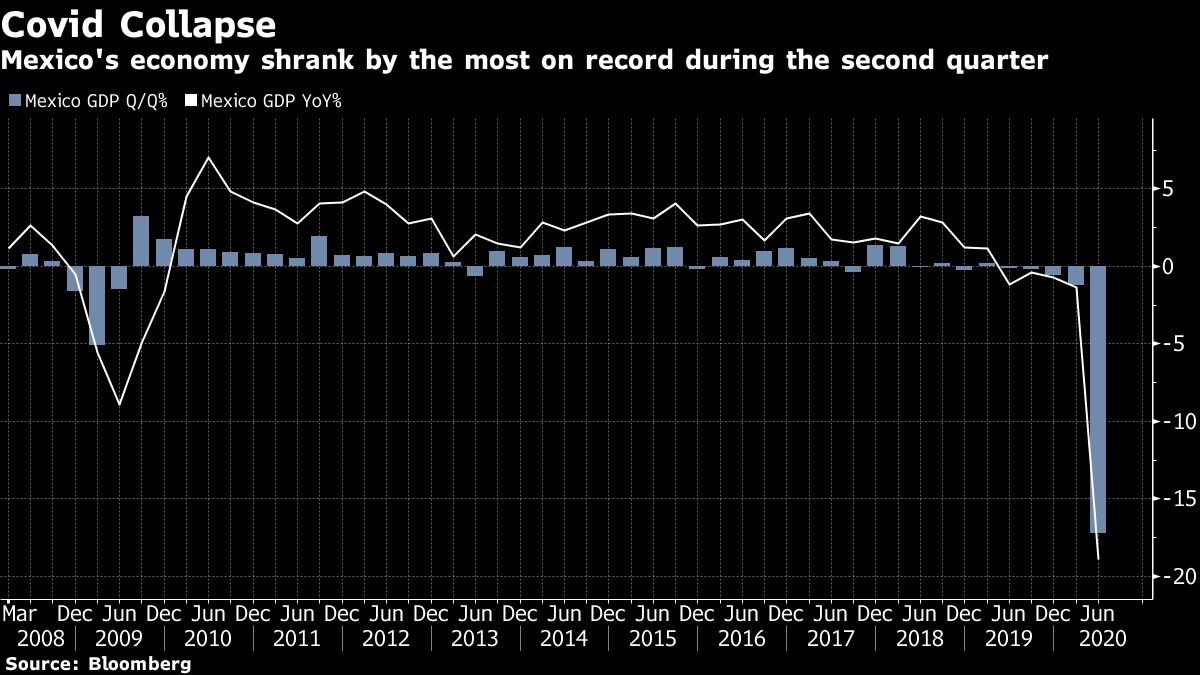
(Bloomberg) — Mexico’s economy sank the most on record in the second quarter, as a haphazard national response to the coronavirus pandemic hurt jobs and output while failing to slow the outbreak, posing a dire challenge to President Andres Manuel Lopez Obrador.
Gross domestic product in the three months through June fell 17.3% compared to the previous quarter, according to preliminary data.
The result, the biggest quarterly slump going back to 1993, came in slightly worse than the median estimate for a 17% drop from economists surveyed by Bloomberg.
On an annual, non-seasonally adjusted basis, GDP declined 18.9% during the quarter, the national statistics institute reported on its website Thursday, compared to a forecast of a 19.4% drop.
Latin America’s second-largest economy is expected to shrink close to 10% this year, representing its deepest recession since the Great Depression in 1932, according to analysts.
Their forecasts have grown bleaker as Mexico continues to post records in new Covid-19 cases, putting the country on track to overtake the U. K. to have the world’s third-highest death toll.
Lopez Obrador’s refusal to fund major stimulus to support companies, combined with the government’s response to the coronavirus outbreak, will consign Mexico to the slowest recovery among Latin America’s economies, according to Carlos Serrano, chief economist at BBVA in Mexico City.
While the government tried to start reopening the economy in June, cases have continued to rise, hampering those efforts, he said.
What Our Economist Says
The sharp drop in the second quarter GDP was mainly due to transitory headwinds from the outbreak and lockdown measures, but the scope and magnitude imply it is likely to have lasting effects. It is also consistent with government policies providing little relief and actions adding some headwinds.
The GDP number supports concerns about the economic growth and fiscal outlooks.
The result was much worse than anticipated by the central bank in its quarterly June report. It implies a wider than officially projected negative output gap and downside risks to inflation forecasts. It also supports expectations for the central bank to provide additional monetary accommodation, while maintaining its cautious tone.
–Felipe Hernandez, Latin America economist, Bloomberg Economics
Read More: As World Splurges on Virus Fight, One Leader Bets on Austerity
Lopez Obrador has downplayed the use of face masks even as his finance minister said they were key to a successful reopening.
Over the past weekend, officials said that there may be tens of thousands unrecorded deaths from the virus.
Services Sector
Thursday’s data showed the service sectors including commercial activity, transportation, financial and media shrank 14.5% from the previous three months, according to the preliminary data. Industrial sectors, including mining, construction and manufacturing contracted 23.6% compared to the prior quarter, while agriculture, livestock and fishing industries fell 2.5%.
Mexico posted its biggest ever trade surplus in June as U.
S. demand, especially for food items, rebounded but anemic non-oil imports showed that internal demand is recovering at a crawl.
Lopez Obrador said last week that the pace of formal job losses slowed in July after the economy shed over 1.1 million posts from March to June. But earlier this month, Deputy Central Bank Governor Jonathan Heath said there were over 34 million people in need of work, using a wider measure, while academics estimated that 16 million Mexicans may have fallen into extreme poverty between February and May.
The April-June result marks the fifth consecutive quarterly GDP decline for Mexico, derailing Lopez Obrador’s pledge to lift growth to 4% per year under his government.
Policy decisions, including the cancellation of a $13 billion airport project, helped damage business confidence and trigger a reduction in investment and capital flight abroad.
Concerns over the economy hit Lopez Obrador’s popularity, with his approval rating dropping to its lowest point since he took office, according to one poll earlier this month.
Julio Ruiz, an economist at Itau BBA in Mexico City, said subsequent policy moves this year have further deepened uncertainty.
Still more changes are on the horizon: Lopez Obrador on Wednesday said in the second half of his term he may seek to change energy laws that have attracted billions in investment.
“They continue to announce policies that generate uncertainty and that could curb the recovery a lot,” Ruiz said.
Read More: Mexico’s Energy Opening at Risk With AMLO Mulling Reversal
(Updates with economist comment in sixth paragraph)
For more articles like this, please visit us at bloomberg.com
©2020 Bloomberg L.
P.