
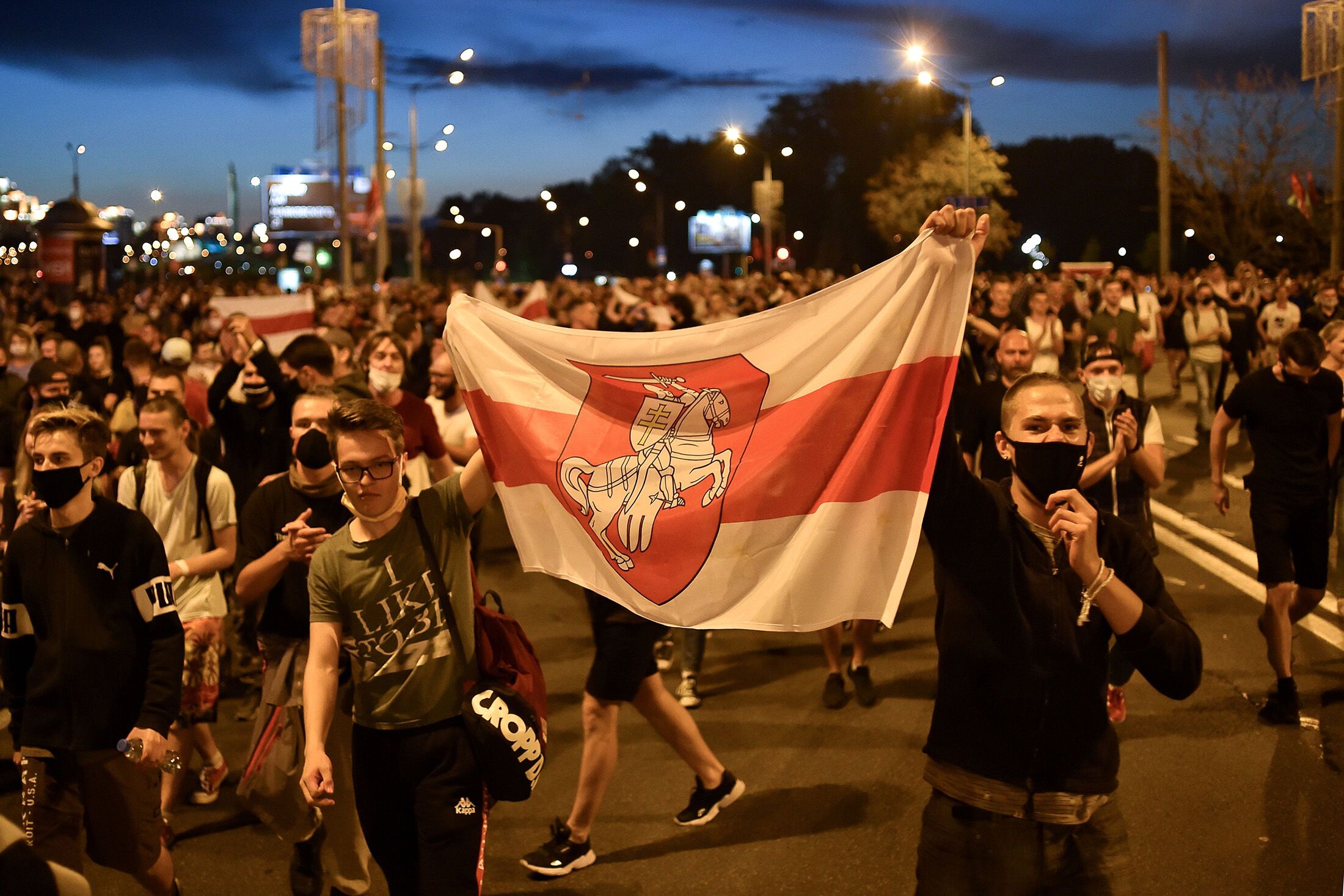
(Bloomberg) — Opposition leaders in Belarus continued their campaign against President Alexander Lukashenko as fraud allegations and international criticism of police crackdowns on protesters marred his claim of a landslide election victory.
“We do not recognize these results,” opposition candidate Svetlana Tikhanovskaya told reporters Monday. “We will do everything possible to challenge” them, she said, while urging the authorities to accept talks to avoid deepening social tensions.
Police spread across the capital, Minsk, on Monday evening, making fresh detentions as groups of people began gathering for a second night of protests.
Tikhanovskaya’s team said she would stay away from demonstrations to avoid a possible provocation, RIA Novosti reported.
Leaders from the European Union spoke out Monday after riot police used water cannons and flash grenades to confront crowds overnight. There was “unacceptable state violence against peaceful protesters,” EU foreign policy chief Josep Borrell said in a statement. Poland urged the bloc to call an emergency summit on the crisis, while Germany said Belarus failed to meet minimum election standards.
U.
S. President Donald Trump is “deeply concerned” and urges the Belarusian government to “respect the right to peaceably assemble and refrain from the use of force,” White House Press Secretary Kayleigh McEnany said at a White House briefing.
Russia, China and Turkey congratulated Lukashenko, 65, on his victory.
The U. S. and the EU have sanctioned Lukashenko, a former Soviet collective farm boss who’s ruled Belarus for 26 years, after cracking down on challengers in previous elections.
Belarus’s dollar-denominated bonds due in 2031 fell for a third straight session on Monday, pushing the yield up 12 basis points to 6.91%, the highest this month.
Setting Fire
The Belarusian president dismissed the opposition as “sheep” who were being directed from abroad, including from neighboring Poland, the U. K. and the Czech Republic, state news service Belta reported. Protesters are “setting fire to the ground beneath their feet.
We can’t allow that,” he said. He blamed foreign powers for disrupting Internet access, which has been restricted in Minsk and other cities since Sunday.
Riot police have detained about 3,000 people, according to the the Interior Ministry. More than 80 people, mostly between the ages of 20 and 25, are being held and may face sentences of up to 15 years, the country’s Investigative Committee said.
Tikhanovskaya submitted a complaint to Belarus’s central election commission calling for the election results to be annulled, the Tass news service reported, citing her campaign staff.
The commission said she had won just 9.9% of votes against 80.2% for Lukashenko to extend his rule into a sixth term, with turnout at 84%.
Opposition groups united behind Tikhanovskaya, a 37-year-old former teacher, when other challengers were either jailed or kept off the ballot, leading to unprecedented protests against Lukashenko’s rule even before the vote. The stay-at-home mother, who ran after her husband Sergei, a political blogger, was detained and barred from the race, has called the crackdown “unacceptable.” Her election ally Maria Kalesnikava said the opposition was ready for long-term protest.
Russian President Vladimir Putin congratulated Lukashenko in a telegram that also pressed him to agree to an “expansion of integration processes” and a deepening of military and political ties, according to a Kremlin statement.
Before the election, Lukashenko had alleged a Russian plot to destabilize Belarus amid tensions with Moscow over his rejection of Kremlin advances.
The crisis is an opportunity for Russia to rein in an unruly ally, Sergei Markov, a political consultant to the Kremlin, said. “The Kremlin wants to see Lukashenko’s relationship with the West sour completely and then it can press ahead with integration,” he said.
Russian nationalist leader Vladimir Zhirinovsky said voters had turned against Lukashenko, and “the fate of Yanukovych” awaits the Belarus leader.
Zhirinovsky, a deputy speaker in Russia’s parliament, was referring to the Ukrainian president who was ousted in 2014 and fled to Russia after months of mass protests.
Opposition activists have complained that high levels of early voting recorded ahead of polling day were an indicator of ballot fraud. The European Platform for Democratic Elections reported that observers had been restricted and detained during early voting.
The opposition to Lukashenko will only grow, and may involve new tactics such as general strikes and blocking government offices, said Markov. “This is not going to be like in the past, when police broke up demonstrations and things went back to normal after a few days,” he said.
For more articles like this, please visit us at bloomberg.com
©2020 Bloomberg L.
P.