
(Bloomberg) — Russian President Vladimir Putin offered potential support to Belarus after leader Alexander Lukashenko appealed for his help in the face of unprecedented protests that have been met with a brutal police crackdown.
Russia is ready to provide assistance to Belarus in “resolving the problems” that arose after the presidential election a week ago, including within the countries’ security alliance “if necessary,” the Kremlin said Sunday in a statement following a second call between the leaders this weekend.
Hundreds of thousands of protesters gathered peacefully in the center of Minsk, the Belarusian capital, and rallied in cities across the country on Sunday, calling for Lukashenko’s resignation and the release of detainees, including jailed opposition challenger Viktor Babariko.
Starting Friday, security forces largely stood aside as protests swelled and authorities began releasing detainees in an apparent effort to ease tensions. Nationwide strikes are set to resume on Monday.
The protests, which started with Lukashenko’s claim of a landslide victory with 80% of the Aug. 9 vote, have spiraled into the largest ever seen in Belarus, fueled by anger at the severity of the police violence, including accusations of torture and the deaths of at least two people.
The Kremlin was betting that Lukashenko would manage to extend his 26-year rule for a sixth term, with his harsh tactics leaving him isolated in the West and ever more dependent on Russia.
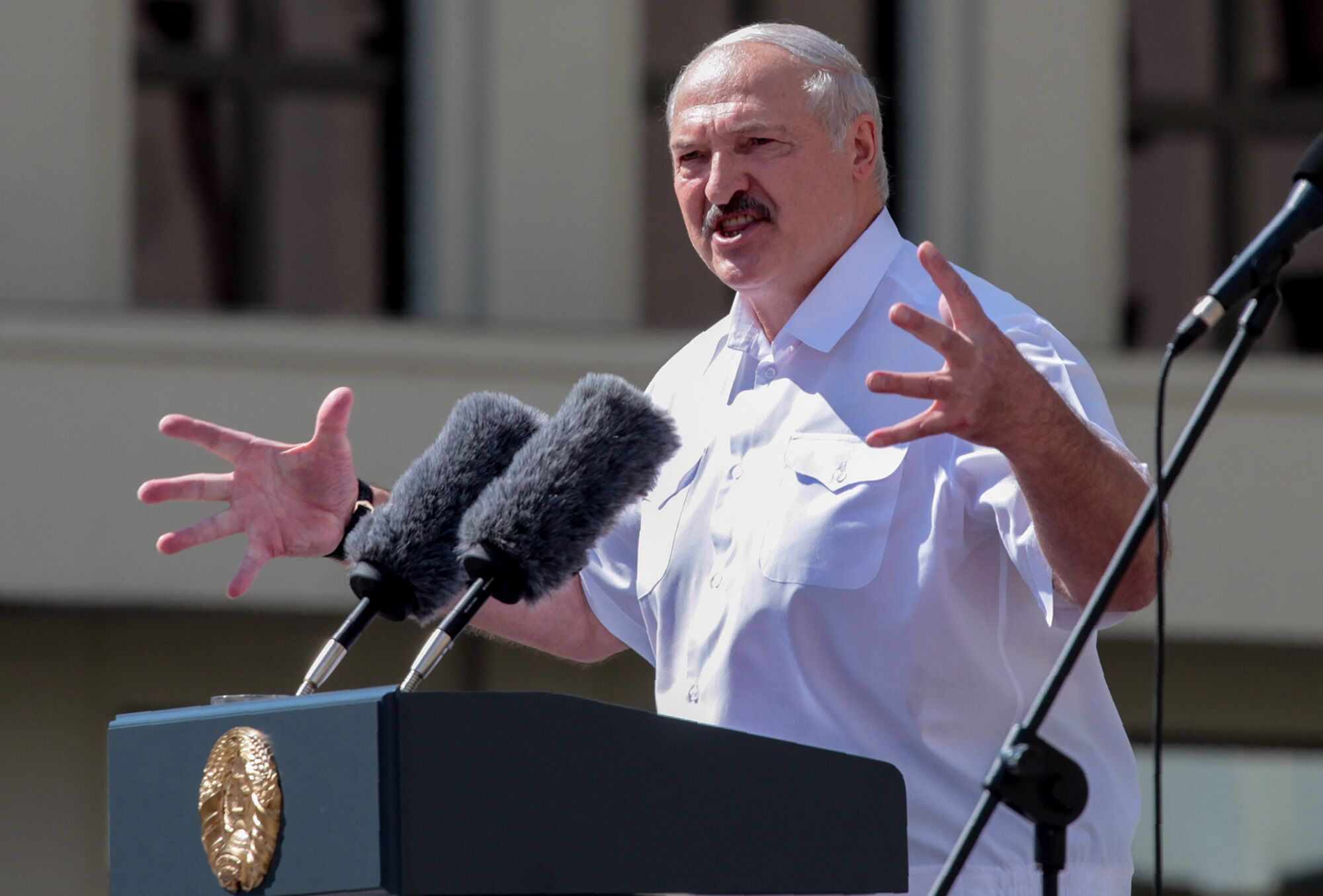
Following his call with Putin, Lukashenko addressed supporters in Independence Square, pledging to remain in office and denying vote fraud, while blaming the unrest on foreign influence.
“I won’t let anyone give away the country, even if I’m dead,” he told the pro-government crowd, many of whom were bussed in from outside Minsk.
While his Interior Ministry estimated there were at least 65,000 people, independent media Nasha Niva put the number closer to 10,000. “Remember, if you destroy the first president, it will be the beginning of your end. You will always, like Ukraine and other countries, be on your knees.”
Putin’s offer of support means little in fact, foreign affairs expert and former diplomat Vladimir Frolov said. “Unless Polish NATO tanks enter Brest, Lithuania sends special forces through the forest, and Ukraine sends in volunteer batalions and right-wing nationalists, then we’ll help.
But otherwise, they can deal themselves.”
Some in the Kremlin fear Lukashenko could be forced from office, according to three people familiar with the situation, leaving Russia scrambling to maintain its special relationship with a vital buffer against the North Atlantic Treaty Organization. Others see his repression of opponents as counterproductive but likely to keep him in power at least for a while, said another person close to the Kremlin.
Svetlana Tikhanovskaya, the main opposition candidate, called for a peaceful handover of power and prosecution of those responsible for violence against protesters in a statement from her team.
“We see that the wall has crumbled,” according to the statement. “The horror and bloody massacre that the authorities staged on the streets of our cities should never be repeated.
We are ready to talk with the authorities about how and when Lukashenko will step down as head of state.”
While Lukashenko has vowed not to leave Belarus, some people around him have sounded out Kremlin contacts on the possibility of fleeing to Russia if he were deposed, two people in Moscow familiar with the conversations said.
READ MORE: Why the Strongman of Belarus Is Fighting for Survival: QuickTake
Sandwiched between Russia and three NATO members, Belarus remains a key, if troublesome, ally for Moscow.
Lukashenko has resisted Moscow’s push for closer economic and political union and looked at building ties with the U. S., Europe and China. But he’s ultimately been a reliable bulwark for Russia against the steady encroachment of Western interests along its European border.
Some in the Russian elite have called for military intervention along the lines of the 2014 move into Ukraine that led the U.
S. and European Union to impose a series of sanctions. Konstantin Zatulin, a senior lawmaker from the ruling United Russia party, said that intervention in Belarus would be “monumental stupidity.”
Russia showed it can take a more tolerant approach to revolutions among its allies when protests in Armenia in 2018 led to the overthrow of a Moscow-friendly leader. The Kremlin moved quickly to build ties with the new government.
In Warsaw, U.
S. Secretary of State Michael Pompeo, who met Lukashenko in February, said the vote wasn’t free or fair but didn’t answer questions about a new election or possible additional sanctions. On Friday, the EU rejected the election result and signaled it’s ready to impose sanctions on Belarus.
In a rare split with the administration from a public servant, Lukashenko’s ambassador to Slovakia and former presidential adviser on foreign policy, Igor Leshchenya, spoke out in support of the protesters in a video speech, posted by Nasha Niva media.
“Hundreds of my compatriots have experienced that a number of law enforcement officials fully restored the traditions of the NKVD in the tolerant European Belarus of the 21st century,” Leshchenya said, referring to Josef Stalin’s secret police. “I stand in solidarity with those who took to the streets in Belarusian cities in peaceful processions so their voice would be heard.”
(Updates with Lukashenko quote, rally numbers in sixth, foreign policy export in eight)
For more articles like this, please visit us at bloomberg.com
©2020 Bloomberg L.
P.