
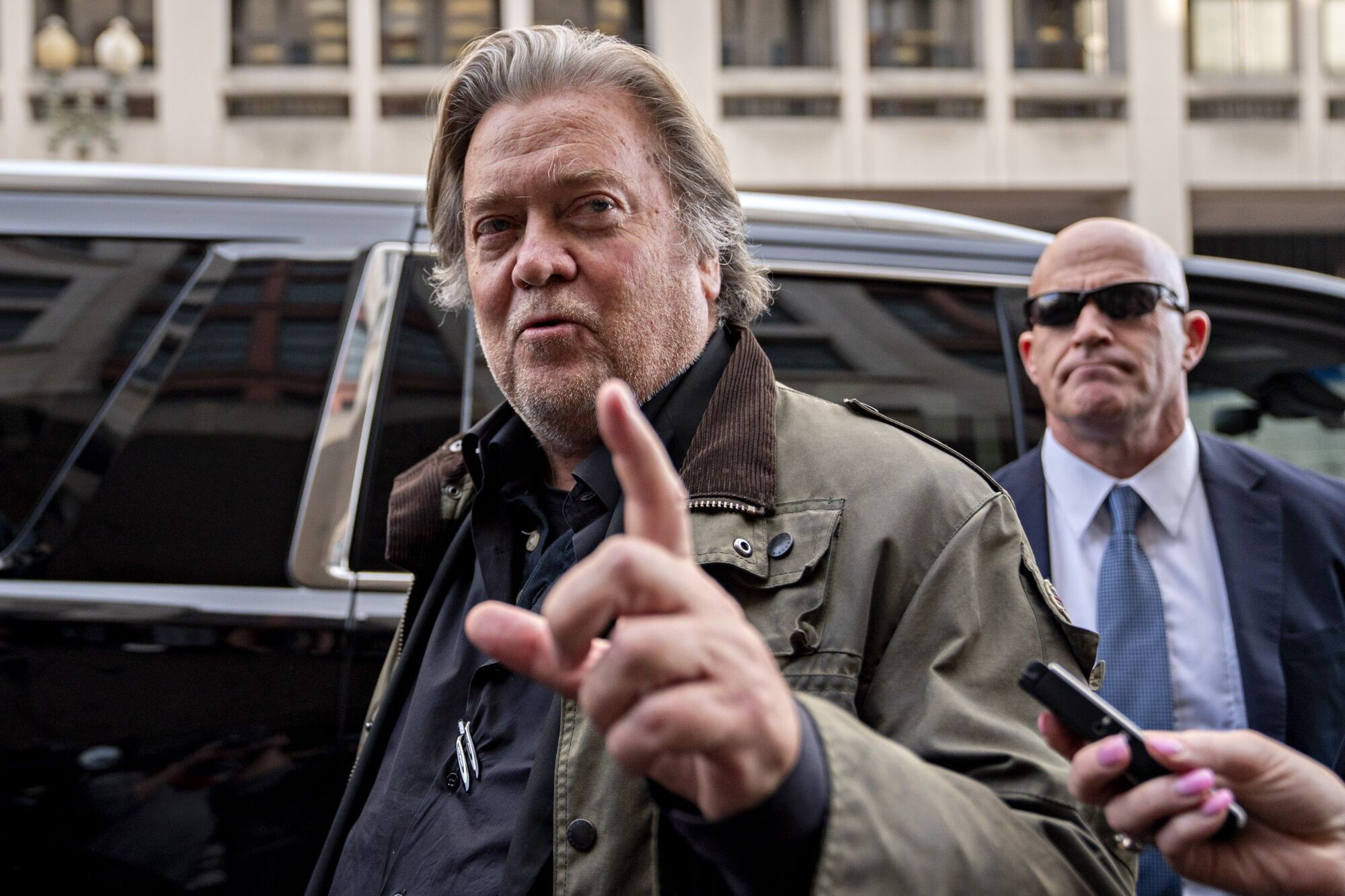
(Bloomberg) — Stephen Bannon, one of the architects of Donald Trump’s 2016 presidential campaign, was arrested and charged with fraud over his involvement in an online group that raised more than $25 million to help fund a wall on the U. S.-Mexico border.
Despite portraying We Build the Wall as a volunteer organization, Bannon received more than $1 million from the group, some of which he used to pay his personal expenses, prosecutors said.
He’s expected to appear in a New York courtroom on Thursday. Three others were also charged in the matter, including the group’s founder, an Air Force veteran named Brian Kolfage.
“As alleged, the defendants defrauded hundreds of thousands of donors, capitalizing on their interest in funding a border wall to raise millions of dollars, under the false pretense that all of that money would be spent on construction,” U.
S. Attorney Audrey Strauss said in a statement.
William Burck, a lawyer for Bannon, had no immediate comment on the charges.
The news of Bannon’s arrest came as the Trump administration lost a bid to block a subpoena for the president’s tax filings. That ruling came in a case brought by the Manhattan district attorney.
Trump told reporters he didn’t support the Bannon project, because he didn’t want a privately financed border wall.
The project “sounded to me like showboating,” he said, and the arrest was “sad thing for Mr. Bannon.”
Possible Sentence
The projects have been afflicted with controversies, including claims that it built in floodplains and created erosion beneath it, and has been a sore spot for Trump. As recently as last month, he tweeted that he thought the project was a bad idea and poorly done, and that it was “only done to make me look bad.” That, despite the organization’s roster of Trump boosters including Blackwater founder Erik Prince and former Wisconsin sheriff David Alexander Clarke Jr.
If found guilty, Bannon and the others could face as many as 20 years in prison, although it’s rare for the maximum sentence to be imposed.
According to the authorities, Bannon orchestrated the scheme alongside Kolfage; Andrew Badolato, an entrepreneur from Sarasota, Florida; and Timothy Shea, from Castle Rock, Colorado.
Kolfage launched We Build the Wall on a crowdfunding site in 2018 to raise funds for the U. S. government to help cover the cost of the border wall, a central promise of the president’s election campign. Later, though, the fundraising campaign changed approach, raising money to construct a wall along privately owned parts of the border.
According to the indictment, the campaign promised donors in social media posts and other solicitations that all the money would go toward construction.
In text messages, prosecutors say, Bannon and Badolato discussed how that assurance would help boost fundraising by creating a positive media narrative and, in Badolato’s words, removing “all self-interest taint.”
Secret Payments
In reality, prosecutors say, Bannon used the funds to make hundreds of thousands of dollars in secret payments to Kolfage. To conceal the payments, Bannon moved the funds raised by We Build the Wall through a nonprofit he controlled before the money was transferred to Kolfage, according to the indictment.
In all, Bannon’s nonprofit received $1 million from We Build the Wall, prosecutors say.
While some of that money went to Kolfage, Bannon kept hundreds of thousands of dollars to cover “personal uses and expenses unrelated to We Build the Wall,” according to the documents. For his part, Kolfage spent the money he received on home renovations, a luxury SUV, a golf cart, cosmetic surgery and jewelery, prosecutors say.
Bannon, 66, served as the chief executive of Trump’s 2016 presidential campaign and was the ideological architect of his populist vision.
The former leader of Breitbart News helped Trump expand his appeal among the far right — often prompting accusations of racism and conspiracy mongering — and in the White House was a leading proponent of the administration’s efforts to ban travel from a group of Muslim-majority countries.
But Bannon’s tenure in the administration was a rocky one. Opponents accused him of leaking frequently to the news media and rushing haphazard efforts to root out “deep state” opponents of the administration, while coverage suggesting that he was leveraging outsize influence to manipulate the president drew Trump’s ire.
Bannon was ousted just seven months into his role amid the firestorm over Trump’s handling of the violence that erupted surrounding white supremacist protests in Charlottesville.
Bannon applauded Trump’s strategy to voice support for some of the demonstrators protesting the removal of Confederate statues who marched with individuals chanting Nazi slogans.
Since its inception, We Build the Wall has completed two sections of fencing along the U. S.-Mexico border, filling in empty gaps of the existing U. S. government barricade. A one-mile section was completed in Sunland Park, New Mexico, in May 2019, and a second three-mile stretch was completed along the Rio Grande in Texas in February.
(Corrects state in 7th paragraph and name of group in 12th paragraph.)
For more articles like this, please visit us at bloomberg.com
©2020 Bloomberg L.
P.