
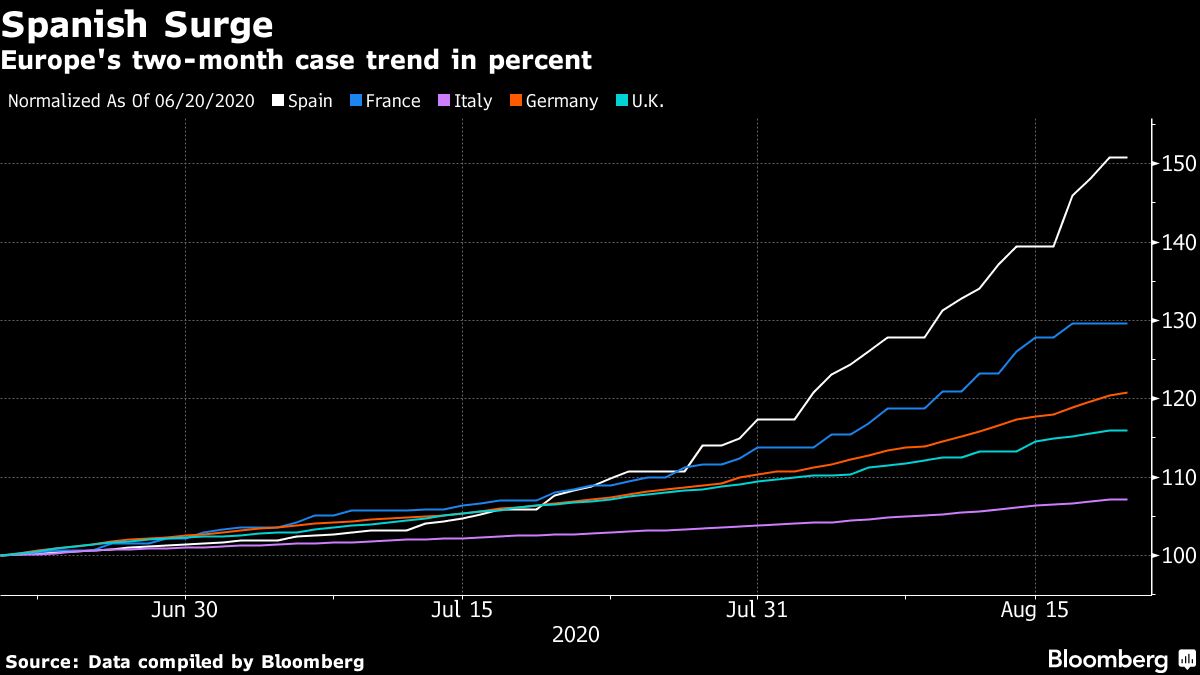
(Bloomberg) — Europe is grappling with a resurgence of coronavirus infections, with little appetite among top officials to resort to stringent restrictions that helped control the spread earlier this year. Meanwhile, data showed that the euro-area economic recovery has unexpectedly lost momentum.
The U. K. economy continued its recovery from a record slump, but the news was clouded by a growing debt burden.
In a further blow to the travel industry, the country’s transport secretary downplayed the benefits of testing at airports, citing the lengthy quarantine period that would still be required.
Hong Kong will start a campaign to test its entire population in September, while South Korea is closer than ever to a lockdown after a surge in cases. Infections in southern U. S. states are slowing and deaths should start to fall next week, the head of the Centers for Disease Control and Prevention said.
Key Developments:
- Global Tracker: Cases exceed 22.7 million; deaths pass 790,000
- J&J plans huge vaccine study while Pfizer cites rapid enrollment
- Cases in Japan may be peaking; Korea eyes stronger measures
- Argentina reports record daily cases, infections drop in Brazil
- Thousands of baby chickens die in U.
S. mail chaos
- Vaccine Tracker: where we are in the race for protection
Subscribe to a daily update on the virus from Bloomberg’s Prognosis team here. Click CVID on the terminal for global data on coronavirus cases and deaths.
Iceland’s Government to Be Tested (7:51 a.m. NY)
Iceland’s government, including the prime minister and finance minister, will need to undergo a double coronavirus test and take precautions in between after infections were diagnosed in people who were staying at a hotel where the officials dined on Tuesday.
South Africa Cases Decline (7:47 a.m.
NY)
The average number of daily positive tests in South Africa, which has the world’s fifth-biggest coronavirus outbreak, fell to 3,868 in the week ended Aug. 20, the lowest since the week ended June 18. The government relaxed restrictions this week, allowing alcohol sales to resume and bars to reopen for the first time since late March.
Roubini Warns of Slow Recovery (7:40 a.m. NY)
The global economy faces a risk of a slow recovery or even another slump along the way unless a vaccine is found, according to Nouriel Roubini.
Speaking on Bloomberg Television on Friday, Roubini predicted that the shape of the recovery, which some predicted to be V, “is becoming a U and the U could become a W if we don’t find a vaccine and don’t have enough stimulus.”
Roubini, who famously warned in 2006 that the housing market in the U. S would soon collapse, highlighted that a fresh outbreak of Covid-19 in Europe could also mean another wave of unemployment.
Still, European workers have much better policies protecting their jobs compared with the U. S., he said.
Turkey Tells Airlines to Consider Firing Expats First (7:10 a.m. NY)
Turkey has floated proposals that would require its airlines to ax foreign pilots and cabin crew before dismissing local workers as the coronavirus crisis shatters travel demand and destroys jobs.
The Ankara-based Directorate General of Civil Aviation or SHGM has written to 10 operators including flag-carrier Turkish Airlines, seeking their opinions on the plan, according to a copy of the letter seen by Bloomberg News.
The localization drive comes as airlines worldwide cut tens of thousands of jobs amid a slump in flights that’s expected to last for years.
Turkish carriers had previously recruited large numbers of expatriates amid a travel boom, with the proportion of overseas crew reaching 11%, the SHGM said in the letter.
Singapore to Allow Travel to New Zealand, Brunei (7 a.m. NY)
Singapore will allow general travel to New Zealand and Brunei Darussalam from September, as the country eases its border control measures to take into account countries where the virus situation is under control.
Travelers from the two countries will undergo a Covid-19 test upon arrival instead of a stay-home notice, the Ministry of Health said in a statement on Friday.
These changes will take effect from Sept. 1, it said.
EU Trade Chief Rejects Criticism He Broke Virus Rules (6:52 a.m. NY)
European Union Trade Commissioner Phil Hogan rejected calls to quit over his controversial attendance of a social event in his native Ireland that appeared to violate rules designed to curb the spread of the coronavirus. The EU Commission also issued a statement backing him up.
Irish Agriculture Minister Dara Calleary stepped down after it emerged he attended and spoke at the event.
The virus has surged back in Ireland, with new daily cases now roughly five times the rate in early July.
British PM Under Pressure to Extend Ban on Evictions (6 a.m. NY)
Prime Minister Boris Johnson is under pressure from opposition parties and charities to extend a ban in England and Wales on evicting tenants unable to keep up their rental payments because of the coronavirus pandemic.
With the prohibition on evictions due to end on Aug. 23, the government is trying to balance the demands of landlords who say it’s unfair to expect them to foot the burden of tenants who aren’t paying rent, and avoiding a surge in homelessness by supporting renters who have been pushed into economic hardship during the pandemic.
Poland, Slovakia Have Record Daily Cases (5 p.m.
HK)
Poland registered a record number of new infections on Friday, taking the total to 60,281. The largest number of new cases are in southern Poland, where the government is considering re-imposing some virus restrictions.
Meanwhile, Slovakia reported 123 new infections, the largest daily total ever. The landlocked country of 5.4 million is still placed at the bottom of the European list of virus deaths per capita, but it has already tightened restrictions for guest workers and public events as new cases started to mount.
Ukraine, meanwhile, reported more than 2,000 new confirmed cases again.
The government tightened restrictions to the highest level in some areas in Western Ukraine on Thursday after the country reported a record 2,134 new infections. The government is also converting more hospitals into special coronavirus units.
U. K. Economy Rebounds (4:30 p.m. HK)
The U. K. economy continued its recovery from a record slump, but the good news was clouded by mounting job losses and a growing government debt burden.
A broad measure of economic activity jumped to the highest in almost seven years in August, while retail sales rose more than forecast in July, reports on Friday showed.
That pickup from the virus slump is being fueled by huge state support, which pushed government debt above 2 trillion pounds ($2.6 trillion) for the first time ever.
Thailand Seeks Production Rights to Oxford Vaccine (4:17 p.m. HK)
Thailand is looking to secure access to a Covid-19 vaccine candidate being developed by University of Oxford through an agreement which would give the Southeast Asian nation the technology rights for local production.
The country has so far detected 3,390 cases of coronavirus and recorded 58 fatalities.
It hasn’t reported any cases from local transmission for nearly three months, but officials remain wary of the reemergence of the virus. A panel that handles the nation’s outbreak strategy earlier approved a one-month extension of the state of emergency through Sept. 30.
Hong Kong to Start Mass Tests (4:05 p.m.
HK)
Hong Kong Chief Executive Carrie Lam said the city will kick off a campaign to test its entire population on Sept. 1, in the first such effort attempted outside of mainland China. Aided by Chinese experts and labs, the blitz will last two weeks. Residents are entitled to a free, one-time test on a voluntary basis.
Lam expressed gratitude to China, saying that Hong Kong would not have been able to conduct mass testing on its own.
Hong Kong is facing pressure to re-open restaurants and relax social-distancing measures as its outbreak wanes, but a bold easing approach carries both public health and political risks. With new daily cases showing a sustained decline businesses are pressing for restrictions on restaurants to be lifted quickly to boost the economy and help residents who rely on eating out due to small apartment sizes.
Europe’s Economic Recovery Stumbles (4 p.m.
HK)
The euro-area economy unexpectedly lost momentum this month as renewed travel restrictions and concerns about the coronavirus took a toll on services. The sharp slowdown shows that the path out of recession won’t be plain sailing, and undermines lingering hopes for a V-shaped recovery. While infections are on the rise, economic concerns mean governments are reluctant to re-impose the type of strict lockdowns seen earlier this year.
The economy had initially bounced back strongly after lockdowns were eased, though many were concerned that the pace could fade.
At their last meeting in July, European Central Bank policy makers were reluctant to draw firm conclusions about the health of the economy, a stance that looks justified by Friday’s numbers.
Data released earlier showed that French manufacturing unexpectedly contracted in August after a two-month rebound, while German growth momentum also slowed.
U. K. Airport Tests Wouldn’t Replace Quarantine (3:40 p.m.
HK)
Transport Secretary Grant Shapps said Covid-19 testing at U. K. airports will not remove the need for travelers to self-isolate because of the long incubation period of the disease.
In comments that will come as a further blow to the travel industry, Shapps said that while the government keeps quarantine rules “under active review,” airport testing picks up only a “very small proportion” of coronavirus carriers, meaning that a second test would be needed up to eight days later.
“In between time, guess what?
You would need to quarantine,” Shapps told BBC Radio 4 on Friday, when asked whether airport testing could replace the U. K. requirement for travelers from non-exempt countries to self-isolate for two weeks. “So you’re not removing quarantine entirely.”
U. K. Government Debt Tops 2 Trillion Pounds (3 p.m. HK)
U. K. government debt passed 2 trillion pounds ($2.6 trillion) for the first time, a milestone that will stoke the debate over how Chancellor of the Exchequer Rishi Sunak should finance his unprecedented support for the pandemic-ravaged economy.
It means what Britain now owes exceeds 100% of economic output, the heaviest burden since the early 1960s, the Office for National Statistics said on Friday.
The data will add to the pressure on Sunak to say how long he is prepared to allow borrowing to accumulate unchecked. Few are calling for immediate action. Debt-servicing costs are at record lows and economists have warned that withdrawing fiscal support prematurely could derail the nascent recovery from the deepest slump in living memory.
German Cases Top 1,000 for Fourth Day (1 p.m.
HK)
Germany recorded 1,586 new infections in the 24 hours through Friday, the same number as Thursday and above 1,000 for a fourth straight day, according to data from Johns Hopkins University.
Total number of cases rose to 231,292, while there were 14 new fatalities, bringing the total to 9,263. Like many of its European neighbors, Germany has experienced an uptick in recent weeks, which authorities blame on social gatherings and travelers.
Japan Wave Peaking, Adviser Says (9:36 a.m.
HK)
Japan’s current wave of coronavirus infections has more or less reached its nationwide peak, said Shigeru Omi, head of the government’s virus advisory panel.
Japan saw a second wave of infections that started a few weeks ago after opening the economy following a period under a state of emergency. The country reported 1,185 new infections on Thursday, according to NHK, down from a peak of more than 1,600 seen on Aug. 7.
South Korean Cases Spread (9:22 a.m.
HK)
South Korea added 324 cases in 24 hours compared with 288 a day earlier, the Korea Centers for Disease Control and Prevention said. There were two additional deaths.
New infections were confirmed across the country, including 125 in Seoul, and the country is at a critical juncture, Vice Health Minister Kim Gang-lip said. President Moon Jae-in called for “strict law enforcement” that includes arresting those who illegally act against the government’s quarantine measures, according to the presidential website.
Pfizer’s Covid-19 Vaccine (8:06 a.m.
HK)
A vaccine being developed by Pfizer Inc. and BioNTech SE is on course for regulatory review as soon as October, the companies said. If regulatory authorization or approval is obtained, they plan to supply up to 100 million doses worldwide by the end of 2020, and approximately 1.3 billion by the end of 2021.
The companies said the vaccine was well tolerated with mild to moderate fever in fewer than 20% of participants.
The companies are continuing to analyze data from the Phase 1 trials in the U. S. and Germany, they said.
Two Mets Test Positive, Games Postponed (6:15 a.m. HK)
The New York Mets have two positive Covid-19 cases, Major League Baseball said in a statement. Thursday’s series finale against the Miami Marlins in Florida and the start of the Subway Series Friday against the New York Yankees at Citi Field have both been postponed.
One player and one staff member tested positive for the Mets, The Athletic’s Ken Rosenthal reported.
Brazil Cases Fall, Deaths Rise (6:05 a.m.
HK)
Brazil reported 45,323 new cases, almost 4,000 fewer than during the previous 24-hour period. While progress in stemming the pandemic has been uneven, weekly new cases have mostly declined since a peak in late July, according to Health Ministry data. Deaths increased by 1,204 to 112,304, the smallest rise since Monday.
For more articles like this, please visit us at bloomberg.com
©2020 Bloomberg L.
P.