
(Bloomberg) — Supply Lines is a daily newsletter that tracks Covid-19’s impact on trade. Sign up here, and subscribe to our Covid-19 podcast for the latest news and analysis on the pandemic.
U. S. and Chinese trade negotiators discussed the phase-one trade deal, with the U. S. saying that both sides saw progress and are committed to its success.
The two countries talked about what China has done as part of the deal, including ensuring greater protection for intellectual property rights and removing impediments to American companies in financial services and agriculture, the U.
S. Trade Representative said in a statement. Both sides agreed to create conditions to push the deal forward, China’s Ministry of Commerce said in a separate statement Tuesday morning in Beijing.
Trade between the world’s largest economies has emerged as a rare area of cooperation as the relationship sours on a number of other fronts ranging from tech security to Hong Kong and the pandemic response.
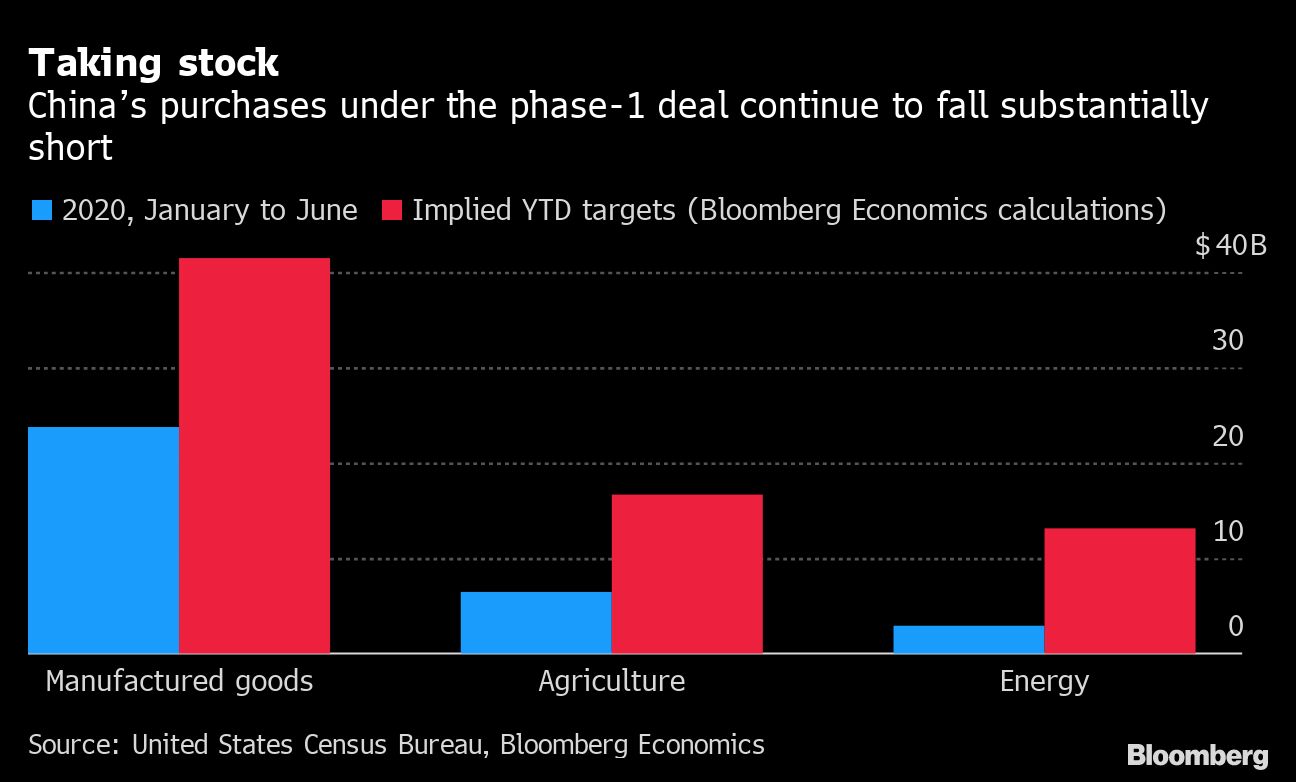
Yet Beijing is far behind where it needs to be to meet its promises to increase purchases of agricultural, energy and manufactured goods from the U. S.
Read more: China Is Buying American But Not Enough to Hit Trade Deal Target
China would need to buy about $130 billion in the second half of this year to comply with the original terms of the agreement signed in January, in which it agreed to purchase an additional $200 billion of American goods and services over the 2017 level by the end of 2021.
“The statement at least tells us that Trump’s administration still treasures the trade deal,” said Raymond Yeung, greater China chief economist with Australia & New Zealand Banking Group Ltd. “China’s buying of U.
S. agricultural and energy products is still an attractive proposition before the presidential election. This suggests that we are not really seeing a full decoupling of the two economies.”
U. S. Trade Representative Robert Lighthizer and Treasury Secretary Steven Mnuchin spoke with Chinese Vice Premier Liu He Monday evening Washington time, according to the U. S. statement. The USTR later corrected that statement as they misspelled Liu’s first name, a mistake that drew attention on Chinese social media.
“The parties also discussed the significant increases in purchases of U.
S. products by China as well as future actions needed to implement the agreement,” the U. S. statement said. Both sides also discussed enhancing macro-policy coordination, according to the Chinese readout.
The call took place on the evening of the first day of the Republican National Convention, at which some speakers criticized Democratic Party nominee Joe Biden’s alleged friendliness to China.
Prior to the talks Bloomberg News reported that China would raise the issue of Washington’s recent crackdown on businesses including TikTok and WeChat.
That wasn’t mentioned in the U. S. announcement or the Chinese report. TikTok on Monday asked a federal judge to block the Trump administration from enacting the ban on its app.
Some Progress
China has made some progress on its commitments. It modified regulations to allow imports of a variety of American farm and food products, while removing foreign equity caps in insurance, securities, and futures.
It also lowered other financial market barriers and gave the greenlight to enterprises like American Express Co., MasterCard Inc. and Fitch Ratings Inc. to enter its market.
U. S. oil exports to China are set to reach a record next month, with about 19 tankers signing provisional bookings to load American crude for the Asian nation in September, according to shipping fixtures, which are subject to change.
If all of them set sail, exports could total 37 million barrels, the most on record for a single month.
China’s customs has also strengthened a crackdown on counterfeits and released quarterly reports as set out in the agreement. The Supreme Court has issued a series of work guidelines and implementation plans on ensuring and improving legal enforcement of violations of intellectual property rights, while the National Intellectual Property Administration also published a work plan for strengthening IP protection in 2020 and 2021.
U.
S. President Donald Trump has projected a more conciliatory tone than he did in early May, when he threatened in a Fox News interview that “if they don’t buy, we’ll terminate the deal, very simple.” In recent days he has sounded more satisfied with Beijing’s compliance with the trade deal even if he’s not about China’s handling of the coronavirus.
(Updates with chart, further details from seventh paragraph.)
For more articles like this, please visit us at bloomberg.com
©2020 Bloomberg L.
P.