
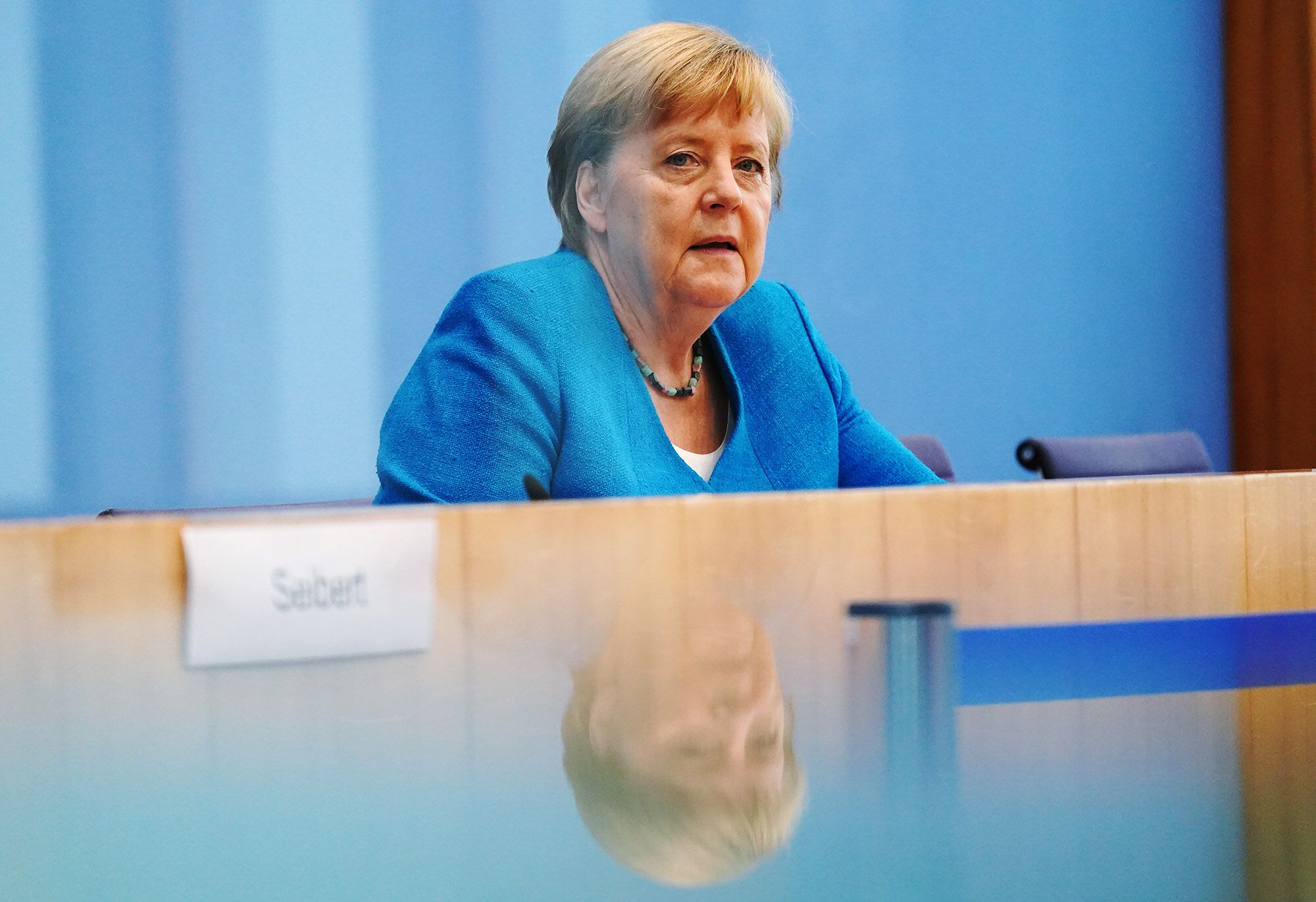
(Bloomberg) — Chancellor Angela Merkel warned the coronavirus crisis represents a challenge to Germany’s financial health because there’s no certainty how long the pandemic will last.
Beating the disease depends on the development and dissemination of a vaccine, and “we don’t know whether that will be three months or 12 months or 15 months,” Merkel said during her annual summer address. “To that extent it is indeed a not known challenge to our financial capacity.”
Germany can afford the measures it’s taken so far, and all decisions were balanced with risk of not acting, she said in Berlin.
The country will get around 22 billion euros ($26 billion) from the European Union’s recovery fund.
Merkel said most of those funds will be spent on existing programs, noting that one requirement is to address shortfalls identified by the European Commission, such as infrastructure investments.
“That is why a large part of the money will certainly go toward what we have already set out to do in the economic stimulus program and what has not yet been fully financed,” she said.
‘Back in Gear’
The country has to work hard to “maintain our economy as much as possible or get it back in gear again,” she said, adding that Germany also needs to focus on issues such as climate change and digitalization that will impact its future competitiveness.
The wide-ranging briefing was one of her last summer press conferences before she steps down after 16 years in power following elections next fall.
She opened the event with a personal appeal to Germans, warning them that the situation will get tougher as the summer draws to a close.
“There are indications that things will become more difficult in coming months,” she said in Berlin. “It’s serious, unchanged serious. Continue to take it seriously.”
While Merkel has been praised for her handling of the pandemic, cracks have started to appear.
She struggled to get state leaders aligned on response measures as infection rates resurge. On Thursday, the chancellor urged Germans to avoid travel to virus-hit areas like the U. S. She said the crisis will challenge Germany’s financial capacity because of the uncertainty over when it will end.
Merkel’s crisis management has been accompanied by her government’s historic decision to abandon its balanced-budget policy, suspending constitutional debt limits as part of a massive stimulus push.
She was also a driving force behind the European Union’s recovery fund, which allows the bloc to pool borrowing for the first time.
Russian Troops
On top of the pandemic, Merkel is battling geopolitical tensions. Germany’s relations with Russia have taken a hit after the alleged poisoning of opposition leader Alexey Navalny, who is being treated at a Berlin clinic close to where the news conference is being held.
She voiced concern about Russia sending its military into Belarus after President Vladimir Putin said the Kremlin has prepared a cadre of police officers to assist the country if necessary.
“I hope such troops aren’t deployed,” Merkel said during her annual summer address, adding that tensions will continue to accompany German-Russian relations in the coming months but there’s no need to harden her stance.
There’s also uncertainty over Brexit, tensions with China and fraught relations with the U.
S. amid clashes with President Donald Trump, who recently announced plans to withdraw around 12,000 troops from German bases.
As Merkel’s tenure gradually draws to a close, she has tried to sidestep discussions about her successor, but has been drawn into the jockeying by appearing in recent weeks with potential contenders from her conservative Christian Democratic-led bloc: North Rhine-Westphalia’s premier Armin Laschet and Bavaria’s Markus Soeder.
Meanwhile, Finance Minister Olaf Scholz has already been declared the chancellor candidate for the Social Democrats, and campaigning has seeped into her fraught coalition.
For more articles like this, please visit us at bloomberg.com
©2020 Bloomberg L.
P.