
(Bloomberg) —
Health Secretary Matt Hancock declined to rule out a second national lockdown amid a surge of coronavirus cases across the U. K., as London Mayor Sadiq Khan warned fresh restrictions could be imposed on the capital.
“I have learned over the last nine months not ever to rule anything out,” Hancock told BBC radio on Friday, when asked about reports ministers are considering a lockdown in October as a virus circuit-breaker. “We want to avoid national lockdown altogether, that is the last line of defense.”
Speaking on LBC radio, Khan confirmed this year’s New Year’s Eve fireworks display has been canceled and urged Londoners to stick to the new “rule of six” limit on gatherings to avoid more stringent measures — such as curfews — becoming necessary.
The mayor was commenting after the Evening Standard newspaper reported that data due for publication Friday will show a surge in Covid-19 cases in London to about 25 per 100,000 from 18.8.
“The number of cases in London are going up; the infection rate is going up, and hospital admissions are going up,” Khan said, though he emphasized the capital is not yet at the point of following the types of restrictions imposed in other parts of England. “We’re keen to do our bit to avoid that happening.”
With new daily cases running at levels last seen in May, the U.
K.’s test and trace system is under strain and millions of people across the country have been placed under local restrictions to limit the spread of the disease. The resurgence poses a major dilemma for Boris Johnson’s government, which is trying to keep the transmission rate down while stimulating an economy that slumped more than any other major developed country during the pandemic.
Restrictions
On Friday, new restrictions on socializing were imposed on large areas of northeast England, adding to measures in place in the northwest and parts of the Midlands.
The prime minister’s scientific advisers have proposed a second national lockdown lasting two weeks to coincide with the October half-term in schools, the Financial Times reported.
Johnson’s Covid Test ‘Shambles’ Risks U. K. Economic Revival
At a Parliamentary hearing this week, Johnson said a second national lockdown would be “disastrous” for the country’s finances, and his government is sticking to its policy of encouraging workers back to what it describes as “Covid-secure” offices.
Ministers have also staked considerable political capital on keeping children in school.
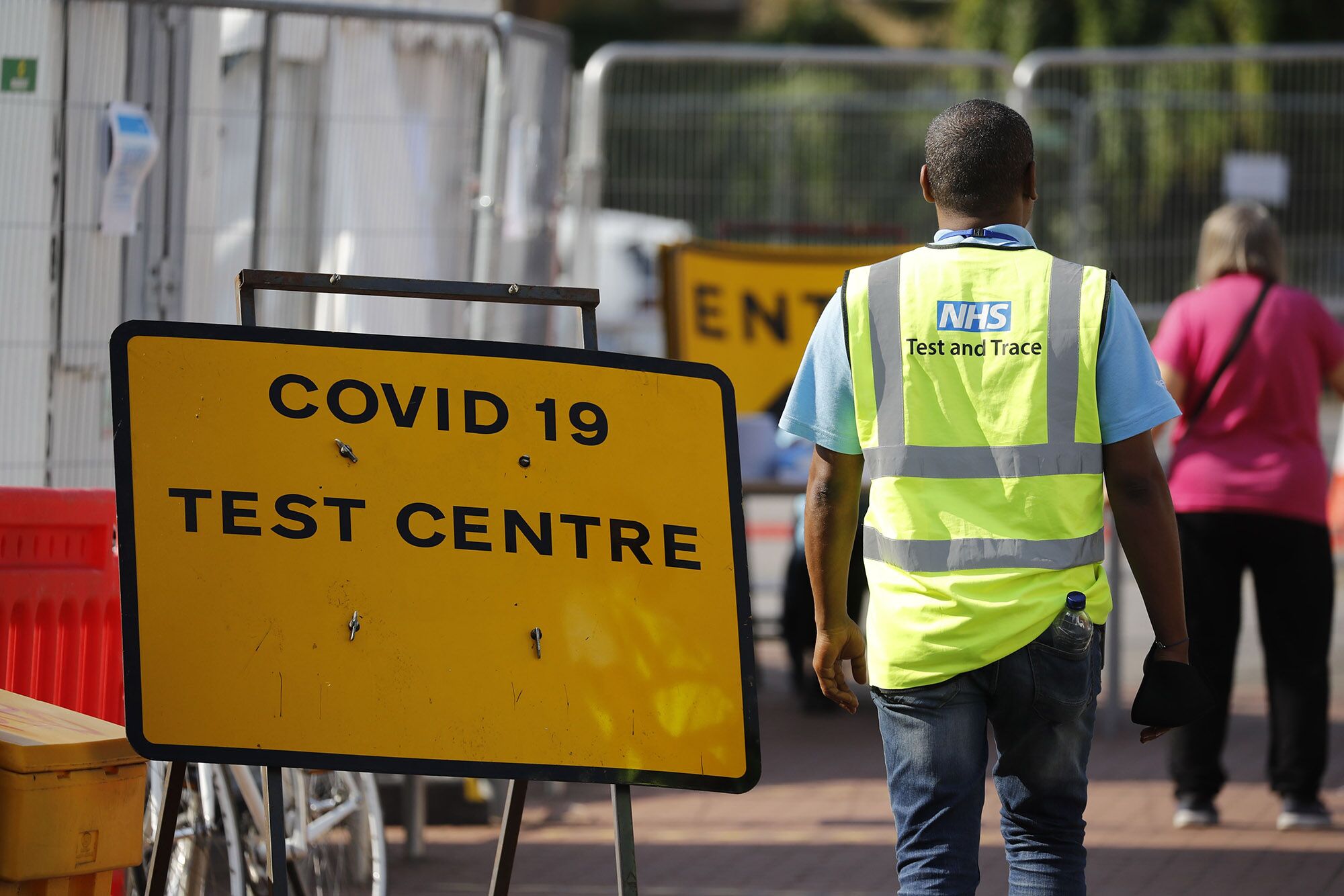
Yet much is riding on the government’s test-and-trace program, which officials regard as vital to keep infection rates down and to give people confidence to return to work. But the system is failing to meet key targets, including on the rapid turnaround of tests and the number of people deemed at risk of contracting the virus who are actually contacted.
Hancock said the country faces a “big moment” but emphasized a second lockdown “is not the proposal that’s on the table.” Asked if scientists are saying schools and business don’t need to be closed, he replied: “that’s right.”
‘Cavalry’
“The strategy is to keep the virus down as much as is possible, whilst protecting education and the economy and doing everything we possibly can for the cavalry that’s on the horizon,” he said, referring to efforts to develop Covid-19 vaccines, new testing technologies and treatments.
From Friday, people in parts of northeast England are banned from mixing with members of other households in private homes and gardens, and leisure and entertainment facilities can’t open between 10 p.m. and 5 a.m., the Department for Health said in a statement.
The areas covered are Northumberland, North Tyneside, Newcastle-upon-Tyne, Gateshead, South Tyneside, Sunderland and County Durham.
Meanwhile the shortage of available tests continues to dominate the front pages of Britain’s newspapers, with its implications for businesses and even schools.
According to a survey by the National Association of Head Teachers, 82% of English schools have children at home because they cannot get a test.
The data, collected from 736 school leaders on Thursday, showed 45% of schools have staff off work because they can’t get a test and 60% have staff at home waiting for results.
‘Struggling’
“This means schools are struggling with staffing, have children missing school, and ultimately that children’s education is being needlessly disrupted,” NAHT general secretary Paul Whiteman said.
Hancock again defended the testing program on Friday, saying the recent surge in demand for tests as schools returned was not accounted for in the scientific modeling.
He also blamed the backlog on people without symptoms — who he said don’t qualify for a test — seeking one regardless.
That position represents a shift in guidance from earlier in the summer, when a surplus of test capacity saw officials encourage people, regardless of their symptoms, to get tested if they had concerns.
(Updates with London mayor comment in first paragraph)
For more articles like this, please visit us at bloomberg.com
©2020 Bloomberg L.
P.