
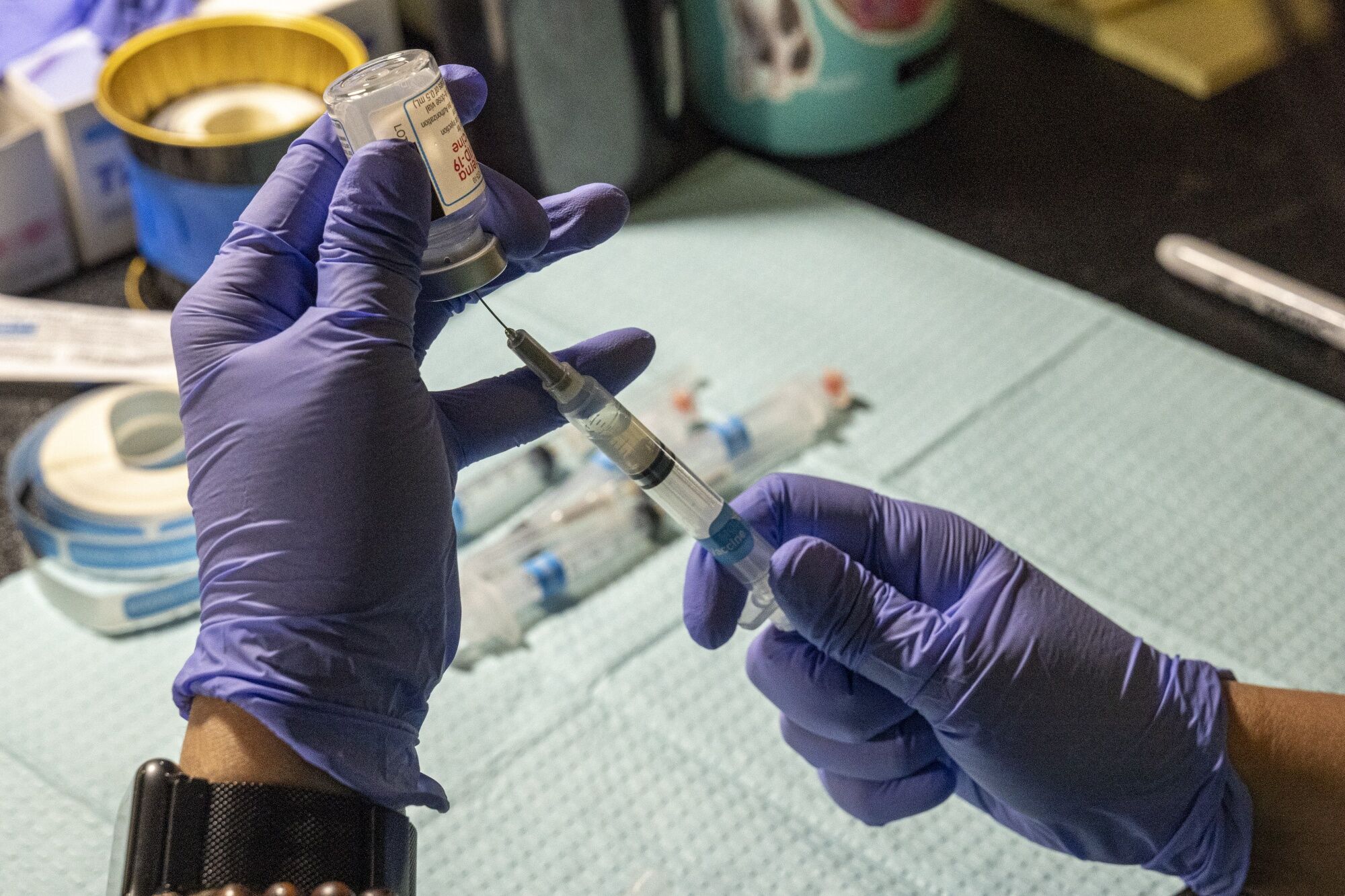
(Bloomberg) — German Chancellor Angela Merkel got her first shot of the AstraZeneca Plc Covid-19 vaccine on Friday, despite possible links to rare blood clots that have led to its use being limited in some countries.
India’s new variant, which has a so-called double mutation, is thought to be fueling the country’s deadlier new wave of infections that’s made it the world’s second worst-hit country, surpassing Brazil.
China is planning to approve its first foreign vaccine before July, according to people familiar with the matter.
The EU probably won’t renew its vaccine contracts with AstraZeneca and Johnson & Johnson, France’s industry minister said on Friday.
Thailand shut schools and banned the sale of alcoholic beverages to stem a fresh outbreak, while Indonesia said it aims to welcome foreign tourists to resort islands that have curbed infections and vaccinated a significant portion of their local population.
Hong Kong and Singapore could start their long-awaited travel bubble as soon as mid-May, but obstacles remain.
A fourth wave of coronavirus infections in Japan is renewing concerns about the Tokyo Olympics.
Key Developments:
- Global Tracker: Cases pass 139.1 million; deaths approaching 3 million
- Vaccine Tracker: More than 848 million shots given worldwide
- Pfizer, BioNTech to boost EU vaccine supply this quarter: Chart
- Why the Mutated Coronavirus Variants Are So Worrisome: QuickTake
- Covid is much deadlier in Brazil than India and no one knows why
- Which vaccine is best, and other questions answered (Video)
- Don’t write off China’s vaccines: Bloomberg Opinion
Subscribe to a daily update on the virus from Bloomberg’s Prognosis team here.
Click CVID on the terminal for global data on cases and deaths.
Merkel Gets Astra Shot (10:01 a.m. NY)
Chancellor Angela Merkel got her first shot of the AstraZeneca Plc Covid-19 vaccine on Friday as Germany’s immunization drive continued to gather pace after a sluggish start.
Vice Chancellor and Finance Minister Olaf Scholz was also due to get the AstraZeneca shot Friday, with both opting for the company’s vaccine despite possible links to rare blood clots that have led to its use being limited in some countries, including Germany.
Merkel earlier defended her plan to take greater control over Germany’s pandemic restrictions to break a “very serious” wave.
In a statement to the lower house of parliament in Berlin on Friday, Merkel pushed back against opposition to a law that would give the federal government the authority to impose local restrictions such as curfews and closing schools and non-essential stores.
India’s Double Mutation (9:32 a.m. NY)
As India’s daily tally of Covid-19 infections surged by a record 200,000-plus cases on two consecutive days, public health experts worry that a new — possibly more virulent — coronavirus variant could be racing through the crowded nation of more than 1.3 billion people.
The new variant, which has a so-called double mutation, is thought to be fueling India’s deadlier new wave of infections that has made it the world’s second worst-hit country, surpassing Brazil, and has already begun to overwhelm its hospitals and crematoriums.
The Asian nation has reported more than 14 million cases so far and more than 174,300 fatalities.
Sinovac Efficacy Study (9:30 a.m. NY)
A Chilean study said Sinovac Biotech Ltd.’s vaccine was 67% effective in preventing symptomatic Covid-19 infections, the first such evidence from a mass vaccination program.
The report also said the vaccine was 85% effective in preventing hospitalizations, 89% effective in preventing people from entering intensive care units and 80% effective in preventing fatalities.
U.
K. Population Growth Slows (8:22 a.m. NY)
The U. K. population grew at its slowest pace since 2003 in the year through the middle of 2020 and may have fallen since then as the coronavirus prompted a departure of foreign workers, a preliminary government estimate shows.
Prime Minister Boris Johnson’s spokesman told reporters the U. K. is monitoring variants, including a strain first identified in India.
A total of 41 million Covid vaccine doses have now been administered in the U.
K., according to data collected by Bloomberg News and Johns Hopkins University. At this rate, it will take a projected four months to cover 75% of the population with a two-dose vaccine.
China to Approve First Foreign Vaccine (8:07 a.m. NY)
China is planning to approve its first foreign Covid-19 vaccine before July, according to people familiar with the matter, as pressure mounts from domestic scientists and the foreign business community to expand beyond the country’s own roster of shots.
Chinese officials have been scrutinizing clinical-trial data for the coronavirus vaccine made by Germany’s BioNTech SE and are expected to green light domestic distribution of the shot within the next 10 weeks, people privy to these discussions say.
Separately, Chinese President Xi Jinping called for deeper collaboration with Germany and France in combating the pandemic during a video conference held Friday among leaders of the three countries.
The country’s economy soared in the first quarter as consumer spending strengthened, suggesting a more balanced recovery after an investment and export-fueled rebound from last year’s coronavirus lockdowns.
Italy, Austria (8:18 a.m.
NY)
Italy is set to allow restaurants with outside tables, as well as sports and shows in the open air, to open from April 26 in areas with low contagion risk, newswire Ansa reported, citing unnamed government sources.
Austria may ease lockdown measures across the country from May, Chancellor Sebastian Kurz said. A commission is working on a plan for how to gradually lift the measures, which are currently regionally different depending on infections and intensive care resources.
The strictest measures are still in force in the eastern part of Austria around Vienna.
German Travel List (7:03 a.m. NY)
Germany’s Robert Koch Institut has taken the U. K. off its list of virus risk areas, meaning travelers will no longer have to quarantine upon arrival in Germany. At the same time, Argentina was upgraded to a high-incidence area, while the UAE were downgraded from a high incidence to a risk area.
J&J Reaches Out (7 a.m.
NY)
Johnson & Johnson privately reached out to Covid-19 vaccine rivals to ask them to join an effort to study the risks of blood clots and speak with one voice about safety, but Pfizer Inc. and Moderna Inc. declined, Dow Jones reported, citing people familiar with the matter.
Communities across the U. S. are revamping their vaccination campaigns to adjust to an indefinite halt in J&J’s doses.
A hold on the use of the vaccine could stretch out for several weeks, according to the head of an advisory panel that’s expected to make a recommendation about whether shots should resume.
The Centers for Disease Control and Prevention’s Advisory Committee on Immunization Practices is tentatively scheduled to reconvene on Thursday or Friday next week.
Anthony Fauci, President Biden’s top medical adviser, said he’s concerned about any prolonged delay in the review.
Thailand Adds Curbs, Indonesia to Open (6:36 a.m. NY)
Thailand banned the sale of alcoholic beverages in restaurants and closed schools for two weeks to stem the nation’s biggest outbreak of coronavirus, likely delaying plans to further reopen borders to foreign tourists.
Thai Beverage Pcl said on Friday it would defer the potential spin-off and listing of its brewery unit, which was on track to be among the biggest initial public offerings in Singapore in a decade, citing the worsening Covid-19 pandemic.
Separately, Indonesia aims to welcome back foreign tourists to the resort islands of Bali, Bintan and Batam by the end of July, with a plan to speed up vaccinations in those areas to halt the spread of the novel coronavirus.on Friday.
South Africa Vaccine Spats (6:10 a.m.
NY)
Pharmaceutical companies supplying South Africa with Covid-19 vaccines are pressing the country to stop trying to loosen patent protections related to the inoculations, a person familiar with the situation said.
South Africa and India are calling for a broad waiver of World Trade Organization rules on the production and export of vaccines and other medical goods needed to combat the coronavirus, a move that could increase access to treatment for developing nations.
The tension is manifesting itself in spats between the government and Johnson & Johnson and Pfizer Inc. over terms in their supply contracts, the person said, asking not to be identified as the parties have given little detail on their talks.
Southern States’ Racial Vaccine Gap (6 a.m.
NY)
Now that almost all adults in the U. S. are eligible for Covid vaccines, the racial and ethnic disparities among those getting shots should narrow.
Bloomberg has been tracking the demographics of vaccinations in the U. S. since February, and starting today we can show which states are closing vaccination gaps among races and ethnicities fastest, and which aren’t.
Sweden, Sputnik (5:42 a.m.
NY)
Sweden expects to get some doses of the Russian Sputnik V vaccine from June as the Nordic nation is coordinating the procurement with “several” other European Union nations, the country’s vaccine coordinator Richard Bergstrom said at press conference.
EU Vaccines (2:50 a.m. NY)
The EU “most probably” won’t renew its coronavirus vaccine contracts with AstraZeneca and Johnson & Johnson, French Industry Minister Agnes Pannier-Runacher said on BFM TV on Friday.
“The decision has not been taken as of today, but I can tell you we haven’t initiated discussions with AstraZeneca and Johnson & Johnson about another contract, whereas we have already started discussions about contracts with BioNTech, Pfizer and Moderna,” Pannier-Runacher said.
A delay to J&J’s vaccine could push EU efforts to vaccinate three-quarters of its population back to December, from the end of September, Airfinity estimates.
Denmark Reopening (2:41 a.m.
NY)
Denmark will speed up its reopening plans following weeks of low contamination figures. Bars and restaurants will open from Wednesday April 21, weeks ahead of schedule. Some restrictions for the oldest students are eased, museums reopen and fans are allowed back to stadiums for sports events.
Japan Vaccinations, Olympics (2:08 a.m. NY)
Japanese Prime Minister Yoshihide Suga is set to call Pfizer’s Chief Executive Officer Albert Bourla to seek an agreement on extra supplies of its coronavirus vaccine, broadcaster Fuji TV reported.
Pfizer’s vaccine is so far the only one approved for use in Japan, and the inoculation process has been slow.
Fewer than 2 million doses have been administered to its population of about 126 million.
Separately, the Japanese government plans to reimpose restrictions on areas around Tokyo to control the latest surge, Economy Minister Yasutoshi Nishimura told an advisory panel Friday.
Japan’s worsening outlook and its slow pace of vaccinations has prompted questions from the public, medical experts and the media about the feasibility of holding the Olympics in July.
Vietnam Sizes Up Virus Damage (12:35 a.m.
NY)
The pandemic economically hurt 9.1 million Vietnamese during the first quarter, according to the government. The nation’s labor force in 1Q shrank by 1.1 million workers from the pervious quarter.
Separately, the head of Vietnam’s Health Ministry Preventive Medicine Department proposed the government reduce its quarantine period for international visitors who have been vaccinated to seven days from the current 14 days, VnExpress news website reported, citing the official.
Philippines to Expand Jabs (9 p.m.
NY)
The Philippines will start inoculating more people as vaccine supply increases in the coming weeks.
The country, which has the most number of active Covid-19 cases in Southeast Asia, has a target to vaccinate as many as 70 million Filipinos and seeks to buy as many as 170 million doses. It’s expecting the delivery of 1 million more Sinovac vaccines in April and another 2 million in May.
Reinfection, Breakthrough Infections (6:31 p.m.
NY)
Young adults previously infected with Covid-19 are still at risk of catching the disease again, according to a study of U. S. military personnel that highlights the importance of vaccinating even those who have tested positive for the virus.
About 10% of 189 people who had been infected once, most of them 18- to 20-year males, later became reinfected, according to a study of 2,346 U.
S. Marine Corps members published Thursday in The Lancet Respiratory Medicine journal.
Separately, the U. S. has found 5,800 “breakthrough” cases of Covid-19, in which a fully vaccinated person was infected, the Centers for Disease Control and Prevention said. The nation has fully vaccinated more than 75 million people.
Breakthrough infections occurred among all ages but more than 40% were 60 years and older.
A third of the cases were asymptomatic, and almost two thirds were female. Seven percent were hospitalized and 1% died.
For more articles like this, please visit us at bloomberg.com
©2021 Bloomberg L. P.