
(Bloomberg) — Stocks turned higher as investors digested the Federal Reserve’s pivot toward tighter monetary policy to combat rising prices — with moves largely already priced into the market over the past two weeks. Two-year Treasury yields hit 0.70%.
The S&P 500 rebounded after initially dropping when the Fed statement came out. Officials intensified their battle against the hottest inflation in a generation by shifting to an earlier end of their asset-buying program and signaling they favor raising interest rates in 2022 at a faster pace than economists were expecting.
Read: Fed Doubles Taper, Signals Three 2022 Hikes in Inflation Pivot
While the potential for a faster hike timeline caused recent market volatility, investors seem to have digested that possibility, Seema Shah, chief strategist at Principal Global Investors, said before the Fed decision.
She also noted that history does not suggest that rate increases are a reason to believe that a correction in stocks is imminent.
The S&P 500’s average annual total return was 10.5% from 2004 to 2006 — when the Fed embarked on “a significantly sharper hiking cycle” than the four to six increases her firm anticipates for 2022-2023, Shah noted. During the rate liftoff in 2016-2018, the stock benchmark averaged 9.8% annually, she added.
Read: Federal Reserve’s Reverse Repo Use Hits Record $1.62 Trillion
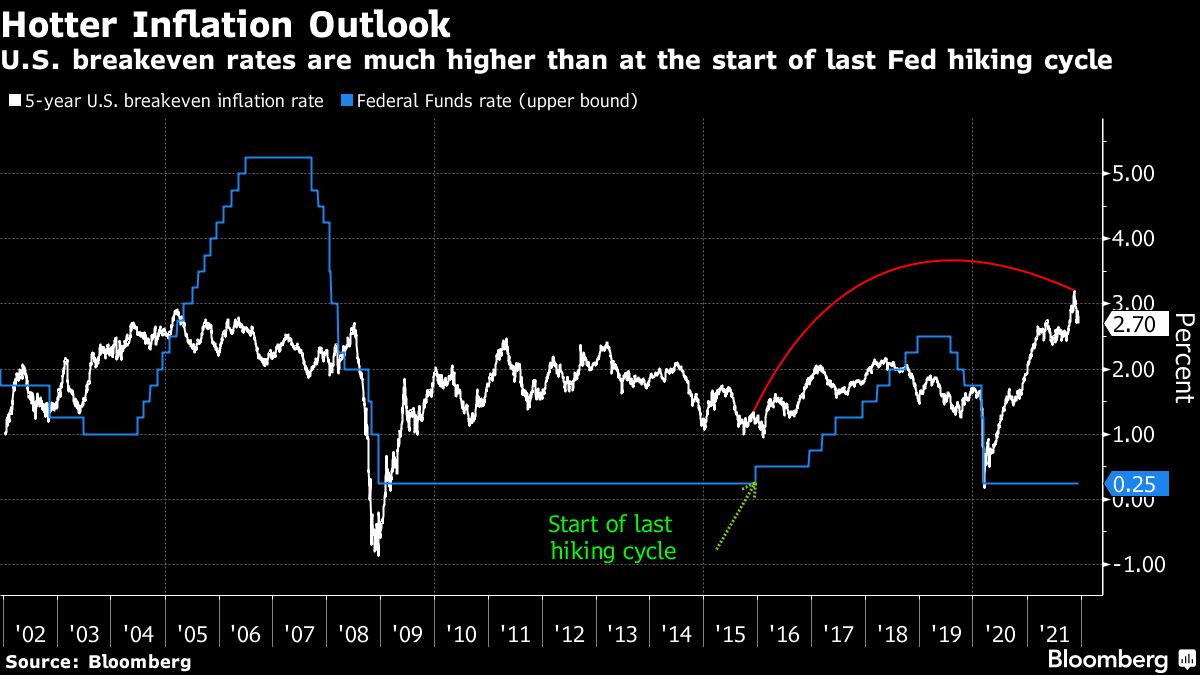
A key gauge in the bond market that measures the gap between yields on inflation-adjusted Treasuries and those on regular securities suggests the Fed will be challenged to get inflation down toward its 2% target.
The five-year breakeven rate — which hit a record high last month — is currently around 2.7%.
Some corporate highlights:
- Lowe’s Cos. delivered a revenue outlook that missed analyst estimates and said it expects home-improvement demand to slow next year.
- Eli Lilly & Co. raised its 2021 earnings and revenue forecast and said it expects 2022 sales in a range of $27.8 billion and $28.3 billion, sending shares up the most since June.
Investors also monitored the latest developments on the omicron coronavirus variant.
Anthony Fauci, who serves as a medical adviser to President Joe Biden, said on a briefing Wednesday that studies so far show strong antibody responses from existing boosters, though protections against omicron are weaker with just two doses. The strain could make up about 13% of Covid-19 cases in New York and New Jersey, projections from the Centers for Disease Control and Prevention show.
Read: U.
K. Covid Cases Hit Record High as Omicron Outbreak Accelerates
Here are some key events this week:
- BOE rate decision, Thursday.
- ECB rate decision, Thursday.
- U. S. housing starts, initial jobless claims, industrial production, Thursday.
- BOJ monetary policy decision, Friday.
- S&P Dow Jones Indices quarterly rebalance effective after markets close, Friday.
- “Quadruple witching” day in the U.
S. market, when options and futures on indexes and equities expire, Friday.
For more market analysis, read our MLIV blog.
Some of the main moves in markets:
Stocks
- The S&P 500 rose 0.5% as of 2:13 p.m. New York time
- The Nasdaq 100 rose 0.3%
- The Dow Jones Industrial Average rose 0.4%
- The MSCI World index rose 0.2%
Currencies
- The Bloomberg Dollar Spot Index rose 0.1%
- The euro was little changed at $1.1249
- The British pound fell 0.1% to $1.3212
- The Japanese yen fell 0.4% to 114.11 per dollar
Bonds
- The yield on 10-year Treasuries advanced two basis points to 1.46%
- Germany’s 10-year yield was little changed at -0.36%
- Britain’s 10-year yield advanced one basis point to 0.74%
Commodities
- West Texas Intermediate crude rose 0.4% to $70.98 a barrel
- Gold futures fell 0.4% to $1,764.40 an ounce
More stories like this are available on bloomberg.com
©2021 Bloomberg L.
P.