
(Bloomberg) — Thailand’s central bank will likely keep its benchmark interest rate unchanged Wednesday to support a nascent economic recovery as the omicron coronavirus variant threatens the outlook.
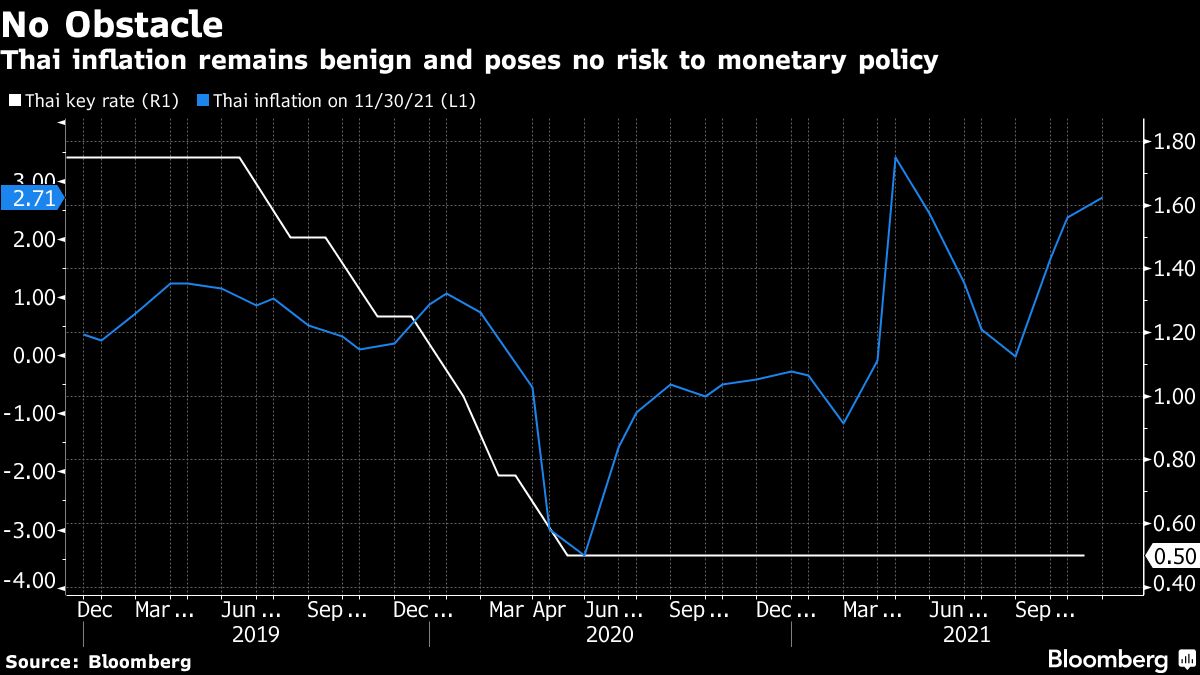
All 20 economists surveyed by Bloomberg expect the Bank of Thailand to keep the policy rate at a record-low 0.5% for the 13th-straight meeting. The central bank will also release latest economic forecasts for this year and the next.
Thailand was counting on rising vaccination rate, easing business curbs and a wider reopening to foreign tourists to bolster the economy’s recovery from a downturn in the third quarter.
But as the fast-spreading omicron variant emerges as a risk to recovery, Governor Sethaput Suthiwartnarueput said last week the central bank will focus on aiding economic growth amid subdued inflation, and is less worried about the U. S. Federal Reserve’s actions.
“The central bank will likely stand pat to wait and see the situation as omicron has clouded the economic outlook,” said Burin Adulwattana, chief economist at Bangkok Bank Pcl. “The rate tightening is unlikely until 2023.
The economic scars from the outbreak will take a few years to heal, which will require continued accommodative monetary policy.”
Here’s what to look for in Wednesday’s decision:
Economic Outlook
The central bank will likely raise its 2021 gross domestic product growth forecast from the 0.7% it predicted in September, following a milder-than-expected 0.3% contraction last quarter.
The state planning agency last month separately released its own forecast, estimating GDP growth of 1.2% this year and 3.5%-4.5% in 2022.
Sethaput said last week the BOT sees some “upside” to its GDP growth forecast this year, but 2022 is fraught with uncertainties including from omicron.
Thailand on Tuesday suspended quarantine-free entry to visitors until Jan. 4 amid rising imported cases of the strain.
Health Minister Anutin Charnvirakul said on Monday the government discovered 63 omicron cases, and 20 more awaiting results. All but one are imported cases.
Baht Weakness
The baht has weakened more than 10% against the dollar so far this year, the worst performer among major Asian currencies tracked by Bloomberg. The weak currency helped boost Thai competitiveness in exports, which jumped 24.7% in November.
The governor has said BOT isn’t targeting a“pre-set level” for baht and the currency is being driven by fundamentals.
The monetary authority will still ensure the currency isn’t too volatile to threaten the nation’s economic recovery from the pandemic.
More stories like this are available on bloomberg.com
©2021 Bloomberg L. P.