
(Bloomberg) — China’s efforts to stem the yuan’s weakness are spurring bets that it may refrain from boosting liquidity in the banking system in the near term, even as Covid lockdowns and a property slowdown undermine its growth prospects.
The People’s Bank of China took bold steps recently to cap the yuan’s decline to the lowest in over two years, but future easing may be measured.
Standard Chartered Bank Plc and Australia & New Zealand Banking Group say injecting liquidity at this stage could undermine the PBOC’s efforts of supporting the yuan by pushing Chinese yields lower, further widening their yield gap with the US and driving outflows.
Policymakers will have a window of opportunity to add cash into the financial system next Thursday when 600 billion yuan ($86 billion) of one-year policy loans come due.
Analysts see a lower chance of a short-term move in the interest rate. That’s especially after a surprise cut in August sparked a yuan selloff that snowballed due to out-sized dollar gains.
PBOC’s moves to support the yuan have reduced “the near-term possibility for both a medium-term lending facility rate cut on Sept. 15 and a reserve requirement ratio cut to replace a potential liquidity withdrawal due to MLF maturities ahead,” said Becky Liu head of China macro strategy at Standard Chartered in Hong Kong. “These suggest limited downside for China rates near term as the authorities are stepping up their efforts to stabilize the yuan.”
While PBOC officials have signaled they have enough monetary-policy room to act, the central bank may have to take a nuanced approach as it balances its twin objectives of boosting growth while keeping the currency stable, especially in the run-up to a twice-a-decade party reshuffle next month.
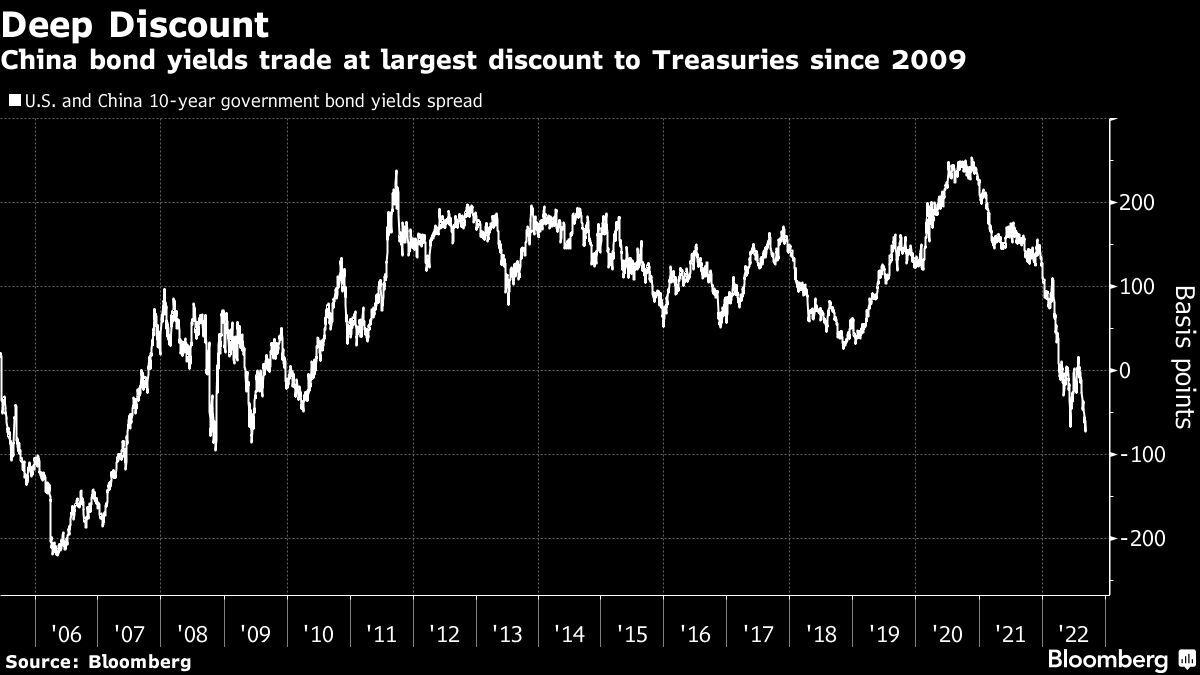
The surge in Treasury yields on aggressive Federal Reserve rate hike bets has widened the gap between 10-year US bonds and Chinese bonds of the same tenor to more than 70 basis points this week, the most since 2009.
A wider gap makes yuan-denominated assets unattractive for foreign investors and drives outflows.
A wider policy gap and domestic slowdown concerns sent the offshore yuan to near a key 7 per dollar level that was last touched in July 2020. Yuan’s weakness prompted the PBOC to set a string of stronger-than-expected yuan fixings and to reduce the foreign-currency reserve ratio for banks to support the currency.
Given the headwinds, Beijing will likely “postpone the next easing move,” Zhaopeng Xing, a senior strategist at Australia & New Zealand Banking Group, wrote this week.
A reserve requirement ratio cut, which would free up more yuan deposits into the system, may come as soon as October, he added.
More stories like this are available on bloomberg.com
©2022 Bloomberg L. P.