
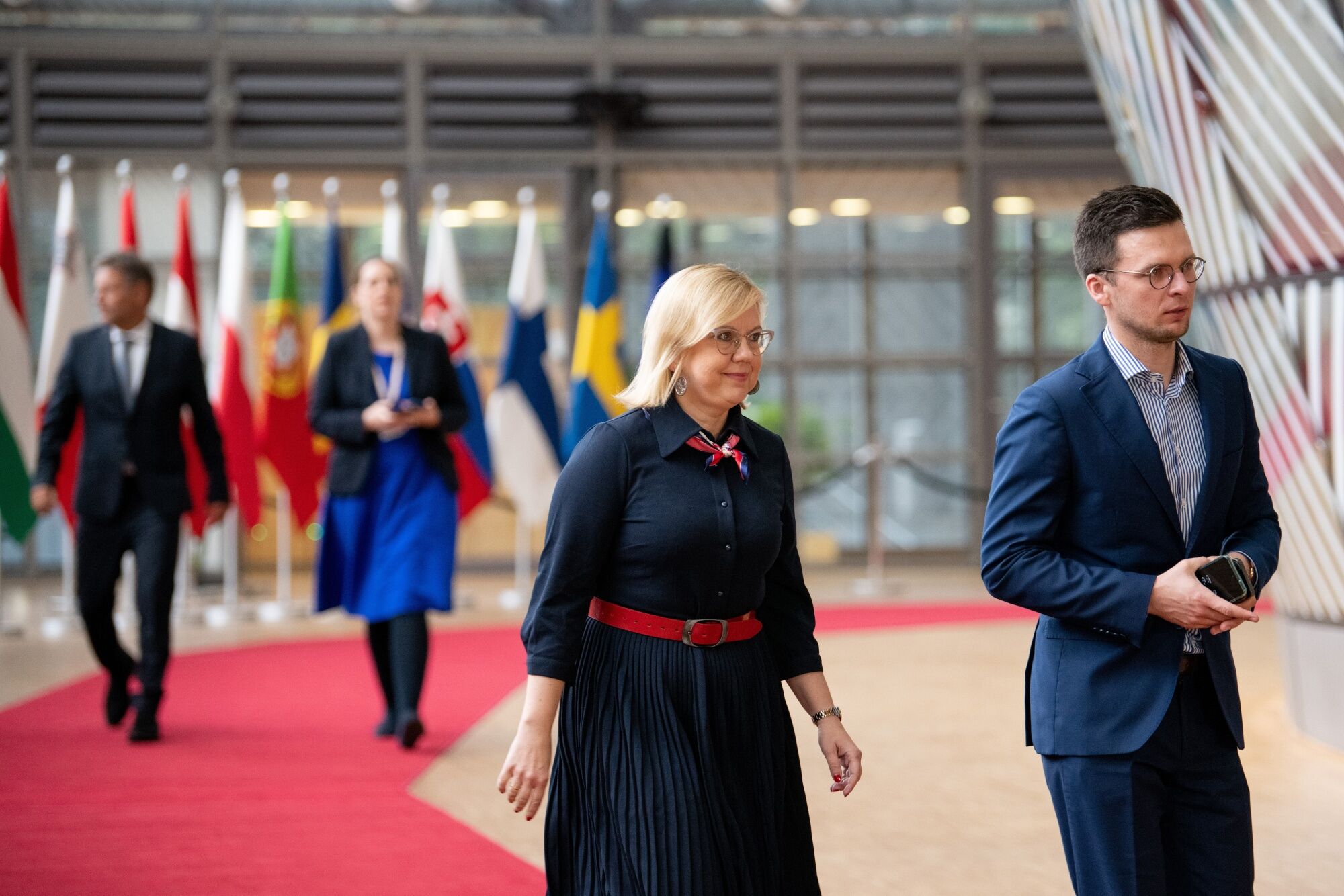
(Bloomberg) — European Union energy ministers said Friday that the bloc’s executive arm should deliver urgent proposals to provide liquidity to energy traders clobbered by massive margin calls and to skim off energy companies’ windfall profits so the funds can be redirected to struggling consumers.
“I hope we will be able to conclude the discussions by the end of September,” Czech Industry Minister Jozef Sikela told reporters.
The ministers asked the commission to propose emergency interventions, including a gas price cap. “Specific measures in this regard should also help limiting the impact of high gas prices on EU electricity markets and energy prices for customers,” according to a joint statement they drafted.
EU Energy Commissioner Kadri Simson said the bloc will propose “unprecedented” measures next week as countries face daunting challenges.
She added that her team is working on a broader plan to adjust the structure of Europe’s electricity market, which she hopes will be “ready early next year.”
The ministers also discussed ways to reduce demand, but stopped short of backing the European Commission’s call for mandatory cuts. Their joint statement called for “incentivizing” coordinated reductions.
Broad Caps
A group of European energy ministers is also pushing to impose price caps on all imported gas, as opposed to only Russian gas, as the bloc grows increasingly desperate to prevent price surges from hammering the economy.
The idea of a broader gas price cap gathered strength during the talks after several member states made it clear they didn’t want to entertain the idea of capping the price of only Russian gas.
Moscow has said it will cut supply to anyone signing up to a price cap. In the end, ministers agreed more work was needed before any such measure could be introduced.
“Fifteen countries spoke clearly in favor of a generalized price cap, on any gas imports, not just of one operator or one country,” Roberto Cingolani, Italy’s minister for ecological transition, told reporters. “There were three who preferred having a price cap on only Russian gas.”
Belgian Prime Minister Alexander De Croo is one of the backers of the idea.
The cap should be temporary and “dynamic,” offering a markup on Asian prices which are currently only half of what European customers pay, he said Thursday in an interview. This will allow time to think through how to restructure the electricity pricing mechanism for the future, he added.
It’s not immediately clear whether supplier nations would agree to have their revenues capped — particularly at time when the bloc is trying to secure more supplies.
Major suppliers include Norway, Qatar and the US.
German Economy Robert Habeck said a price cap could be an option, but it’s only the second best one. “The right option would be to not even let prices get so high and then to bring them down, but that we and all European citizens would not even be confronted with such high prices,” he said.
Why Europe Wants to Change the Way Power Gets Priced: QuickTake
One week after Moscow suddenly shut down its main pipeline to Europe, the continent is getting increasingly desperate to stem an energy crisis that’s threatening to become an economic, social and financial crisis too.
Nordic governments and the UK have separately taken steps to prevent financial contagion, with the UK creating a £40 billion ($46.3 billion) last-resort fund for energy traders.
The meeting on Friday is just the first step: Ministers asked the commission to propose detailed regulation and then governments will have to sign off. Commission President Ursula von der Leyen holds her annual address to the European Parliament on Sept. 14.
Some ministers warned that the bloc will need time to reach agreement on the various proposals.
“There are 27 states with completely different energy mixes, with completely different geographical positions meaning heavier or less heavy summers and winters, with completely different interconnections,” Cingolani said. “You need to accept that with such a heterogeneous mix of situations, unfortunately it is very difficult to find the silver bullet, the solution that pleases everyone, quickly.”
More stories like this are available on bloomberg.com
©2022 Bloomberg L.
P.