
(Bloomberg) — The daily currency fixing set by the People’s Bank of China takes on added significance Friday after the offshore yuan weakened past the key 7 per US dollar level for the first time since 2020, a threshold it has rarely breached over the past decade.
Currency traders will be glued to their computer screens at 9:15 a.m. in Beijing, tuning in for what is shaping up to be a crucial test of whether Chinese officials will allow the currency to keep falling — or take steps to slow or reverse the slide.
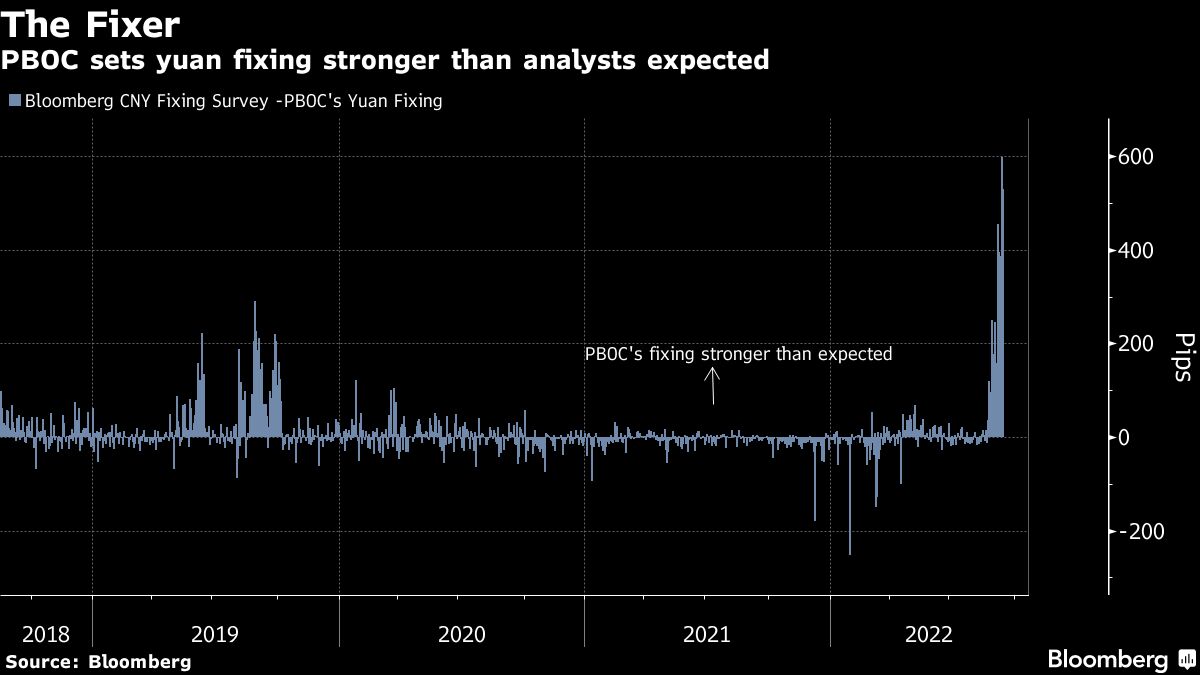
While warning investors not to bet on any particular level, the PBOC has set the fixing much stronger than analysts expected in recent days as the yuan kept slipping.
That has been the most visible signal from Beijing yet that it is seeking to stabilize the currency ahead of the Party Congress next month, when President Xi Jinping is expected to secure an unprecedented third term.
Still, strategists say Beijing is unlikely to draw a hard line at the 7 to the dollar level, even though it may continue using the fixing to slow down its slide against the US currency.
“It’s not a house-on-fire move,” said Brad Bechtel, global head of FX at Jefferies LLC. “The PBOC is quietly pushing back through the daily fixing, but they are not really doing anything else.
Central banks have realized that it’s a dollar trade. They could fight it, but there’s not much they can do about it.”
The Chinese currency is among those worldwide that are under pressure as the US dollar rallies on the back of the Federal Reserve’s most aggressive rate hikes in decades. The Fed’s moves have drawn cash into the US by widening the gap between rates in the US and elsewhere, particularly in China and Japan, where officials are keeping monetary policy loose to stoke growth.
On Thursday, China’s biggest banks lowered their benchmark deposit rates across the board for the first time since 2015 to shore up an economy that is weighted down by Beijing’s Covid zero policy and a housing slump.
China’s 10-year bond yields are some 80 basis points below comparable US Treasuries, marking the largest such gap since 2009.
The offshore yuan fell as much as 0.7% to 7.0186 per dollar Thursday, the lowest since July 2020, while the onshore exchange rate managed to stay just below 7. The currency has lost over 9% this year, heading for the biggest annual loss since 1994.
To counter the decline, the PBOC has set a string of strong fixings since late August.
On Wednesday, the fixing came in about 600 pips, or 6 basis points, stronger than analysts and traders polled by Bloomberg expected, the most since the survey started in 2018. Policy makers have also reduced the amount of dollar deposits banks need to set aside as reserves, essentially adding dollar supplies to prop up the yuan.
Erik Nelson, a currency strategist at Wells Fargo, said he’s predicting another “gigantic” fixing — about 500 pips stronger than analysts expect — Friday, because the authorities are concerned that rapid depreciation may spur capital outflow.
Yuan short-sellers may take some profit, helping the currency to stabilize, heading into the Party Congress, he said.
“The scary thing for them is another round of capital outflow,” said Nelson. “Investors will be hesitant to chase it from here.”
Few expect the currency to collapse. China’s mighty exports, while slowing, still provide support for the currency. Official data showed Thursday that net foreign-exchange settlement — a measure of cross-border flows — rose to the highest since January.
Bechtel, the Jefferies analyst, said a decline to 7.2 per dollar would be a “harder line in the sand” for the central bank.
The yuan has only approached that level twice –- in 2019 and 2020 –- but hasn’t hit it since offshore trading started in 2010.
Policy makers also have plenty in their toolbox to manage the currency, including boosting bill issuance to drain yuan liquidity in the offshore market and raising costs for investors to bet against the currency by using forwards contracts.
Even so, these measures may only slow the speed of the yuan decline and not be enough to reverse the trend, according to JPMorgan Chase & Co.
“The PBOC has started and will likely continue to lean against currency depreciation, but is unlikely to fully arrest CNY weakness,” JPMorgan strategists including Arindam Sandilya wrote in a note, using the currency symbol for the yuan. “The absence of draconian measures to cap currency depreciation so far points to further headroom for CNY weakness to run.”
(Updates first two paragraphs.)
More stories like this are available on bloomberg.com
©2022 Bloomberg L.
P.