
(Bloomberg) — Australia’s central bank chief Philip Lowe said the case for outsized interest-rate increases has “diminished” now that the cash rate is approaching “more normal settings,” suggesting smaller moves ahead.
The Reserve Bank’s board will discuss the merits of hiking by a quarter-percentage point or a half-point at its Oct. 4 meeting, Governor Lowe said in response to Australian lawmakers’ questions in semi-annual testimony Friday.
“The fact that we’ve raised interest rates quite a lot already increases the strength of the argument for smaller increases going forward,” Lowe told lawmakers. “We are closer to a normal setting now which means that the case for large adjustments in interest rates is diminished.”
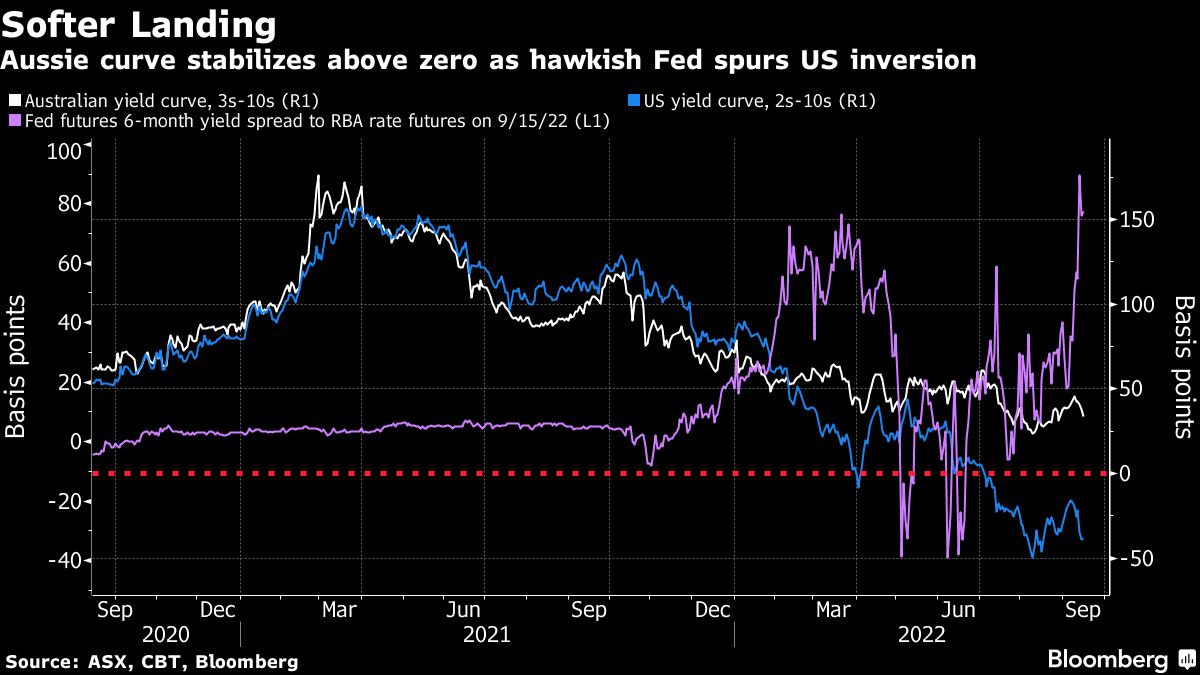
Lowe’s comments came even after stronger-than-expected US inflation fueled speculation the Federal Reserve may adopt even more aggressive monetary tightening at next week’s meeting.
Other central banks including the Bank of England and Swiss National Bank are also expected to be hawkish.
In the course of questioning, Lowe pushed back against suggestions he pause to assess the impact of previous moves, saying a few more rate hikes would be needed to tame inflation. He also pointed to a shift in inflation psychology.
That latter comment prompted National Australia Bank Ltd. to switch its October rate call to a half-point from a prior quarter-point expectation, while acknowledging a smaller move remains a “live possibility.”
Markets responded to NAB’s forecast change, with the three-year government bond yield climbing as high as 3.44% and the 10-year yield increasing 4 basis points to 3.73%.
Overnight-indexed swaps for October also rose to price in a better than 70% chance of a half-point hike.
“It is a close call,” said Su-Lin Ong, head of Australian economic and fixed-income strategy at Royal Bank of Canada, who forecasts a quarter-point hike in October. “In line with the global trend, the RBA is likely to need to move into clearly restrictive territory.”
Money markets reckon the RBA will remain aggressive, pricing in a cash rate of 3.4% by year’s end, from 2.35% at present, and a peak of 3.9% in 2023.
The RBA has raised rates by 2.25 percentage points since May to tackle inflation that accelerated to 6.1% in the second quarter.
It’s expected to peak at a little below 8% late this year before decelerating in 2023 as higher rates weigh on activity.
Lowe painted a solid picture of the country’s A$2.2 trillion ($1.5 trillion) economy, repeating that the very low level of unemployment and still-elevated savings supported household spending.
He also highlighted myriad global risks ranging from Europe’s “extraordinary increases” in energy prices to the Fed indicating policy will need to become restrictive and China’s economy slowing amid its ongoing Covid-zero policy.
“It will be difficult for Australia to stay on that narrow path to a soft landing if there is further material bad news on the global economy,” Lowe said.
The RBA has forecast a slowdown in economic growth to under 2% next year.
There are already signs of cracks emerging.
Australia’s jobless rate unexpectedly rose in August to 3.5% after a surprise drop in employment the previous month while credit and debit card data from the country’s biggest banks show a slowdown in consumer spending.
Meantime, a decline in Australian house prices is gathering pace, recording the biggest monthly drop in August since 1983.
Lowe told lawmakers he wouldn’t be surprised to see a 10% “cumulative” drop in house prices following a 25% gain in two years.
(Updates with NAB call change, market reaction, economist’s comment.)
More stories like this are available on bloomberg.com
©2022 Bloomberg L.
P.