
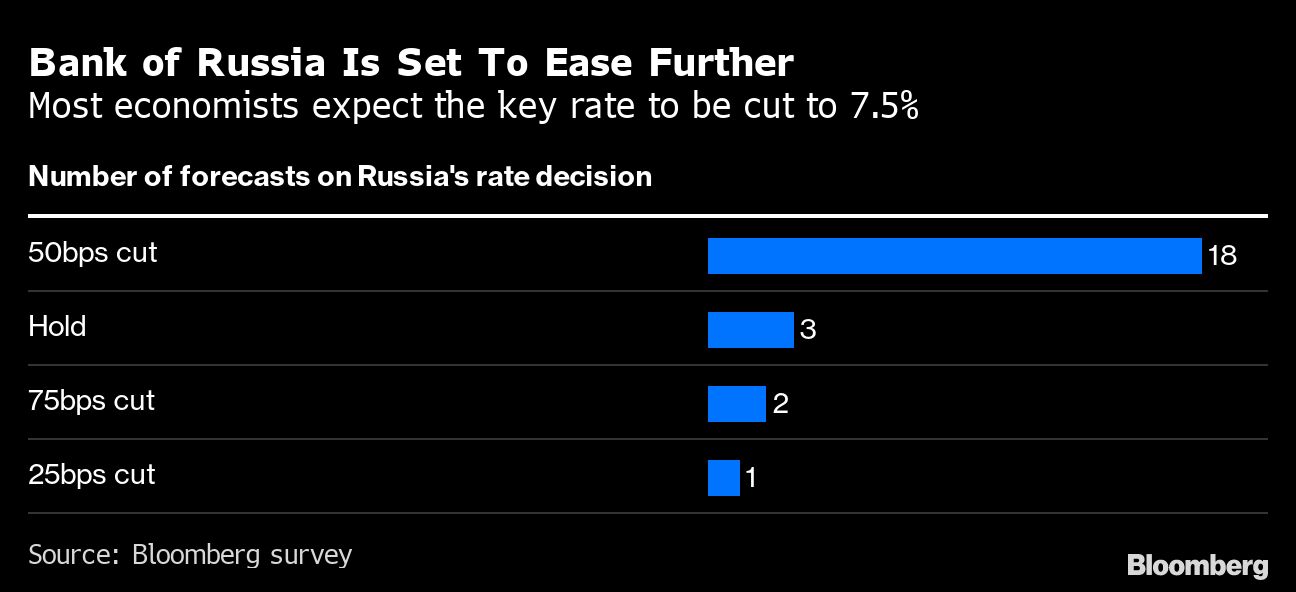
(Bloomberg) — Russia may bring interest-rate cuts to a halt in the face of risks to inflation, though most economists still expect the central bank to deliver the smallest reduction since it started easing monetary policy after the invasion of Ukraine.
Monthly declines in consumer prices that stretched through the summer allow for the sixth straight decrease in borrowing costs on Friday, before a possible pause that may last well into next year.
But a pickup in inflationary expectations, following a dollop of fiscal stimulus by the government, will put the Bank of Russia on alert.
After bigger-than-anticipated rate cuts at four meetings in a row, caution may already creep in this week.
For now, Goldman Sachs Group Inc., HSBC Holdings Plc and Morgan Stanley are the only forecasters among the 24 polled by Bloomberg expecting a hold. A majority predicts a cut of half a percentage point to 7.5%.
Governor Governor Elvira Nabiullina will hold a news conference at 3 p.m. in Moscow.
What Bloomberg Economics Says…
“The Bank of Russia may surprise the consensus by keeping the policy rate unchanged at its Sept. 16 meeting.
There are three reasons for doing so: rising inflation expectations, government guidance for expansionary fiscal policy, and a recession that has proved so shallow that even current easing seems excessive.”
–Alexander Isakov, Russia economist. Read more here
The urgency to revive the economy after the shock of international sanctions is giving way to worry that consumer costs could be harder to contain in the months ahead.
Policy makers may opt for a relatively cautious step this time, given that price expectations and a wider budget deficit are “posing challenges” for inflation, according to Citigroup Inc. economist Ivan Tchakarov.
Renewed threats to prices are coming to the forefront of attention for Nabiullina as the economy skirts a severe downturn, with borrowing costs already below their level before the invasion of Ukraine.
Economists expect the key rate won’t budge lower until the first quarter of 2023 after ending this year at 7.5%.
At the same time, Nabiullina has signaled policy makers are ready to tolerate inflation “slightly above” their target of 4% as the economy adjusts. Annual price growth eased to 14.3% in August, down from nearly 18% in April, with the central bank anticipating it may reach as low as 12% by end-2022.
Rates may stay on hold until next June following a cut of 50 basis points on Friday, according to Barclays Plc.
“Pro-inflationary risks remain high amid remaining supply-side restrictions and further growth of money supply driven by some improvement in lending and the fiscal impulse”, Barclays analysts including by Zalina Alborova said in a note.
More stories like this are available on bloomberg.com
©2022 Bloomberg L.
P.