
(Bloomberg) — Quant or a stock picker, retail or pension fund manager, everyone is a macro trader in this inflation-driven era — and it’s only getting worse.
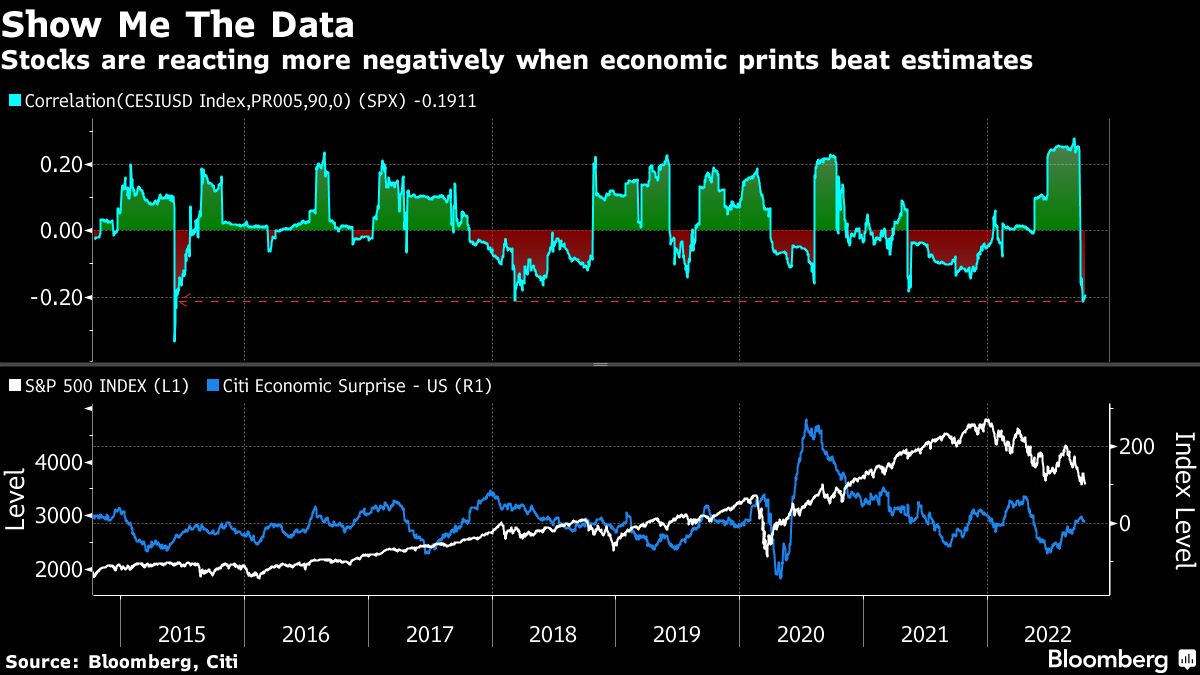
The link between the S&P 500 and Citigroup Inc.’s widely followed surprise index for the US economy has jumped to the most negative since 2015. Hotter-than-expected economic data are fueling expectations that the Federal Reserve will enact disruptive rate hikes — sending stocks toward fresh bear-market lows.
Likewise, Treasuries remain at the mercy of big-picture readings from jobs to manufacturing, with the asset class exhibiting an increasingly negative connection to the Citi gauge, which measures the degree to which data exceed or miss forecasts.
An inflation overshoot, for example, constitutes a beat.
With data ruling Wall Street, the stakes are high for Thursday’s report on consumer prices. A hot reading could seal the case for a fourth rate hike of 75 basis points, sending equities into another tailspin.
Another way of thinking of it: Where valuations and fundamental analysis drove capital flows, every asset is getting hit again and again by endless speculation over the policy resolve of the world’s most powerful central bank.
“Every piece of data is viewed in the prism of how it will affect the FOMC’s decisions,” said Art Hogan, B.
Riley’s chief marketing strategist. “The only thing that will likely break the ‘bad-news-is-good-news’ fever will be when we get to the place where the Fed takes a pause in rates.”
Recently, any sign that price pressures remain elevated sends markets into sell mode, with stocks and bonds falling together. It happened early Wednesday, when a reading on producer prices topped estimates and an overnight rally in US stock futures evaporated.
Minutes from the Fed’s last policy meeting later in the afternoon suggested some officials saw danger in excessive policy tightening. The S&P 500 fell 0.3% at the close.
“Any sign of slowdown would be appreciated by stocks and bonds as it could open the door to a Fed pivot in the coming months,” said Christophe Barraud, chief economist at Market Securities LLP in Paris.
Yet bets on an imminent dovish turn in policy — a prospect that’s been summarily dismissed by a succession of Fed officials — were left cruelly disappointed last week.
Fed Vice Chair Lael Brainard said on Monday that previous interest-rate increases are still working through the economy and that she supported moving forward “deliberately and in a data-dependent manner.”
The US dollar is one of the few assets that likes data beats — and cheers Fed hawkishness.
The correlation between the greenback and the Citi index is the most positive in five years, according to data compiled by Bloomberg. Meanwhile the last time shares were so negatively correlated with economic surprises was the summer of 2015, in the months before the Fed began raising borrowing costs.
Thursday’s consumer price index reading is expected to show a slight deceleration to 8.1% annually, reflecting a decline in gasoline prices.
But the core reading that excludes food and energy is set to rise 6.5% from a year earlier, matching the rate seen in March that was the highest since 1982. Such readings would be unlikely to deter the Fed from raising rates sharply.
“Asset classes can’t help but have higher correlations to the macro data,” said Kristina Hooper, chief global market strategist at Invesco. “This continues to happen until the Fed stops being the key driver of markets.”
Read more: US Core Inflation Seen Returning to 40-Year High as Rents Rise
Meanwhile a Barclays Plc study shows cross-asset correlations have only ever been higher in the dark days of the pandemic, judging by in-tandem moves of numerous indexes across regions and assets over the past two decades.
And the top 50 companies in the S&P 500 are moving around in concert to a degree unseen since the macro-driven investing climate of 2020.
“This is yet another indication of the overarching impact of the toxic combination of aggressive policy and slowing global growth,” said Barclays strategist Stefano Pascale.
More stories like this are available on bloomberg.com
©2022 Bloomberg L.
P.