
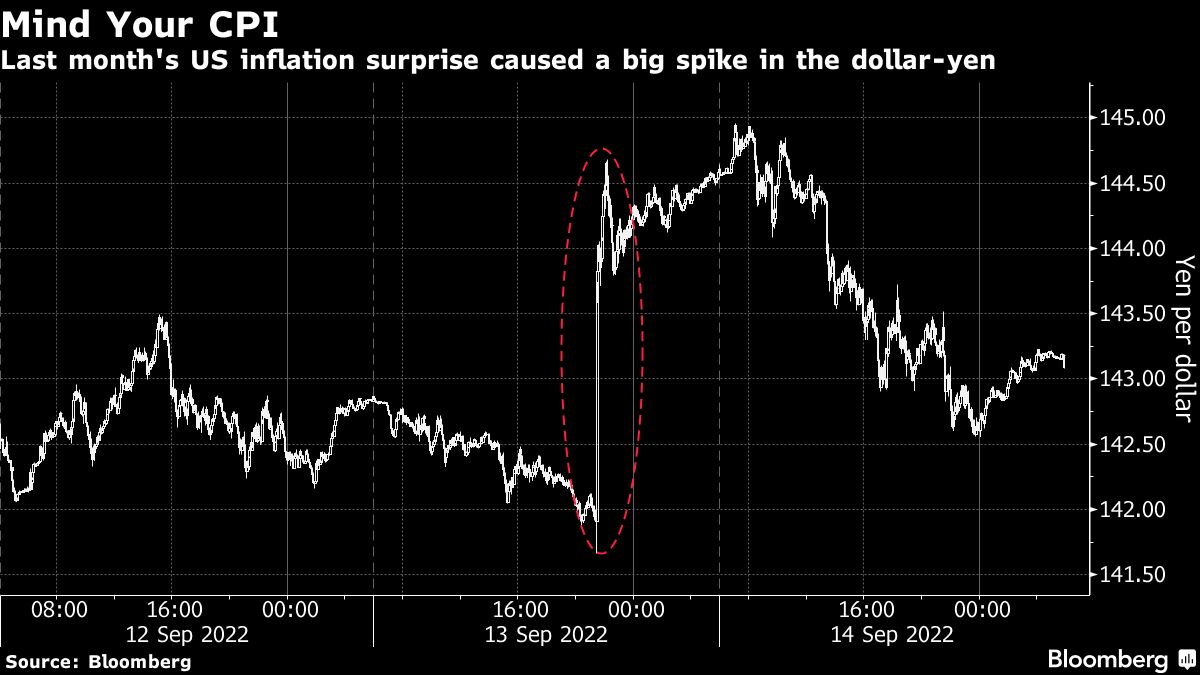
(Bloomberg) — Yen traders are readying for another volatile session Thursday with the release of key US inflation figures — data which sent the Japanese currency tumbling 2% in a matter of minutes last month on its path toward intervention.
Strategists have said Japanese authorities won’t necessarily have a line in the sand at which they’ll act again and are likely focusing on the speed of declines.
That’s a point the country’s finance minister reiterated Thursday as he spoke in Washington DC and warned against excessive moves.
“If speculators move and create sudden volatility we’ll take bold action, that stance hasn’t changed,” said Shunichi Suzuki, who’d met with Group of Twenty counterparts earlier in the day. “It’s not a matter of crossing a specific level. What we’re solidly watching is volatility.”
With the yen back in prime intervention territory, having surpassed the level that prompted action in September, trader focus has intensified on the reaction to another potential consumer price index surprise.
The August CPI reading is expected to show a slight deceleration to 8.1% annually, reflecting a decline in gasoline prices.
But last month’s figure for July came in above expectations, boosting the case for further Federal Reserve hikes, which weigh on the yen given the Bank of Japan is keeping rates pinned to the floor.
The Japanese currency traded just off a fresh 24-year low, around 146.80 per dollar in Tokyo on Thursday.
“If US CPI tops forecast and 10-year US yield rises above 4%, yen selling may accelerate and heighten the probability of Japanese intervention,” said Yoshifumi Takechi, chief analyst at Money Partners in Tokyo. “Even if the yen’s drop becomes moderate, I think they are on the verge of stepping in, closely choosing catalysts, either timing or events such as data releases.”
Yen Weakens Past Level That Triggered Last Japan Intervention
Suzuki said he’d also explained Japan’s recent intervention to other nations, and that Group of Seven nations had reaffirmed existing commitments regarding foreign exchange markets.
G-7 nations also agreed that many nations’ currencies had moved greatly as a result of increased volatility.
“We can’t allow excessive moves from speculators,” said Suzuki. “We’re watching moves in the market with a real sense of urgency. If there are excessive moves we’ll take appropriate responses.”
The Japanese currency has erased last month’s intervention-driven gains despite the ministry’s 2.84 trillion yen ($19.5 billion) spend.
IMF Stands by BOJ Governor Kuroda’s Rock Solid Easing Stance
For Mohammed Apabhai, Citigroup Inc.’s head of Asia-Pacific trading strategies, the yen could well slump further to 160 per dollar and beyond, unless the Fed pivots on interest rates or on quantitative tightening.
“It seems that the direction of dollar-yen, not withstanding any short-term bounces, will be to head a lot higher, Apabhai told Bloomberg Television. “Maybe even up to 185.”
(Citigroup says dollar-yen could hit 160 or beyond)
More stories like this are available on bloomberg.com
©2022 Bloomberg L.
P.