
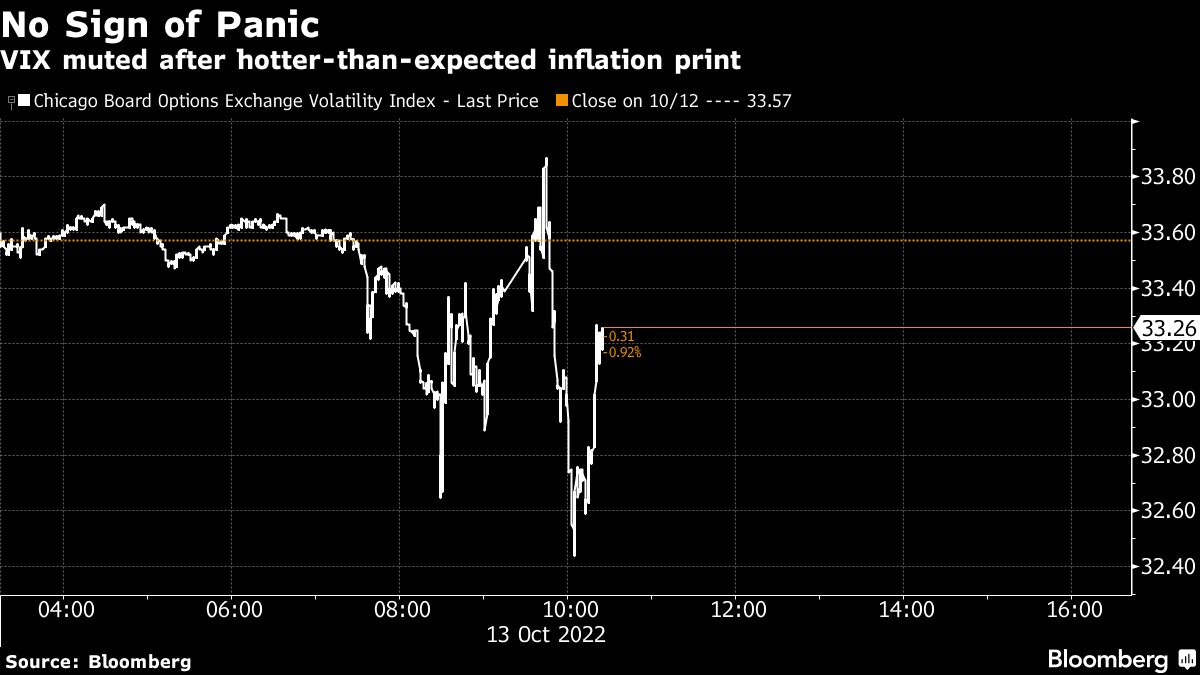
(Bloomberg) — Another ugly inflation report rattled global markets Thursday, yet a glance at Wall Street’s famous fear gauge suggests a lack of outright panic.
While the S&P 500 Index fell as much as 2.4% following the hotter-than-expected data release, the Cboe Volatility Index declined and was down 0.8 points to 32.8 points as of 11 a.m. in New York. The equity gauge had pared its tumble to 0.9%.
The VIX measures expected swings in America’s benchmark index and more typically surges in times of turmoil.
Its muted reaction is a sign that there’s little widespread alarm among investors, said Max Gokhman, chief investment officer of AlphaTrAI.
The bad news? That may indicate there’s more room for stocks to fall.
“There isn’t much fear in the options markets from which VIX is computed,” Gokhman said. “One of the signs I’m watching for to call capitulation on the selloff is seeing investors truly scared,” such as a VIX closer to 50, he said.
The consumer price index reading was a much-watch event for investors, with the outcome likely to cement the path of monetary tightening.
With the Federal Reserve mired in a battle against the hottest inflation in decades, many in the market may have prepared for Thursday’s turbulence.
Portfolio managers “had no use in buying protection since their portfolios were already conservatively positioned,” said Julian Emanuel, chief equity, derivatives and quantitative strategist at Evercore ISI.
In the last two major market bottoms, the VIX had exceeded 80, noted Steve Chiavarone, senior portfolio manager at Federated Hermes.
“Its tempting to try to call a bottom because the market is down as much as it is,” he said. “The problem is that many of the conditions needed for a bottom are not nearly in place.”
More stories like this are available on bloomberg.com
©2022 Bloomberg L.
P.