
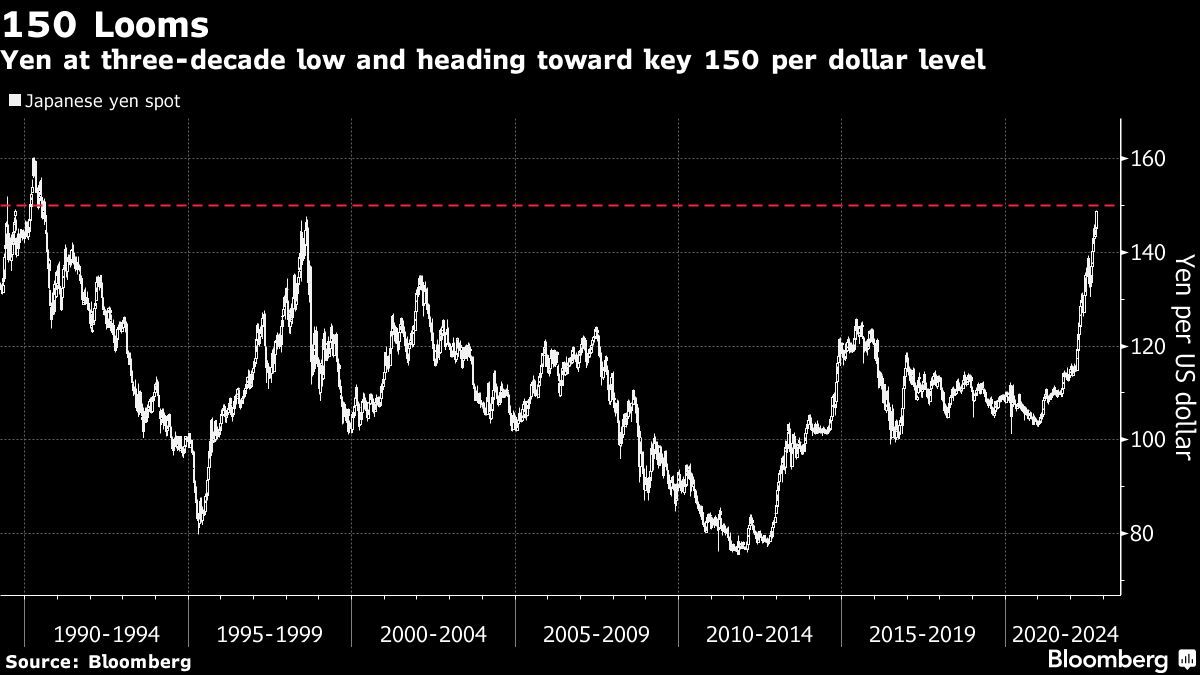
(Bloomberg) — Traders remained on high alert for possible intervention to support the yen Monday after it touched a 32-year low and neared the key psychological 150 per dollar level.
The Japanese currency was little changed around 148.60 in Tokyo trading after nine straight weeks of losses. Finance Minister Shunichi Suzuki reiterated to reporters Monday that the country will take bold action if there are speculative foreign exchange moves.
“We’re constantly watching the foreign exchange market moves with a sense of urgency,” he said. “If there are excessive moves triggered by speculators or others, there’s absolutely no change in our stance that we’ll take bold action.”
The strong words were just the latest in a series of warnings following the yen’s slump to a three-decade low, as authorities tried to dissuade traders from testing its intervention strategy.
A rapid slide in the yen to 145.90 per dollar last month triggered the nation’s first intervention to support the currency in 24 years.
Strategists have said Japanese officials won’t necessarily have a line in the sand at which they’ll act again and are likely focusing on the speed of declines. But some have also said 150 is a key psychological level for Japanese citizens and a breach would likely heap pressure on the government domestically to act again.
“It seems Japan has faced key milestones every five-yen at current levels, first 140 was seen key, then 145 and now 150,” said Shinsuke Kajita, chief strategist at Resona Holdings in Tokyo. “Intervention is possible anytime as players are seen wanting to test 150 and Japan’s action.”
The yen has tumbled about 23% against the dollar this year due to a widening monetary policy differential between the US and Japan.
It erased last month’s intervention-driven gains despite the ministry’s 2.84 trillion yen ($19.5 billion) spend.
BOJ Easing
Bank of Japan Governor Haruhiko Kuroda continues to insist that he will stick with rock-bottom interest rates until stable inflation is achieved, comments that keep offering yen bears fuel for shorting. He reiterated his stance in parliament Monday, arguing that Japan is still in the middle of recovering from the pandemic, and that he expects inflation to come back down to below 2% next fiscal year onward.
“It’s important that we achieve our price target in a stable and sustainable manner, and I believe it’s appropriate to maintain monetary easing,” he said.
Prime Minister Fumio Kishida appeared to support Kuroda’s stance in the same session, saying that he’ll leave specific methods of monetary policy to the BOJ.
“Cooperation between the government and BOJ remains very important,” said Kishida. “The government hopes that the BOJ will continue its efforts toward achieving its stable, sustainable price target.”
Given multilateral agreements that warn against disorderly currency movements, Japanese authorities will find it less difficult to get tacit support for intervention if they are seen to be responding to “excessive volatility.”
Japan’s chief currency official Masato Kanda said Monday that Group of 20 finance ministers and central bankers shared the view during meetings last week in Washington that currency volatility has been rising.
One-week implied volatility in the yen has climbed from recent lows.
“While we think that the MOF would not hesitate to conduct additional intervention operations if deemed necessary, the need appears less clear as long as volatility in the cross remains dampened,” wrote Goldman Sachs Group Inc. strategists including Kamakshya Trivedi. “The extent of further yen weakness looks more limited from here as the risks to rates look more symmetric at current levels.”
(Updates with comments from Kuroda, Kishida.)
More stories like this are available on bloomberg.com
©2022 Bloomberg L.
P.