
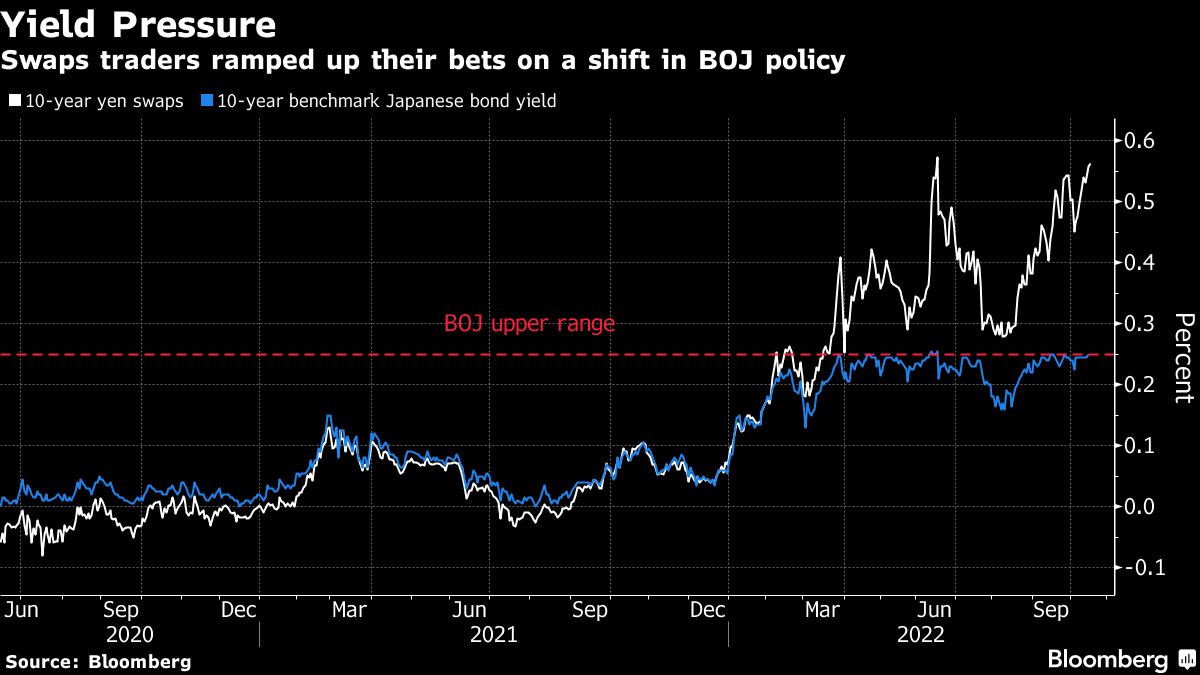
(Bloomberg) — Governor Haruhiko Kuroda has taken pains to explain why the Bank of Japan is nowhere close to even a modest adjustment to its ultra-easy policy, but traders are yet to be convinced.
Yen swaps are climbing, average coupons on 10-year corporate bonds are pushing higher and overnight-indexed swaps are pricing in an end to negative-rate policy around the time Kuroda steps down in April.
His yield curve control is also getting tested with the benchmark yield rising above the BOJ’s target range on Wednesday.
“I’m not sure Japan is going to have a UK moment, but certainly there are cracks appearing in the JGB market that imply the market is preparing for the BOJ” to have to tweak its yield curve control policy earlier than anticipated, said Brad Gibson, co-head of Asia Pacific fixed income at AllianceBernstein Australia Ltd., in an interview on Bloomberg Television.
These charts show how investors in some parts of the credit and swap markets are preparing for a surge in 10-year yields, essentially wagering the central bank will alter its policy of curve control.
This will test Kuroda’s determination to stick with rock-bottom rates in the final months of his term, a policy that’s increasingly out of line with global peers.
Swaps Surge
The BOJ’s ultra-accommodative policy has driven the yen to its weakest since 1990, despite the Ministry of Finance’s intervention to stem losses, with traders focusing on the yawning gap between Japanese and US benchmark yields.
Speculation is growing that the currency depreciation will eventually force the central bank to let 10-year yields move higher, as other major central banks globally relentlessly raise rates.
Such bets are being reflected in yen swaps, whose 10-year rates have climbed to more than twice the level of the benchmark bond yield.
“Now we think maybe there will be some measures for a tweak of YCC maybe in the first quarter, before Kuroda leaves in April,” AllianceBernstein’s Gibson said.
The 10-year bond yield rose to 0.255% earlier Wednesday, crossing the 0.25% limit before settling back at it.
Coupons Increase
In Japan’s credit market, investors are demanding a bigger premium for the risk longer-dated bond yields spike.
The average coupon on 10-year corporate bonds sold in October rose to 0.92%, up from 0.57% at the start of the financial year in April, according to data compiled by Bloomberg. In contrast, the average rate on five-year notes fell slightly to 0.44% in that period.
“Investors are asking for bigger returns as they expect that the 10-year government bond yield will rise if the BOJ tweaks yield-curve control,” said Masayuki Tsujino, a senior fund manager at Asahi Life Asset Management Co.
Negative interest rates and yield-curve control will no longer be necessary when Kuroda’s term ends, as global bond yields are rising, he said.
End to Negative Rates
Overnight-indexed swaps are fully pricing in an end to the BOJ’s negative-rate policy around the time Kuroda leaves his post in April, indicating that the central bank will lift the short-term policy rate by 10 basis points from negative 0.1%, based on data compiled by Bloomberg.
“There’s a good chance that the BOJ will tweak its yield-curve-control policy after Kuroda leaves to reduce its side-effects,” said Akio Kato, general manager of strategic research and investment at Mitsubishi UFJ Kokusai Asset Management Co. in Tokyo. “Regardless of whatever changes the BOJ adds, it will mean the central bank tolerates higher yields.”
Bond Buying
Still, despite these market signals, direct pressure on the BOJ to defend its yield target has eased a touch since the summer, at least by one measure.
While the central bank continues to buy 10-year bonds in the market, purchases are running below the record of about $120 billion it spent in June.
(Adds 10-year yield crosses BOJ’s tolerance level in second paragraph)
More stories like this are available on bloomberg.com
©2022 Bloomberg L. P.