
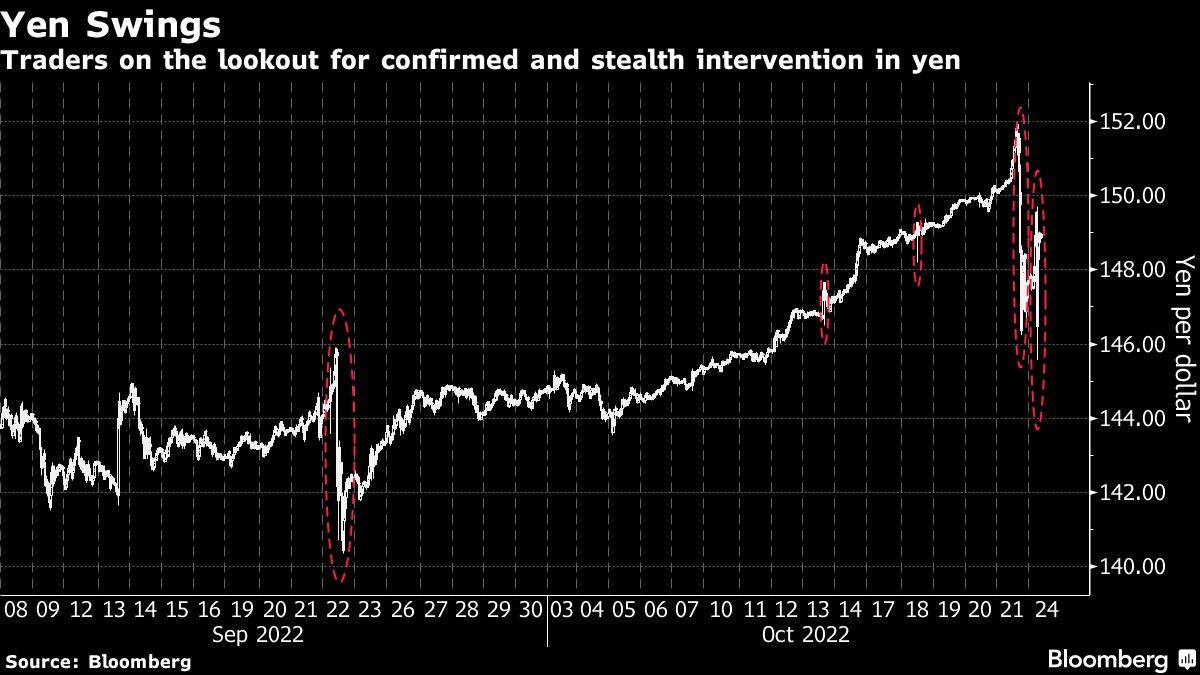
(Bloomberg) — Japan seems to be using a new currency intervention playbook compared to a decade ago, in a bid to get the most from its unilateral action.
Most of its intervention, confirmed and suspected, took place outside of regular Japan trading hours, with the exception of probable action Monday — unlike moves in 2010 and 2011 to weaken the yen. In contrast to that period, the government has only stated it intervened once, with the reluctance to do so seen as an additional tool to deter speculators.
The shift in strategy — concentrating its efforts on overseas funds — makes sense considering most of the yen’s weakness this year has occurred outside of Japanese trading hours.
More than four-fifths of the currency’s 23% slump against the dollar has happened in offshore markets, according to data compiled by Bloomberg.
For Kiyoshi Ishigane, chief fund manager at Mitsubishi UFJ Kokusai Asset Management Co. in Tokyo, the strategy mirrors that seen during traditional coordinated intervention with overseas peers, even though this time the action is taken unilaterally.
This may subtly increase its influence on markets, he said
“In conducting an intervention overseas, Japan can indicate that it has gotten approval from local authorities there,” said the 34-year market veteran. “It’s effectively a coordinated intervention and it has a meaningful impact.”
While Finance Minister Shunichi Suzuki said earlier this month that policy makers had made efforts to gain understanding for Japan’s actions from the US and other nations, there is no indication it is anywhere close to an agreement for coordinated action to rein in the dollar’s strength.
Lack of Confirmation
The yen whipsawed in Tokyo trading Monday amid signs of a second intervention in two sessions.
It was trading at 149.36 per dollar in early morning in New York. Suzuki declined to comment and avoided even explaining why he isn’t doing so. That’s a sea change from the official approach taken in 2010-2011 when the government typically announced their action immediately after stepping into the market.
“The lack of confirmation is acting as a smoke screen,” said Koji Fukaya, a fellow at Market Risk Advisory in Tokyo. “Speculators find it hard to take positions when there’s no clue to when an intervention will take place or whether it has happened at all.”
Japan likely spent more than $30 billion last week to support the currency, the Financial Times reported, citing estimates by traders.
The government confirmed a spend of around $20 billion in September to prop up the yen.
With the Bank of Japan expected to stick to its accommodative policy this week, the yawning yield gap with the US looks set to continue to weigh on the yen. As a result, analysts have said officials are likely to focus on the speed of declines rather than any particular level before intervening.
“While intervention is unsustainable, we think the MOF would prefer dollar-yen below 150, even if they have not explicitly said so,” Mazen Issa, a senior strategist at TD Securities, wrote in a note.
(Updates yen trading levels in third and sixth paragraphs.)
More stories like this are available on bloomberg.com
©2022 Bloomberg L.
P.