
(Bloomberg) — As Japanese authorities intervene to rescue the weakening yen from the clutches of foreign speculators, the bigger risk to further declines lies closer to home — importers.
Japan’s need for foreign goods — from natural gas to oil to foodstuffs — creates constant demand for dollars that is insensitive to yield differentials, technical levels and expectations for monetary policy.
Even if speculative traders stepped out of the market, trade flows are enough to continue to pressure the yen, especially amid reduced liquidity and high hedging costs, according to analysts.
“There is a huge volume of dollar demand outstanding,” said Tohru Sasaki, head of Japan markets research at JPMorgan Chase & Co. in Tokyo. “Importers have to buy tremendous amounts as hedging contracts are knocked out.”
The yen strengthened 0.8% to 147.72 per dollar at 11:42 a.m. in New York Tuesday.
It continues to be the worst-performing major currency this year despite signs of Japan intervention. The yen has slumped to a three-decade low against the dollar this year as investors focused on the yawning yield gap between the US and Japan.
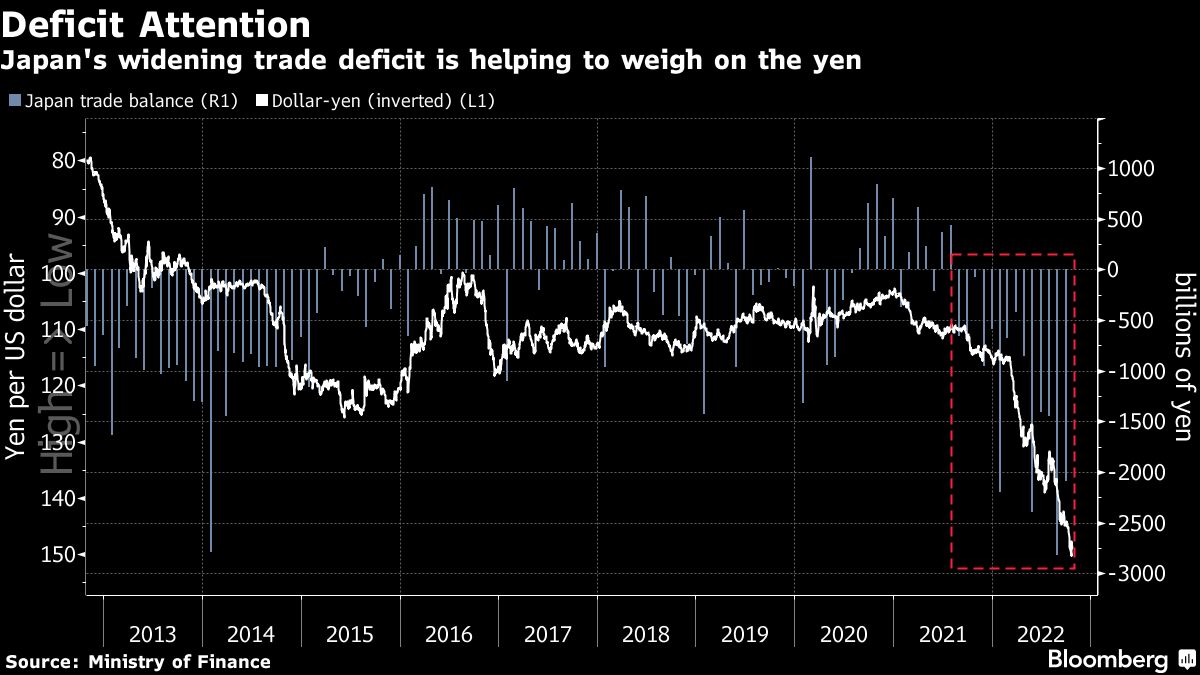
Japan’s trade deficit topped 2 trillion yen ($13.4 billion) for a second straight month in September, bringing the total for the calendar year to about 14 trillion yen — a record.
The trade gap extended its longest streak of red ink since 2015, as the weaker yen pushed up the import bill, an outcome that will weigh on the economy and feed back into further currency weakness.
“The dollar-yen is likely to keep rising from Japanese importers this winter going out and buying LNG, buying coal, buying oil,” said Jordan Rochester, a currency strategist at Nomura International Plc. on Bloomberg Surveillance Tuesday. “Even though these prices are cooling down, seasonally as we get into winter those purchases of LNG should accelerate, pushing dollar-yen higher.”
Speculator Problem
Finance Minister Shunichi Suzuki has said Japan is in a firm confrontation with speculators and won’t tolerate excessive yen moves.
Estimates suggest the government may have spent more than $57 billion to protect the currency over the last two months, a figure that includes a confirmed $19.7 billion as part of September’s intervention.
“We conduct currency intervention to deal with excessive foreign exchange volatility when we see rapid, one-sided moves on the back of speculation,” Suzuki said Tuesday.
But for Greg Anderson, global head of currency strategy at Bank of Montreal, speculators aren’t pushing the yen lower any more given the risk of intervention.
The culprits are the trade deficit and large institutional investors reducing hedging activity.
“It does not look like there is some big block of speculators trying to take on the Bank of Japan,” said Anderson. “If anything, it’s almost the opposite, that the offshore community is scared to death to touch dollar-yen because it is no longer liquid, its too volatile, too risky.”
BOJ Catalyst
Yen traders were bracing for a rocky week as chatter around suspected intervention mixed with the likely impact of the BOJ meeting.
Economists expect the central bank to keep its policy unchanged again at its two-day meeting ending Friday, a decision which could trigger further yen weakness.
Suzuki said he didn’t think Japan’s intervention strategy was contradictory to BOJ policy, speaking to reporters Tuesday. The finance minister reiterated his support for independent monetary policy.
“The aim of intervention is different from BOJ policy, which seeks to realize sustainable, stable inflation with wage growth,” he said. “The BOJ is carrying out policy to achieve its stable price target while keeping in mind the fact that Japan’s economic recovery remains weaker than the recoveries in the US and Europe.”
Regardless of government action, the Japanese currency is likely to remain under pressure, according to JPMorgan’s Sasaki.
“Several trillions yen of intervention won’t stand in the way and deficits will continue and the yen weakness trend will continue,” he said.
–With assistance from Yoshiaki Nohara.
(Adds pricing update, comments throughout.)
More stories like this are available on bloomberg.com
©2022 Bloomberg L.
P.