
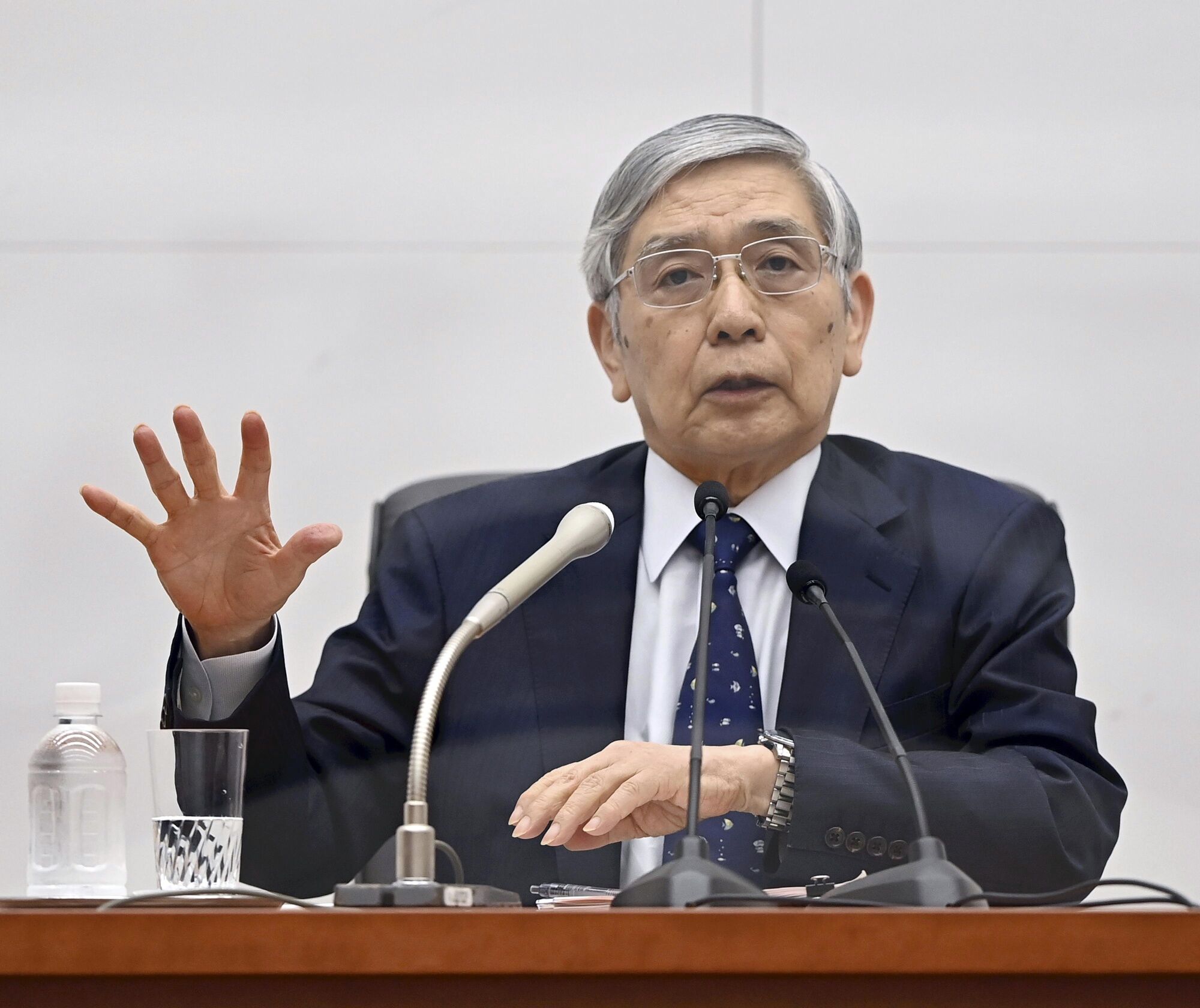
(Bloomberg) — Bank of Japan Governor Haruhiko Kuroda appears as determined as ever to see out his inflation mission without buckling to market or political pressure.
Entering the final six months of his decade-long stint at the helm, Kuroda on Friday will stick with the central banking world’s last remaining negative interest rate, according to all 49 economists surveyed by Bloomberg.
Also set to stay: a 0.25% cap on 10-year bond yields.
Such doggedness risks triggering a fresh spiral lower for the embattled yen and another round of currency intervention from Japanese authorities. It’s also likely to result in a further ramp up of BOJ bond purchases to keep benchmark yields in check.
Explaining the refusal to shift is getting all the harder. Consumer prices are climbing the most in over three decades, and BOJ officials are likely to boost their own inflation forecast to at least 2.5% for this fiscal year, people familiar with the matter said.
That’s above the BOJ’s 2% target.
Kuroda will likely reprise his argument that prices are in a temporary burst, and stimulative policy is still needed to fuel the sort of wage-propelled gains the BOJ wants. For investors, the takeaway is the same: a further widening in the gap with others, as the Federal Reserve tees up a 75 basis-point hike next week.
“It’s getting harder and harder for the BOJ just to keep standing pat,” said Hiromichi Shirakawa, chief Japan economist at Credit Suisse Group AG. “There’s no doubt the yen will slide rapidly again, like last month, if Kuroda makes no adjustments at all to policy or his messaging.”
Last month, Kuroda’s stimulus-will-stay missive set off a plunge in the yen that triggered Japan’s first intervention to prop up the currency in 24 years.
The currency is now even weaker, despite further rounds of probable yen buying by authorities in recent days.
The hope may be intervention at least moderates the currency’s drop, buying time until the Fed pivots toward less-aggressive tightening. By the time Kuroda’s term is up in April, the US central bank should be near the end of its campaign, if most forecasts bear out — potentially making a shift by a new BOJ governor less destabilizing.
An uptick in two-year yields, and in 10-year swap rates, to the highest levels in years suggests at least some traders are betting on a change down the road.
But for now, any abrupt shift by the BOJ risks triggering a huge wave of fallout through markets globally.
That leaves Japanese households and businesses grappling with the consequences of an over 22% decline in the yen against the dollar this year. As of early Wednesday morning, the currency was around 148 per dollar, after starting 2022 around 115.
Prime Minister Fumio Kishida’s government is preparing an economic-support package, reportedly worth 26 trillion yen ($175 billion), to help counter the negative effects of Japan’s loss in purchasing power.
It’s aimed for unveiling later this month.
A draft of the package seen by Bloomberg showed continued government backing for achieving the BOJ’s goal of achieving “sustainable” inflation.
What Bloomberg Economics Says…
“Investors will focus on how the BOJ adjusts its price and growth forecasts to reflect weakening global demand and the yen’s steep slide. The BOJ will probably raise its inflation forecast for the year ending in March, while cutting its GDP projections for that period and the next.”
— Yuki Masujima, economist.
Click here for more.
But the draft plan also calls on the BOJ to pay sufficient attention to the impact of market moves.
That raises the potential for political backlash should any of Kuroda’s remarks at Friday’s press briefing trigger undue volatility in markets.
Kuroda himself looks largely unruffled, convinced of the appropriateness of the current policy path, according to people familiar with the matter. As a former finance ministry official who once ran the country’s foreign exchange policy, confronting volatile markets is nothing new to the 78-year-old BOJ chief.
The BOJ’s latest quarterly set of forecasts will probably show inflation at sub-2% for the next fiscal year, according to people familiar with the matter.
Expectations for price gains to cool would underscore Kuroda’s resolve to keep easing while almost everyone else in the world tightens.
But shifting tides of public support could prove a powerful backdrop for Kishida’s choice of a successor to Kuroda in coming months. A poll by the Mainichi newspaper found 55% of respondents said BOJ policy should be reviewed, compared with 22% who said it shouldn’t.
A further deterioration in Kishida’s own approval ratings — already at the lowest level of his premiership — could push the premier to seek someone open to changing policy as a new governor after Kuroda steps down in April, said Nobuyasu Atago, chief economist at Ichiyoshi Securities.
“It would come as no surprise if Kishida’s team got so frustrated they just said enough is enough,” Atago said. “When yen volatility is this high, it’s hard for Kuroda to simply stick to what he intends.”
The costs of maintaining Kuroda’s yield-curve control regime have mounted as traders attempt to push yields past the cap.
So far in October the BOJ has bought around 2.3 trillion yen of five-to-10 year government bonds at fixed rates, on top of its regular and unscheduled purchases.
“There’s really no limit to the yen’s weakness as long as Kuroda sticks to his policy — levels are irrelevant,” said Amir Anvarzadeh, strategist at Asymmetric Advisors Pte, who has tracked Japanese markets closely for three decades. “The Bank of Japan is way out of sync with global rates, and that’s causing the yen to depreciate.”
–With assistance from Cormac Mullen.
More stories like this are available on bloomberg.com
©2022 Bloomberg L.
P.