
(Bloomberg) — New Zealand Finance Minister Grant Robertson has sought advice on whether the central bank should be asked to achieve its inflation and employment targets within a more specific time-frame, according to a Treasury Department document.
The document, prepared for Robertson and released by the Treasury Monday in Wellington, discusses the Reserve Bank’s five-yearly review of its Monetary Policy Remit, which is currently underway, and canvasses potential changes.
It says Robertson has indicated he’d be interested in an assessment “of whether the Remit could be clearer in terms of the time-frame in which monetary policy is expected to return inflation and employment to their targets.”
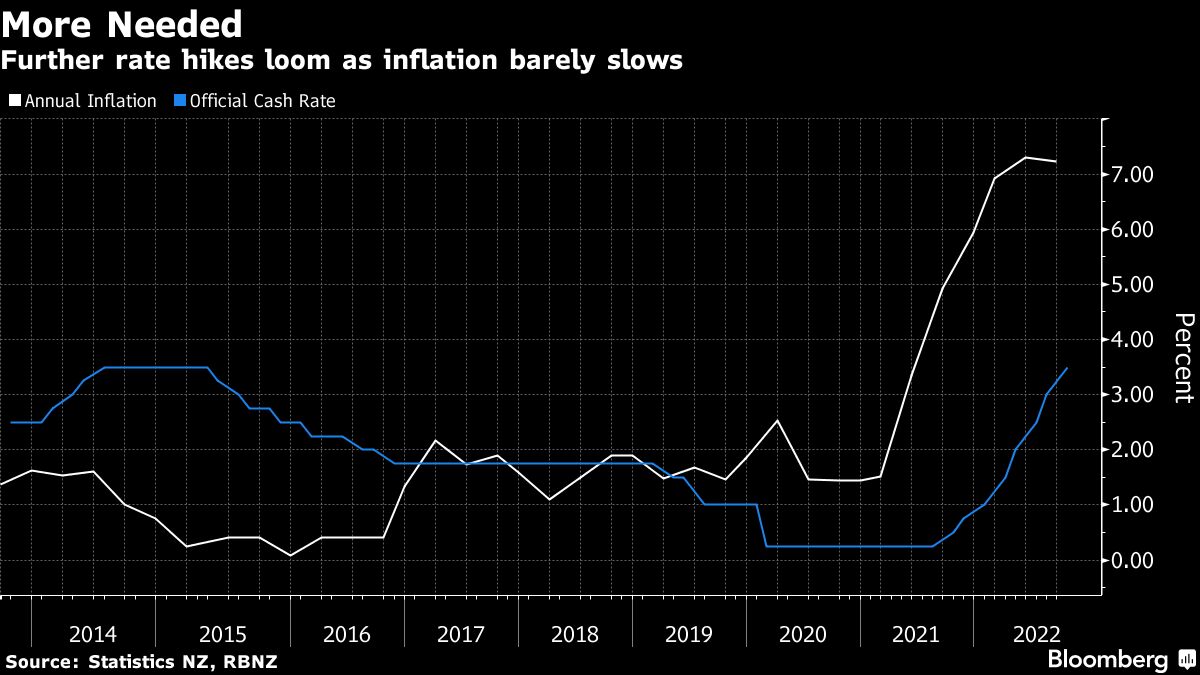
“This issue is relevant in the context of the recent persistence of inflationary pressures, which have led to expectations that inflation will remain above target for several years,” the document, dated Sept. 1, says.
It says that the RBNZ “is intending to discuss the width of the inflation target band, whether an explicit mid-point should be retained, and the horizon for the price stability target in its Remit advice.”
The RBNZ’s current remit states that it should try to keep future annual inflation between 1% and 3% with a focus on the 2% midpoint “over the medium term,” and also support maximum sustainable employment.
Both the RBNZ and the Treasury are due to advise Robertson on any recommended changes to the remit next year.
A new remit must be issued by February 2024.
The Treasury document says the charter that governs the RBNZ’s Monetary Policy Committee should also be reviewed “to evaluate whether it is necessary or desirable to replace it whenever a new Remit is issued.”
The charter is an agreement between the finance minister and the MPC that outlines how decisions will be made, how the MPC will be transparent and accountable, and how it will handle external communications.
“Two areas that we recommend you request the RBNZ to consider are whether changes to the Charter should be made to support greater transparency about the range of views within the MPC, and to incentivize individual MPC members to be more visible and accountable to the public,” Treasury says.
“The review of the Charter could also include an assessment of whether the current consensus-based decision-making model remains the best option,” it said.
Under the current charter, the MPC aims to reach a consensus decision with a vote taking place if consensus cannot be reached.
So far, no votes have been documented in the MPC’s record of meeting issued in conjunction with policy decisions.
“There is no public record of any voting taking place at the MPC even during the Covid-19 period when uncertainty levels were (and remain) elevated,” Treasury says.
Treasury also suggested external MPC members, who have almost never made public comments in their roles since the committee was established in 2019, could become more accountable by giving speeches.
More stories like this are available on bloomberg.com
©2022 Bloomberg L.
P.