
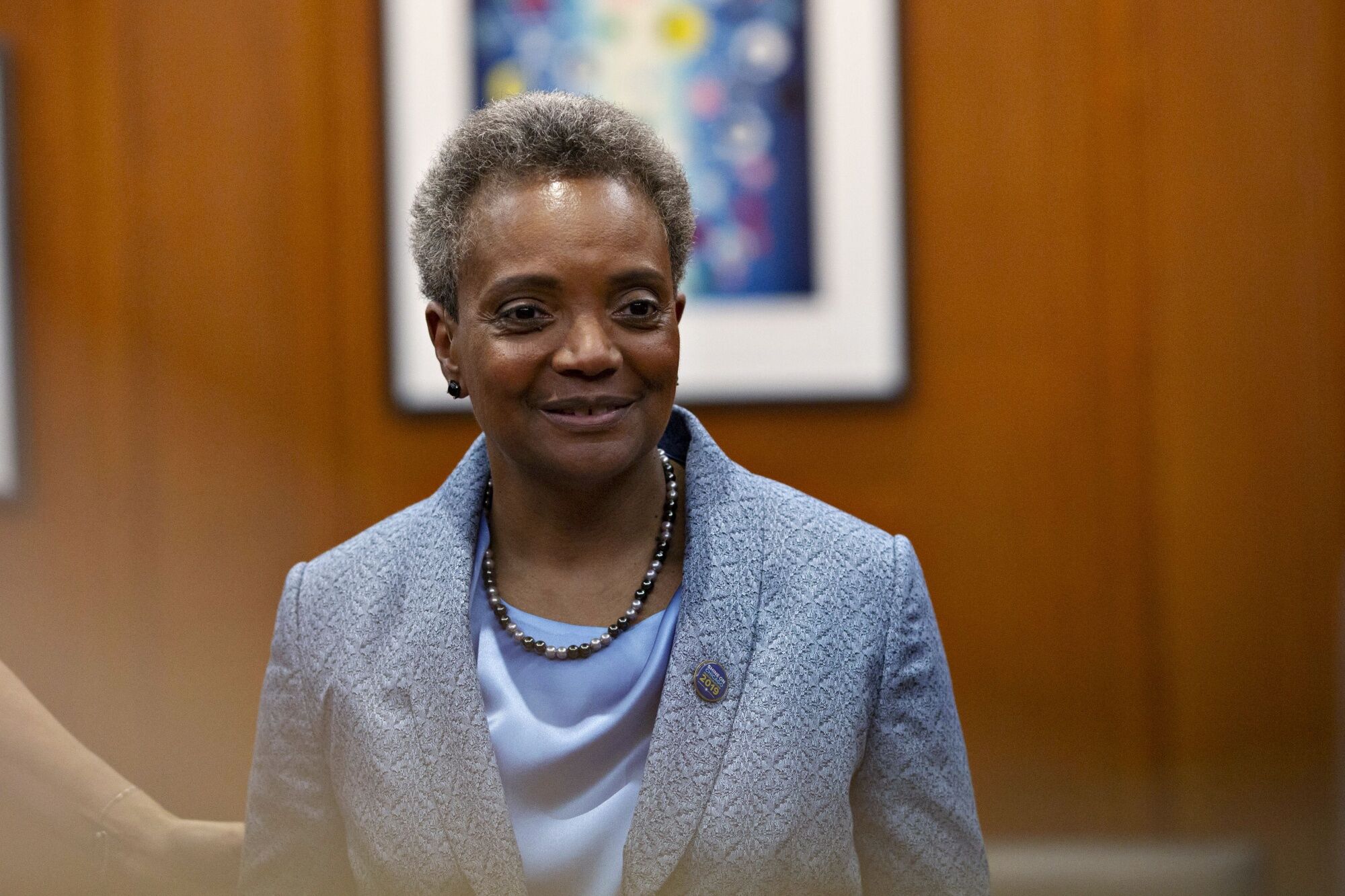
(Bloomberg) — Chicago Mayor Lori Lightfoot defended her public safety strategy on Wednesday after city council members, residents and a watchdog group expressed concerns over police department staffing and a lack of budget transparency.
The mayor has proposed an additional $100 million for violence prevention and public safety in her $16.4 billion budget for 2023, with total public safety spending accounting for nearly half of general fund expenditures.
The increase includes a 3% boost for the police department that would bring its budget to $1.94 billion. Lightfoot has said some of the police money would also go to more helicopters and updated vehicles.
But aldermen, residents and a watchdog group say the city needs to be more transparent about the additional public safety spending in the budget. And they raised concerns about the police department’s ability to recruit and retain officers, as well as comply with a 2019 federal consent decree and achieve its goals of community policing.
The department’s “funding grows nearly every year, yet there continues to be a serious lack of effort to increase efficiency or transparency over how those resources are being used,” said Loren Jones, an organizer with Empowering Communities for Public Safety, at a police oversight commission meeting on Monday.
During a police department budget meeting on Friday, city officials touted that 693 new recruits have begun police training this year, more than the last three years combined.
But departures and retirements since 2020 have outweighed those figures. Overall, the department has seen a net loss of around 1,700 officers since Lightfoot took office, and as of October has a vacancy rate of close to 13%.
“We’re not questioning whether the mayor is committed to constitutional policing and the consent decree,” said Laurence Msall, president of the watchdog Civic Federation.
But those programs, he said, require “adequate police staffing so you can keep patrols in the neighborhood, so they have familiarity.”
High vacancies also mean more overtime for existing officers, Superintendent of the Chicago Police Department David Brown said. The police department has already blown $12 million past its $100 million allocation for 2022, a trend that Brown attributed to more special events, such as the Pride Parade, that require additional security.
The city’s office of financial analysis projects that total overtime spending in 2022 could top $170 million.
“We budget a certain amount, but we have always exceeded that,” Brown said.
At a police budget hearing Friday, aldermen questioned the beleaguered department’s ability to curb overall crime, including carjacking complaints and transit concerns. Citywide, crime is up 39% compared to this time last year –- driven primarily by theft, police statistics show.
But there has been a 12% drop in shootings and homicides, and Lightfoot on Friday highlighted that the 15 neighborhoods which have historically driven half of Chicago’s overall crime have witnessed double-digit declines.
“My constituents are tired — there’s no other way to put this,” said Alderman Jason Ervin, who chairs the city council’s Black caucus, of open-air drug markets on the city’s west side. “We’ve got to figure something out on enforcement.”
Related: Chicago Plans to Speed Up Vacant Lot Sales in Bid to Curb Crime
As the mayor highlighted additional investments in public safety infrastructure, several community organizers expressed concern during a public comment period Wednesday about the city’s continuation of a nearly $9 million contract with ShotSpotter, a gun detection technology that Chicago’s Office of Inspector General has found to be ineffective.
The Inspector General’s report “did not specifically suggest that ShotSpotter alerts are not indicative of actual gunfire,” according to a statement from the company.
It is “wrong” to call an alert without immediate evidence of a crime a “false alert,” the company said.
Community organizers asked the city to instead allocate the money from that contract to a Treatment Not Trauma ordinance, which would expand a program that dispatches mental health clinicians and emergency medical responders to some 911 calls and increase funding for city-run mental health clinics.
Others have also called on the city to allocate funding from vacant police positions to the pilot.
On Wednesday, Lightfoot seemed to agree with a more holistic approach, emphasizing that law enforcement alone cannot fully address violence.
“Public safety comes in many different forms,” Lightfoot said. “Obviously the money that we provide to the police department on a regular basis, that’s a big chunk of it.
But we also have invested heavily in things like street outreach, mental health supports, economic supports, supports for our young people.”
(Updates story published on Oct. 26 with statement from ShotSpotter in 12th paragraph.)
More stories like this are available on bloomberg.com
©2022 Bloomberg L. P.