
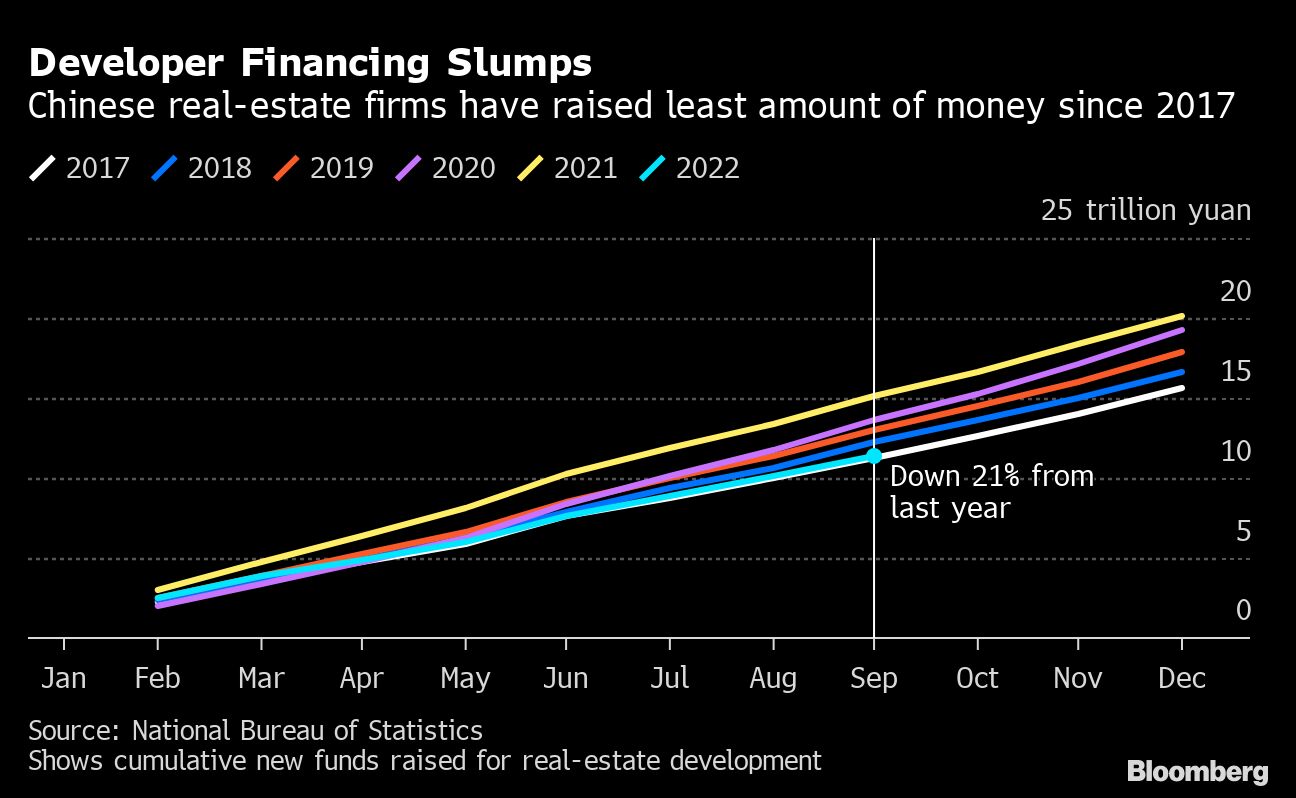
(Bloomberg) — China expanded a key financing support program designed for private firms including real estate companies, a move that promises to help developers sell more bonds and ease their liquidity woes.
The National Association of Financial Market Institutional Investors widened the bond financing program to about 250 billion yuan ($34.5 billion) for private companies including developers, the regulator said in a statement, without specifying the previous size of the quota.
The ways to support such financing include bond guarantees, credit enhancement and bond purchases, it said, adding that the move is part of efforts to stabilize the economy and could be expanded further if needed.
The additional aid came after People’s Bank of China Deputy Governor Pan Gongsheng called for more support for bond sales by private developers last month as distress mounts following record defaults.
The broader property crisis has shut most private developers out of the market for bond financing both domestically and offshore.
The statement didn’t say how much bond financing has been supported, or how much aid is meant for developers, but Pan said in 2018 that an initial estimate of the program showed it can support as much as 160 billion yuan in bond sales. He also said back then that the financing tool was not intended for private developers or companies in industries with overcapacity.
NAFMII, as the regulator is known, has recently organized credit enhancement support for some private developers and achieved “good effects,” the statement said.
As the size and scope of the program expands further in the future, it will have a bigger role in bolstering investor confidence and expanding private companies’ financings, it said.
The program could help the private sector, but might not be sufficient to completely address the issues real estate companies are facing, said Lu Ting, chief China economist at Nomura Holdings Inc.
“Developers still face mounting bond repayment pressures in coming months,” Lu said. “We expect no major policy changes in the property sector until at least March 2023.”
–With assistance from Alice Huang and James Mayger.
(Updates with comments from Nomura in sixth paragraph)
More stories like this are available on bloomberg.com
©2022 Bloomberg L.
P.