
(Bloomberg) —
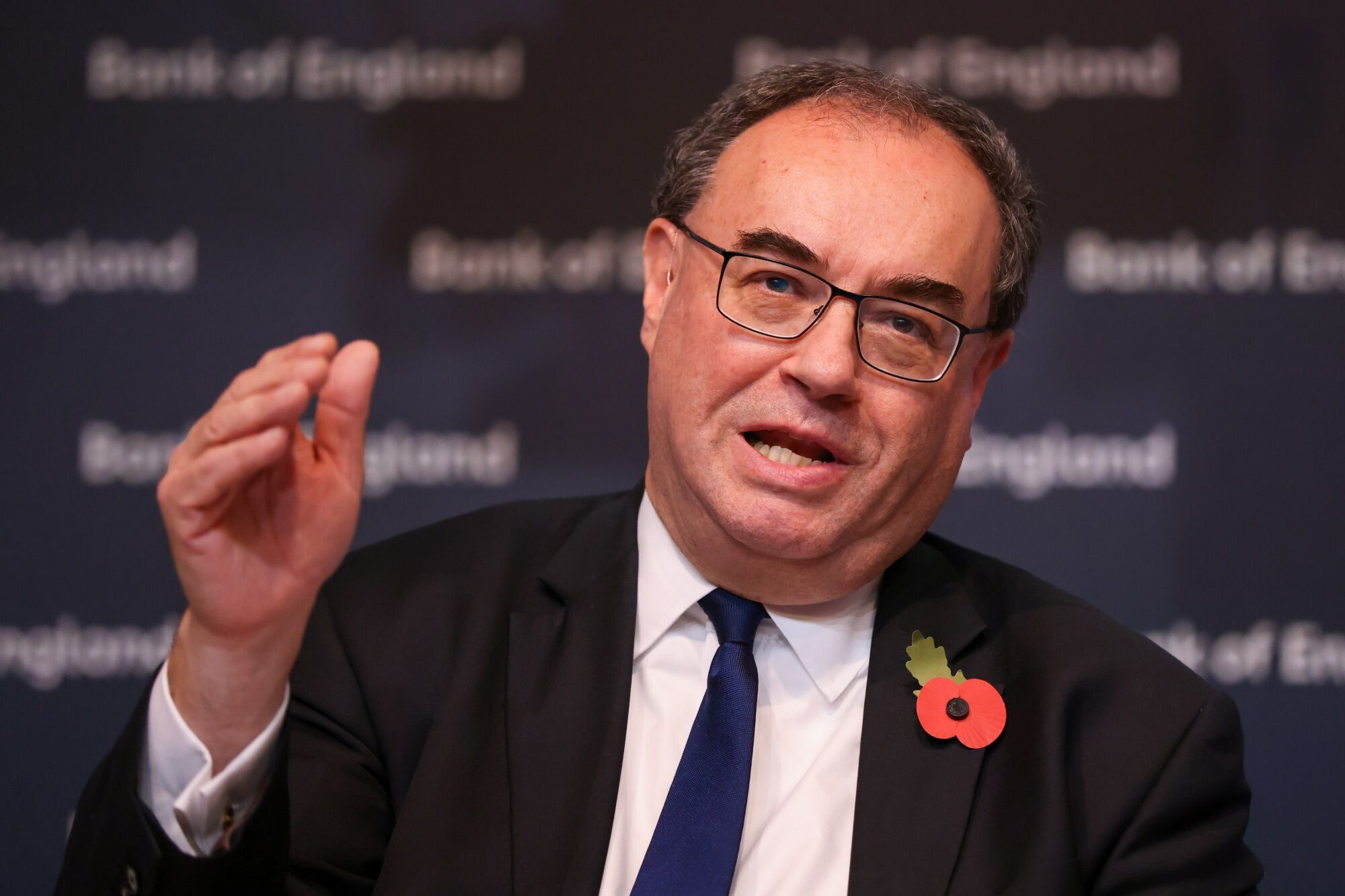
Bank of England Governor Andrew Bailey rejected the notion that he helped contribute to the downfall of Prime Minister Liz Truss, saying extending a market intervention would have created more problems.
Speaking in an interview, Bailey said he disagreed with a column by Narayana Kocherlakota, a former president of the Federal Reserve Bank of Minneapolis, who wrote that the UK central bank is to blame for the market turmoil that led to Truss’s departure.
Kocherlakota said the BOE’s failure to regulate pension funds properly along with its decision to pull the plug on a emergency support for bond markets meant that it was the central bank that forced Truss to quit.
“That I’m afraid is wrong,” Bailey said in an interview with Bloomberg Television on Thursday. “If we had gone on longer than that, we would have created a moral hazard problem” where investors think the central bank will always step in to protect them.
The episode concerns the BOE’s decision to extend emergency funding to a $1 trillion corner of the UK bond market that follows liability-driven investment strategies or LDIs.
That market froze up in the wake of a fiscal plan published by Truss’s government on Sept. 23, pledging a big increase in government borrowing to fund tax cuts.
UK bonds plunged, forcing LDI funds to cash in long-dated bonds. The BOE stepped in on Sept. 28 with emergency purchases of those bonds, saying at the time its action would be limited until Oct. 14. Markets were rattled again when Bailey, speaking in Washington on Oct. 11, said funds had three more days to bring order to their positions before the BOE ended its support.
Truss decided to resign the next week.
“The way the Truss government collapsed should concern all who support democracy,” Kocherlakota wrote in a column for Bloomberg. “The prime minister was seeking to fulfill her campaign promises. She was thwarted not by markets, but by a hole in financial regulation — a hole that the Bank of England proved strangely unwilling to plug.”
Bailey said the BOE’s intervention was always designed to be short-term to prevent a meltdown in the market.
“Our intervention, as a central bank as it should be, was to address a precise financial stability problem,” Bailey told Sky News. “Our conclusion was that by the point that we said we would end that intervention we had restored stability to that part of the world, and I think all the evidence since then supports it.”
Asked directly whether he was responsible for Truss’s ouster, Bailey replied: “Of course we didn’t depose Liz Truss.
I would never do something like that.”
Read more:
- Markets Didn’t Oust Truss. The BOE Did: Narayana Kocherlakota
- BOE Tells Investors to Rein In Expectations for Rate Hikes
(Corrects second to last paragraph to show comment came from Sky News. Story first moved on Nov. 3.)
More stories like this are available on bloomberg.com
©2022 Bloomberg L.
P.