
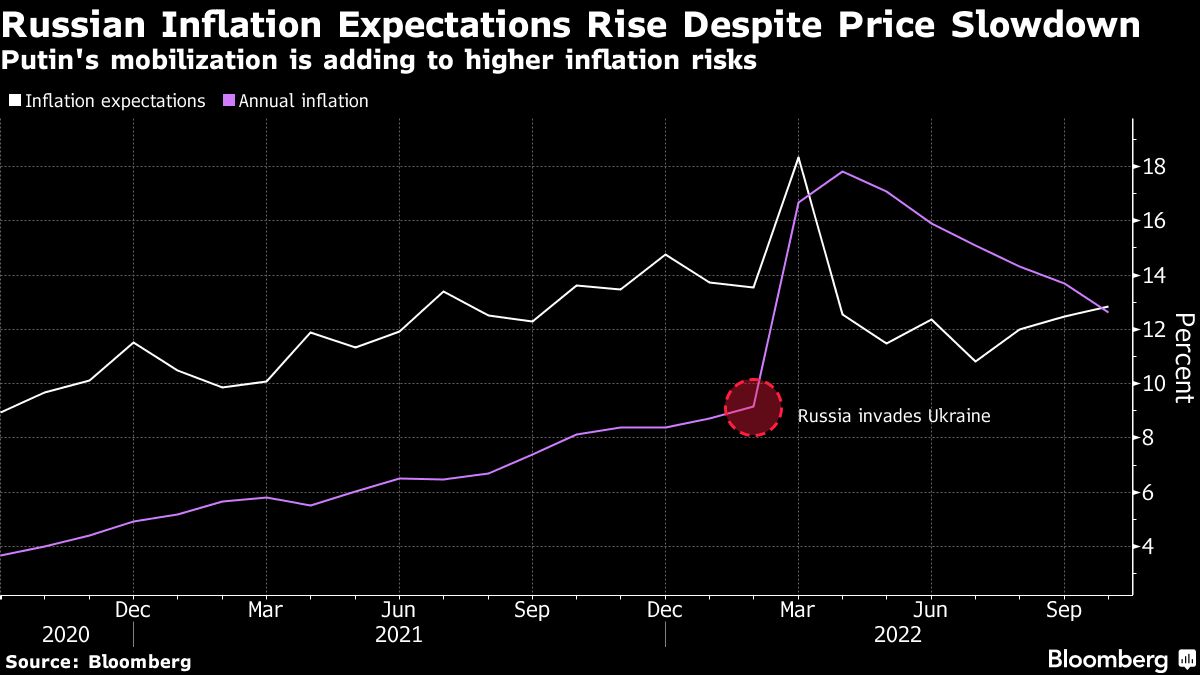
(Bloomberg) — Russian inflation decelerated to the lowest since President Vladimir Putin’s invasion of Ukraine, though risks are on the rise after the Kremlin’s call-up of reservists to fight in the war.
Data on Wednesday showed annual inflation slowed to 12.6% in October, a slightly larger decline than forecast by economists in a Bloomberg survey. It decelerated for a sixth month from a peak of almost 18% in April.
The mobilization, alongside an even bigger flight of men abroad, is unsettling already weak consumer demand by prompting households to put off spending.
But the enlistment of 300,000 reservists to join the fight will likely add to workforce shortages and push up wages.
“The mobilization and migration outflows have become a new shock to the poor consumer demand since the end of September,” said Olga Belenkaya, economist at Finam. “How consumer demand will fare in connection with the announced completion of the partial mobilization remains to be seen, but we don’t expect a significant increase in inflation by the end of the year.”
Although inflation galloped at the fastest in 20 years following the invasion, an emergency rate hike and massive gains in the ruble managed to put a brake on consumer prices.
A crash in consumer spending, combined with a seasonal drop in the cost of fruit and vegetables, have kept monthly inflation negative or just around zero since May.
The call-up, originally announced in late September, poses a threat to prices that Russia’s central bank highlighted at the end of last month as it held interest rates for the first time since the immediate aftermath of the attack on Ukraine.
The Bank of Russia, whose bias has turned “neutral” after an unprecedented cycle of monetary easing, now expects inflation to end this year at 12%-13% and reach 5%-7% at end-2023.
Putin said this week price growth could approach 5% or fall even lower in the first quarter of next year.
“The partial mobilization is leading to disinflation,” said Locko Bank economist Dmitry Polevoy. “Everyone is now tightening spending.”
What Bloomberg Economics Says…
“Inflationary pressures are back in Russia. That will keep the central bank from easing further in the fourth quarter.”
–Alexander Isakov, Russia economist.
For more, click here
But the outlook is shifting. The Bank of Russia has signaled a policy pause is likely after six rate cuts in a row brought the benchmark to 7.5%.
Weekly inflation already turned positive in September after a long stretch of declines, with price expectations of households growing for months.
An upward adjustment in state-administered utility tariffs will help keep inflation at 12% or higher toward the end of the year, according to Polevoy.
Bloomberg Economics forecasts price growth at 13.4% by December, which would be among the highest year-end readings in two decades.
The central bank has warned that beyond the coming months, the mobilization “will be pro-inflationary as it adds to supply-side restrictions in the broader economy.”
More stories like this are available on bloomberg.com
©2022 Bloomberg L.
P.