
(Bloomberg) — The European Central Bank has increased the amount of securities that central banks in the euro area can lend out against cash collateral, a bid to satisfy demand for high-quality liquid assets around year-end.
The limit on such transactions will be 250 billion euros ($250 billion) as of Nov. 10, compared with 150 billion euros previously, the ECB said in a statement. “This is a precautionary measure to ease collateral scarcity and support market functioning around the year-end,” said Executive Board member Isabel Schnabel in a tweet.
Years of bond purchases under the ECB’s quantitative easing programs have exacerbated a shortage of collateral in Europe, making it more expensive for traders to borrow securities in the repo markets and provide liquidity to clients.
The scarcity threatens to get more acute toward the end of the year as banks scale back on lending to meet regulatory requirements.
Last month, the International Capital Market Association warned dislocations could even hinder the ECB’s ability to tighten policy by keeping money-market rates depressed, and called on policy makers to address the issue.
“This is only one of the many factors conspiring to lower collateral scarcity going forward,” said Antoine Bouvet, strategist at ING Groep NV.
A decision by the German finance agency to increase securities lending, collateral released by early repayment of ECB pandemic-era loans to banks and eventually quantitative tightening could also help, he added.
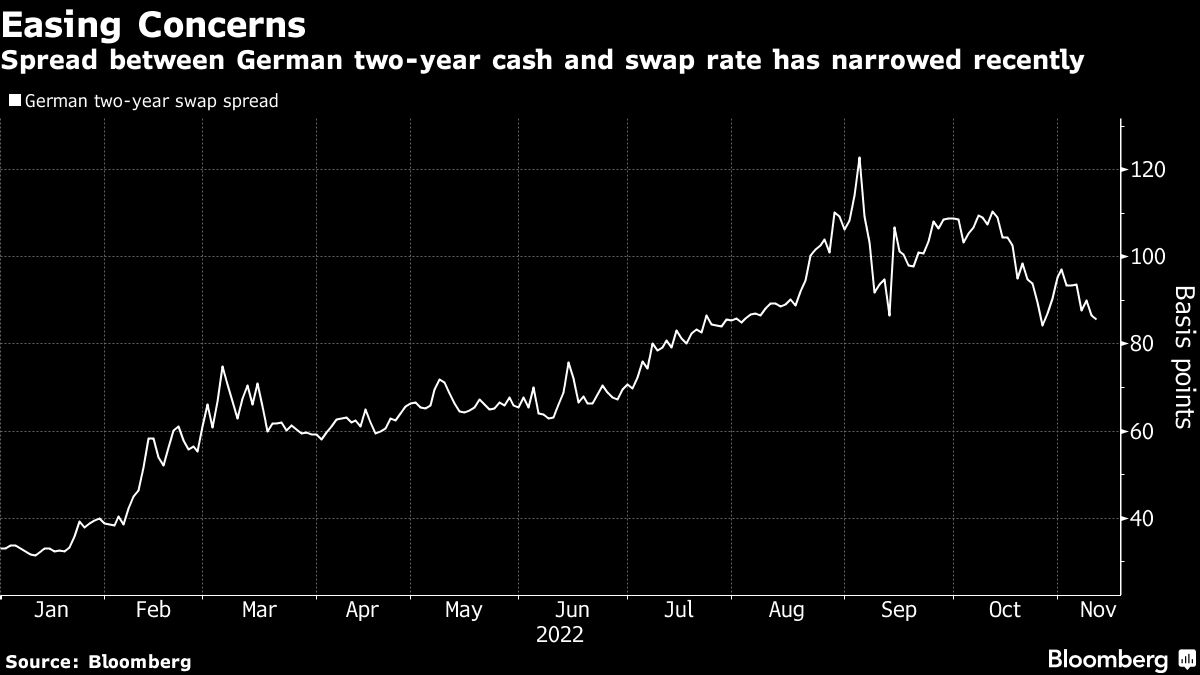
Demand for German collateral, the haven asset in the euro-zone, has been particularly strong this year. The German two-year swap spread – the difference between the yield on two-year bonds and the equivalent swap rate — has narrowed about 35 basis points from a record high in September.
The spread, a gauge of collateral scarcity, narrowed marginally after the decision.
–With assistance from Alice Gledhill and Greg Ritchie.
More stories like this are available on bloomberg.com
©2022 Bloomberg L. P.