
(Bloomberg) — The European Central Bank may need to increase interest rates to a level that puts a brake on the economy in order to get prices under control, according to three of its top officials.
Executive Board member Isabel Schnabel said in Ljubljana that hiking rates to a “neutral” setting won’t be enough to tame record inflation, even if the odds of a euro-area recession are on the rise.
The sentiment was echoed by Slovenian central bank chief Bostjan Vasle and his Slovak counterpart, Peter Kazimir.
“There is no time for monetary policy to pause,” Schnabel said at the event. “We will need to raise rates further, probably into restrictive territory, to bring inflation back to our medium-term inflation target in a timely manner.”
The comments by the hawkish-leaning members of the Governing Council signal a determination to keep raising borrowing costs well beyond the end of the year.
A level that neither restricts nor stimulates the economy is thought to be somewhere near 2%, whereas the ECB’s deposit rate currently stands at 1.5%.
The ECB already hiked by 200 basis points in three meetings, the most aggressive tightening in its history. Policy makers will have to decide whether to go for a third straight 75 basis-point increase in December, or whether they can afford to slow down.
“What’s needed in my opinion are further increases in interest rates, and here we’ll most probably have to go beyond the levels which are currently understood as neutral rates,” Vasle said.
Kazimir agreed, saying the time for accommodative monetary policy was over. “We’ll have to go further, more to the restrictive part,” he said.
The euro area is increasingly expected to fall into recession as consumers and companies suffer from surging energy costs.
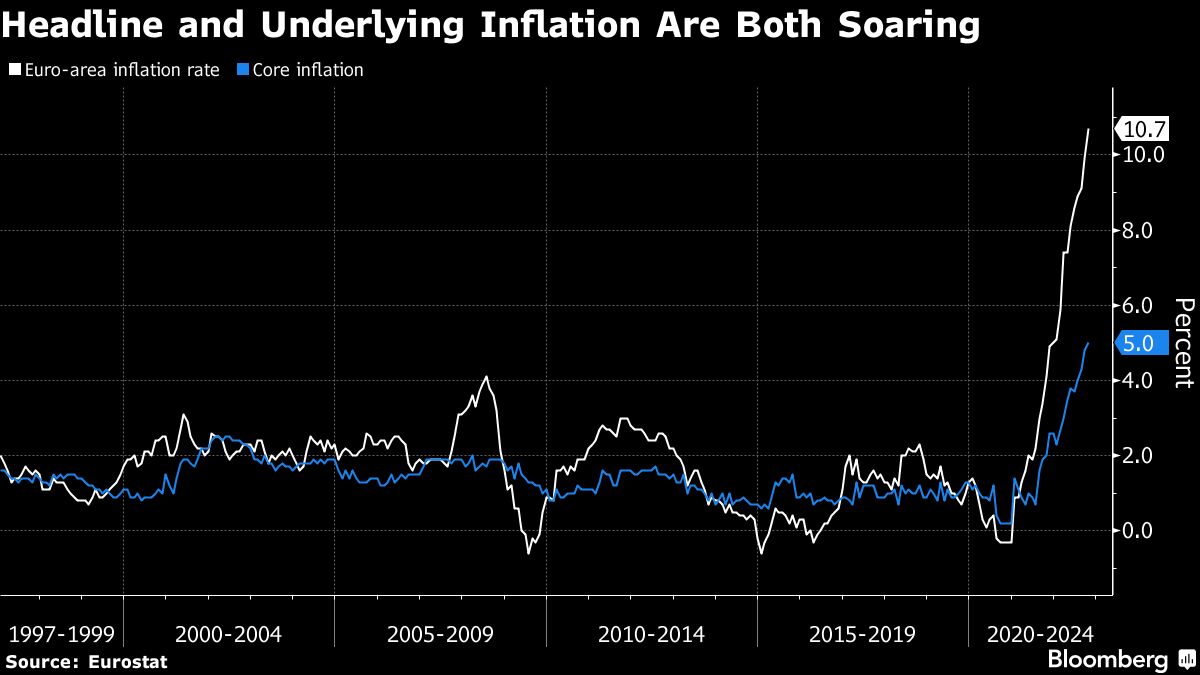
Officials including President Christine Lagarde have however said that the contraction probably won’t be severe enough to get prices under control. Inflation accelerated to a fresh high of 10.7% last month.
“It’s clear that the risk of a recession has gone up, given the data that we’ve seen,” Schnabel said. “There’s the impression that if there’s a recession, this recession probably is not going to be very deep and not very prolonged.”
This means it may “not be sufficient to bring inflation down as much as is needed in order to get back to our inflation target over the medium term,” she said.
More stories like this are available on bloomberg.com
©2022 Bloomberg L.
P.