
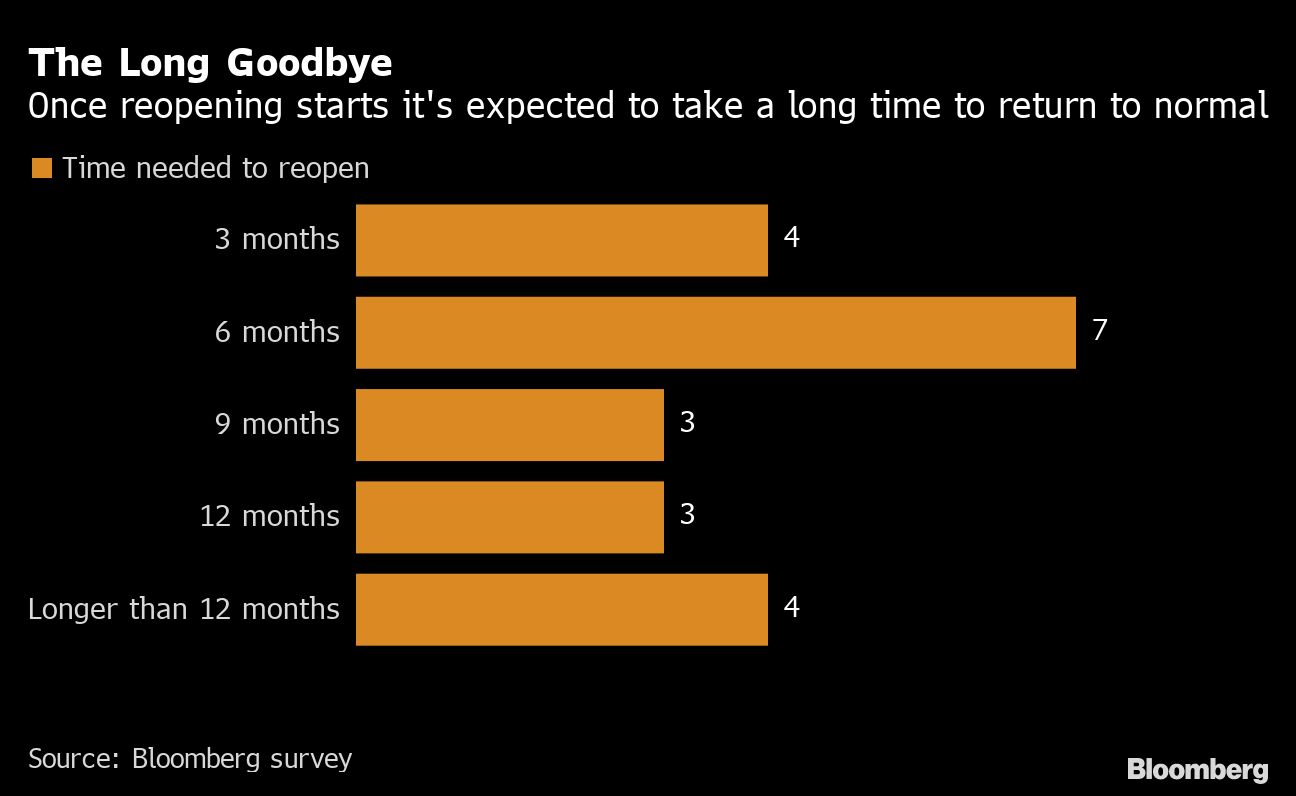
(Bloomberg) — China’s exit from the Covid pandemic could run through the end of next year, with reopening only starting sometime from April and a slow return to normality likely weighing on investors’ hopes for a quick economic recovery, according to a survey of economists.
Almost half of the 23 economists surveyed by Bloomberg News said they think reopening from Covid Zero will begin in the second quarter of 2023, after the parliamentary meeting which usually happens in early March.
Another seven said it will start in the July-September period, while two don’t expect change until sometime in 2024, which would be at least four years after the virus was first reported in Wuhan.
The Bloomberg survey asked respondents to choose a time period in which they expect a reopening to start but did not ask them to define what the initial steps might be.
The Chinese government has given no public indication on the timing of an exit from the current policy, which combines mass testing with movement controls and lockdowns to stop infections.
However, maintaining Covid Zero is becoming more disruptive and expensive, fueling expectations that sooner or later Beijing will need to shift and start reopening, both domestically and internationally.
The nation’s top leaders appeared to recognize that at a meeting on Thursday, which urged officials be more targeted with their restrictions while stressing the need to stick with the Covid Zero policy.
The Politburo statement said “the epidemic’s impact on economic and social development ought to be minimized,” and called for “more resolute and decisive anti-epidemic measures” so that the country can “restore the normal order of work and life as soon as possible.”
The timing of when the government starts to reduce the restrictions which are weighing on consumption and investment is the key question for economists as they assess next year’s outlook.
Any recovery will hinge on how quickly people start spending money again after Covid curbs are eased, according to UBS Group AG, given the economy won’t be able to rely as much on help from exports and infrastructure investment.
“When the pivot to living with the virus does begin, it will unleash significant demand, according to a report from Bloomberg Economics. Reopening “will boost GDP growth in the year that follows by as much as 1.6 percentage points,” with sectors such as transport, hospitality and retail to see the biggest uplift, the report said.
Even with a relaxation in Covid rules, Shu said the economy “will still face strong headwinds from the downturn in property and weakening external demand.” Assuming Covid Zero is lifted in the second half of the year, growth should pick up to 5.7% in 2023 from 3.5% this year, she wrote.
It might also take lot longer than some in markets are expecting for domestic travel, private consumption and business activity to return to normal.
That’s because China may face a big wave of infections and deaths once it loosens restrictions, if the experiences of other places in the Asia Pacific region where similar Covid policies were implemented are a guide.
Taiwan, Australia and New Zealand all experienced a swift rise in cases and deaths for a time after they loosened their restrictions, even with high levels of vaccination and prior outbreaks.
Expected Deaths
The situation might be even worse in China, which faces an “immunity gap” because it has successfully protected the vast majority of its 1.4 billion people from exposure to the virus.
A May study by researchers at Shanghai’s Fudan University gave one forecast of what could happen if the government were to allow the omicron variant to spread unchecked: a “tsunami” of infections resulting in 1.6 million deaths.
Even if China reopens much more slowly and cautiously, it would still face problems. If the country can keep deaths down to the level of Singapore, which has had the lowest per capita rate among developed nations, it would suffer more than 400,000 Covid fatalities.
If deaths rose to the level of Australia, where most deaths happened after that nation got rid of its own strict controls, more than 800,000 Chinese would die.
Whatever the magnitude, mass death in a short period of time will likely shock a population which so far has only seen around 5,000 confirmed deaths from the virus in the past two-and-a-half years. Even if that doesn’t prompt local governments around the country to temporarily pull back on reopening measures, it would likely mean many people would stay home instead of going out to spend and work, either out of caution or because they’re sick or caring for a family member who is.
“Exit won’t just be long and gradual, but could also involve some back-and-forth and false expectations” as policy relaxation is contingent on a host of factors, according to a recent report from consultancy Trivium China. “Businesses and investors should factor Zero Covid into their China plans for all of 2023.”
(Updates with Politburo statement in fifth paragraph.)
More stories like this are available on bloomberg.com
©2022 Bloomberg L.
P.