
(Bloomberg) — Applied Materials Inc., the biggest maker of chip-manufacturing equipment, gave a better-than-feared sales forecast for the current period as supply-chain improvements help offset an economic slowdown.
Fiscal first-quarter sales will be roughly $6.7 billion, the company said in a statement Thursday. That compares with an average analyst estimate of $6.34 billion.
The outlook brings fresh optimism that Applied Materials can weather a tumultuous stretch for the chip industry.
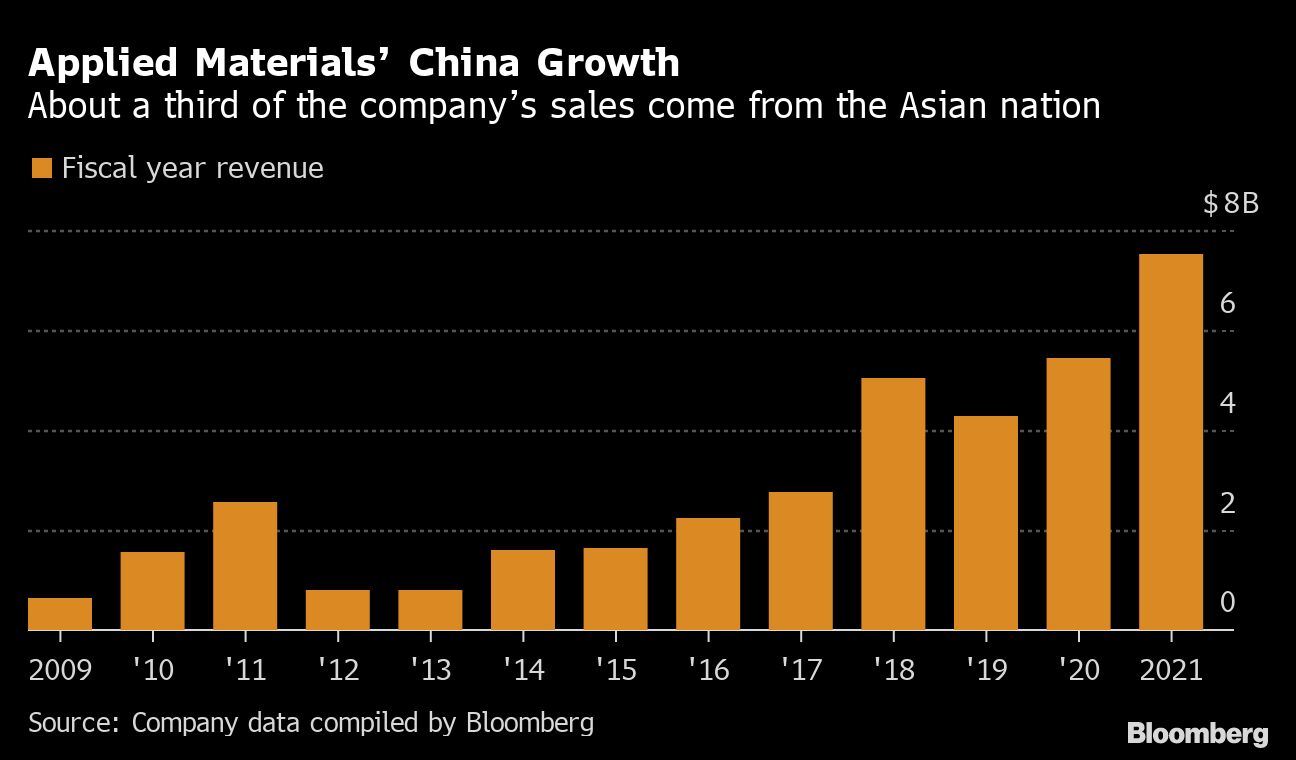
The company, like its peers, is facing twin headwinds: a collapse in orders for some types of chips and an escalating standoff between China and the US. Large customers such as Micron Technology Inc. and Intel Corp. have said they will cut budgets to cope with weaker demand. On the China front, Applied Materials has disclosed that sales into the country will be hundreds of millions of dollars shy of previous levels.
Applied Materials shares rose more than 2% in extended trading following the announcement.
They’d earlier closed at $104.45 Thursday, leaving them down 34% in 2022.
“We remain focused on mitigating supply chain constraints and doing everything possible to meet customer demand,” Chief Executive Officer Gary Dickerson said in a statement.
Read more: Micron warns that its outlook for 2023 has weakened
Fourth-quarter profit was $2.03 a share, excluding some items.
Sales rose 10% to $6.75 billion in the period, marking the 12th straight quarterly expansion. Analysts predicted a profit of $1.68 a share and revenue of $6.38 billion.
In October, Applied Materials slashed its forecast for the fourth quarter, warning that the new export regulations would reduce sales by about $400 million. The Santa Clara, California-based company projected revenue of about $6.4 billion and said the rules would continue to weigh on its financial performance in the fiscal first quarter, ending in January.
The Biden White House announced the latest export curbs Oct. 7, part of a campaign to halt China’s ability to develop the most advanced chips and equip its military.
Applied Materials and a handful of companies — US peers KLA Corp. and Lam Research Corp., the Netherlands’ ASML NV and Japan’s Tokyo Electron Ltd. — totally dominate the market for machines needed to make semiconductors. In addition to imposing rules on US companies, the administration is negotiating with European and Japanese governments to get them to do the same with their businesses.
Read more: Chip industry braces for ‘heavy blow’ from China rules
The restrictions come at a tough time for the industry.
After shortages during the pandemic, chipmakers had rushed to build new production. But now companies are looking to trim their budgets. The demand for PC-related chips has fallen as customers shun big-ticket purchases, and that’s weighed on chip stocks. The Philadelphia Stock Exchange Semiconductor Index, a key benchmark, has dropped 31% this year.
Companies such as Applied Materials and Intel can’t easily walk away from China, which is the biggest single market for their products and part of a global supply chain for electronics.
More stories like this are available on bloomberg.com
©2022 Bloomberg L.
P.