
(Bloomberg) — The long-awaited policy rescue for Chinese developers finally landed this month to ease a severe liquidity crunch. The hurdle of collapsing home demand may prove just as steep a challenge.
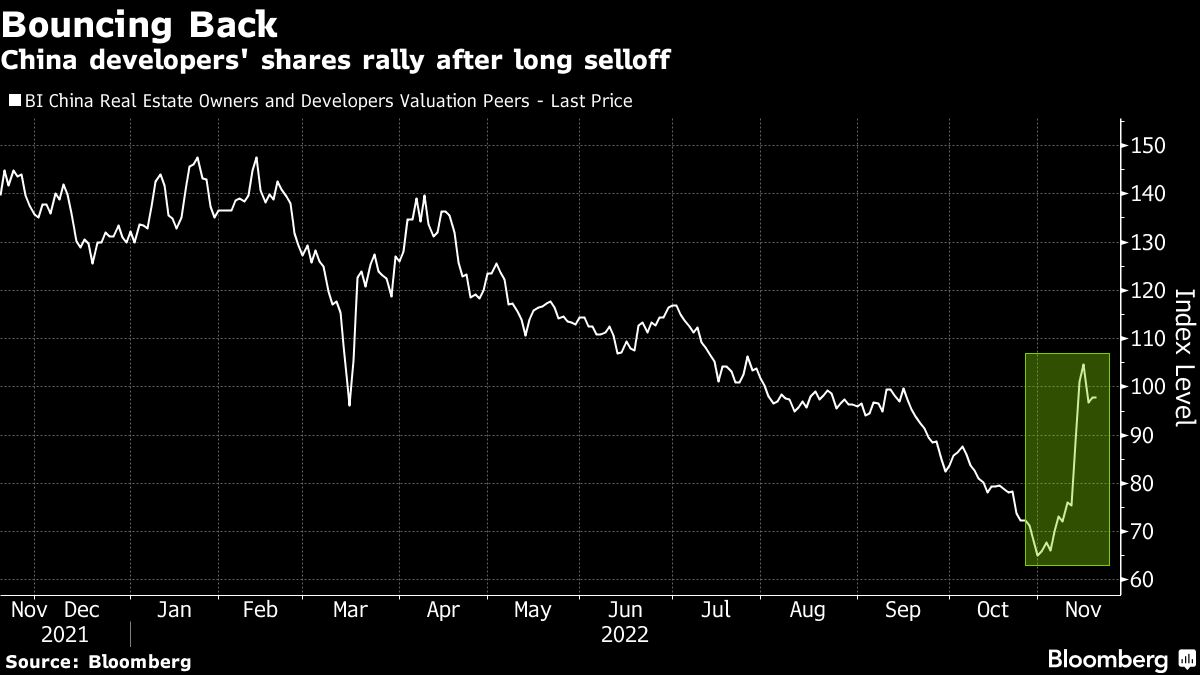
Assets linked to the nation’s fragile real-estate sector have rallied over the past two weeks after regulators introduced directives that addressed everything from companies’ liquidity problems to the use of pre-sales funds.
While the efforts cheered investors, a report this week showed new home prices fell for a 14th month, while Moody’s investors Service predicted sales would drop as much as 15%.
“I don’t think the support measures are adequate as long as home-buyers’ sentiment and contracted sales remain depressed,” said Zerlina Zeng, an analyst at Creditsights Singapore LLC. “Most of the measures are targeted at containing systemic and tail risk rather than bailing out bondholders,” and it will also take time to “see the real transmission of these policies,” she said.
The support measures introduced in the past week spurred record gains in the shares of developers, and helped to drive Hong Kong’s stock gauges into a bull market.
Loomis Sayles & Co. described them as a “game changer” that may help restructure an industry beset by defaults and halted construction. A gauge tracking China junk dollar bonds, mostly from property companies, advanced 6.2 cents this week on the dollar to 58.5 cents, rebounding from historic lows.
Read More: China’s Property Rescue Is a ‘Game Changer,’ Loomis’s Eagan Says
A Bloomberg index of Chinese builders rallied another 8% this week, following a record 27% surge last week.
They gave up some their gains on Friday, dropping 2%. Regulators issued a 16-point plan for boosting the real-estate market on Nov. 11, and the authorities followed that up on Nov. 14 by saying they’re allowing developers to access more money from home pre-sales, the industry’s biggest source of funds.
Slumping Prices
Optimism was tempered a few days later when a government report showed home prices slumped the most in seven years in October.
New-home prices in 70 cities slid 0.37% from September, the National Bureau of Statistics said. The existing-home market dropped 0.47%, the most since 2014.
“Under the current policy, changes on the demand side remain to be seen, and thus the magnitude and sustainability of the improvement in credit conditions of real-estate companies also needs to be continued to be observed,” said Yewei Yang, chief bond analyst at Guosheng Securities.
China’s contracted property sales will decline 10% to 15% by the end of next year, Moody’s investors Service said in a report his week.
Recent measures to help the industry will only “slowly take effect and lead to a gradual recovery,” it said.
This month’s property rescue package will mainly benefit private developers that have yet to default, according to analysts following the industry. The nation’s largest developer Country Garden Holdings Co. was the first to take advantage by making a share placement following the weekend’s news.
The biggest gainers in offshore bonds this week have been Seazen Group Ltd., Country Garden and Gemdale Ever Prosperity Investment Ltd., according to a Bloomberg high-yield index.
All three have returned more than 100% in the past week. Developers that lagged behind include Zhongliang Holdings Group Co., which lost 1.6% in the past week as it suspended all offshore payments.
Earlier this month, an analyst at Loomis Sayles said the crisis in Chinese property dollar bonds was so extreme that meaningful analysis is no longer possible.
“Policy guidance on extending loan terms and bond repayments should help larger and financially stronger developers,” Chang Wei Liang, a macro strategist at DBS Bank Ltd. in Singapore, wrote in a research note. “Entities that have already defaulted, or are already teetering on the edge of default, are not likely to benefit.”
–With assistance from Alice Huang, John Cheng and Lorretta Chen.
More stories like this are available on bloomberg.com
©2022 Bloomberg L.
P.