
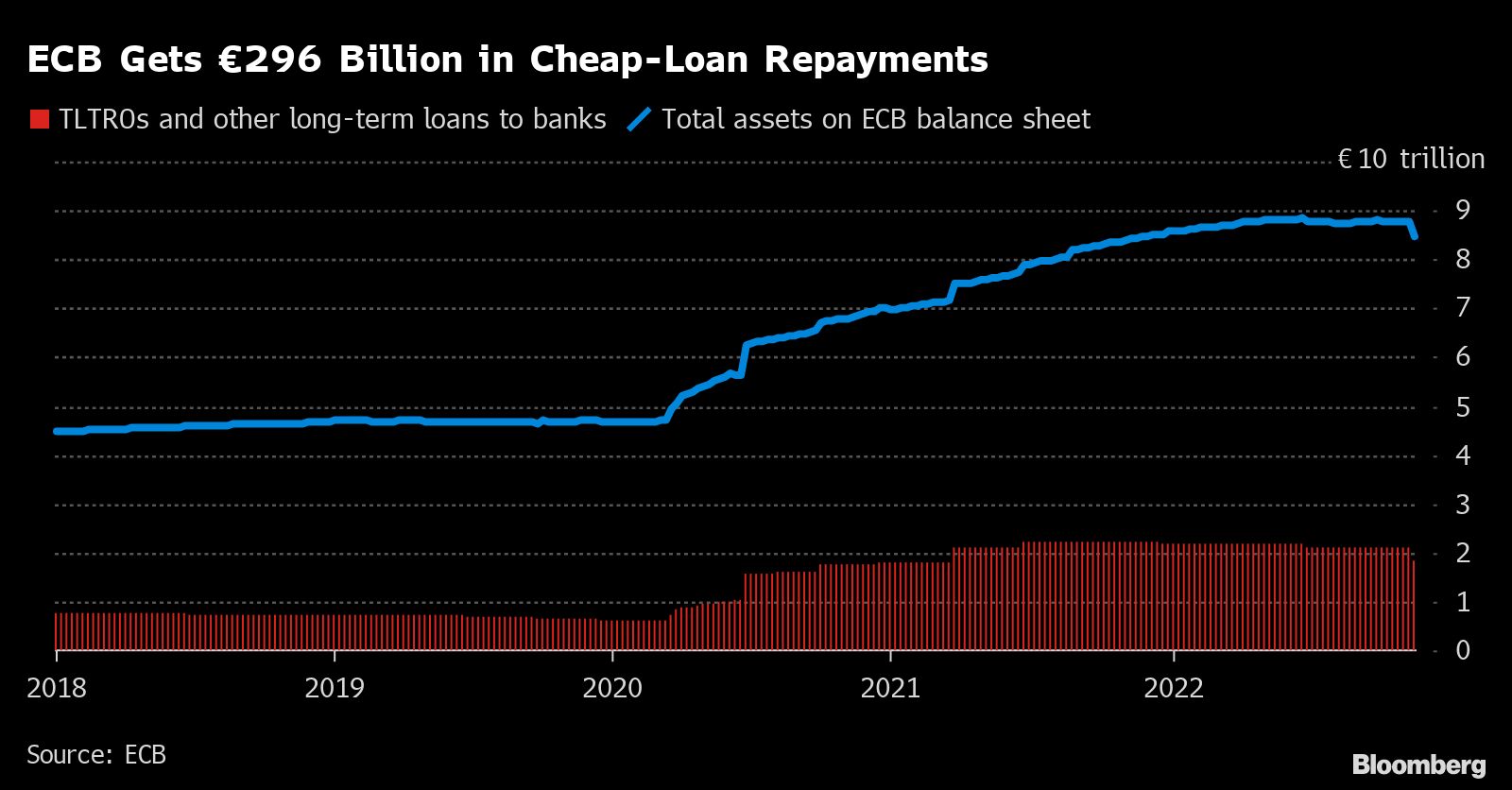
(Bloomberg) — Banks will return €296.3 billion ($308 billion) of cheap loans to the European Central Bank after their terms were toughened to help the battle against record inflation.
The repayment represents just under 15% of the total outstanding amount of so-called TLTRO loans, which were used during the pandemic to keep credit flowing to households and businesses. The median forecast in a Bloomberg poll this month was for €600 billion to be given back.
The projections ranged from €200 billion to €1.5 trillion.
German two-year bonds erased losses and outperformed equivalent interest-rate swaps after the data. The spread between yields and swap rates widened two basis points to around 84 basis points.
The smaller-than-expected repayment may not be what the ECB was hoping for. Officials have fretted that the shift in economic conditions since the TLTRO program was rolled out means the loans risk distorting their efforts to tame soaring prices, while also worsening a shortage of collateral needed for money markets to operate effectively.
Officials in October announced an increase in the cost of TLTRO financing from Nov. 23, putting a stop to banks earning a risk-free income by parking cash from the program back at the ECB.
The retroactive measure sparked complaints by some lenders.
Jussi Hiljanen, a strategist at SEB who predicted banks would return €300 billion, cited several possible factors behind Friday’s number.
German and other core banks have only limited government-debt purchases financed by TLTROs “and continue to regard the loans as attractive from a cost perspective,” he said by email. “Generally, banks may have also preferred to maintain liquidity positions toward year-end and potential risks of market turbulence.”
Lenders will have further options for reimbursement in each of the next four months, and then on a quarterly basis.
The ECB has hiked its key interest rate at the most aggressive pace in its history to curb inflation that at 10.6% last month is more than five times the 2% target.
President Christine Lagarde said earlier Friday that borrowing costs may need to be lifted to levels that restrict economic expansion in order to drive down inflation.
The ECB is also set to discuss how to shrink the roughly €5 trillion stash of bonds purchased as stimulus during recent crises — a process known as QT.
What Bloomberg Economics Says:
“Banks in the euro area have only returned a fraction of their outstanding balances from the European Central Bank’s longer-term refinancing operations after the Governing Council decided last month to raise the interest rate on those loans.
The hawks at the ECB may add this to their list of reasons to begin QT early next year.”
–David Powell, senior euro-area economist. Click here for full REACT.
A plan for how to implement QT will be determined at the ECB’s December meeting. The process is expected to start sometime in the first half of 2023.
–With assistance from Harumi Ichikura and Greg Ritchie.
(Updates with analyst starting in sixth paragraph.)
More stories like this are available on bloomberg.com
©2022 Bloomberg L.
P.