
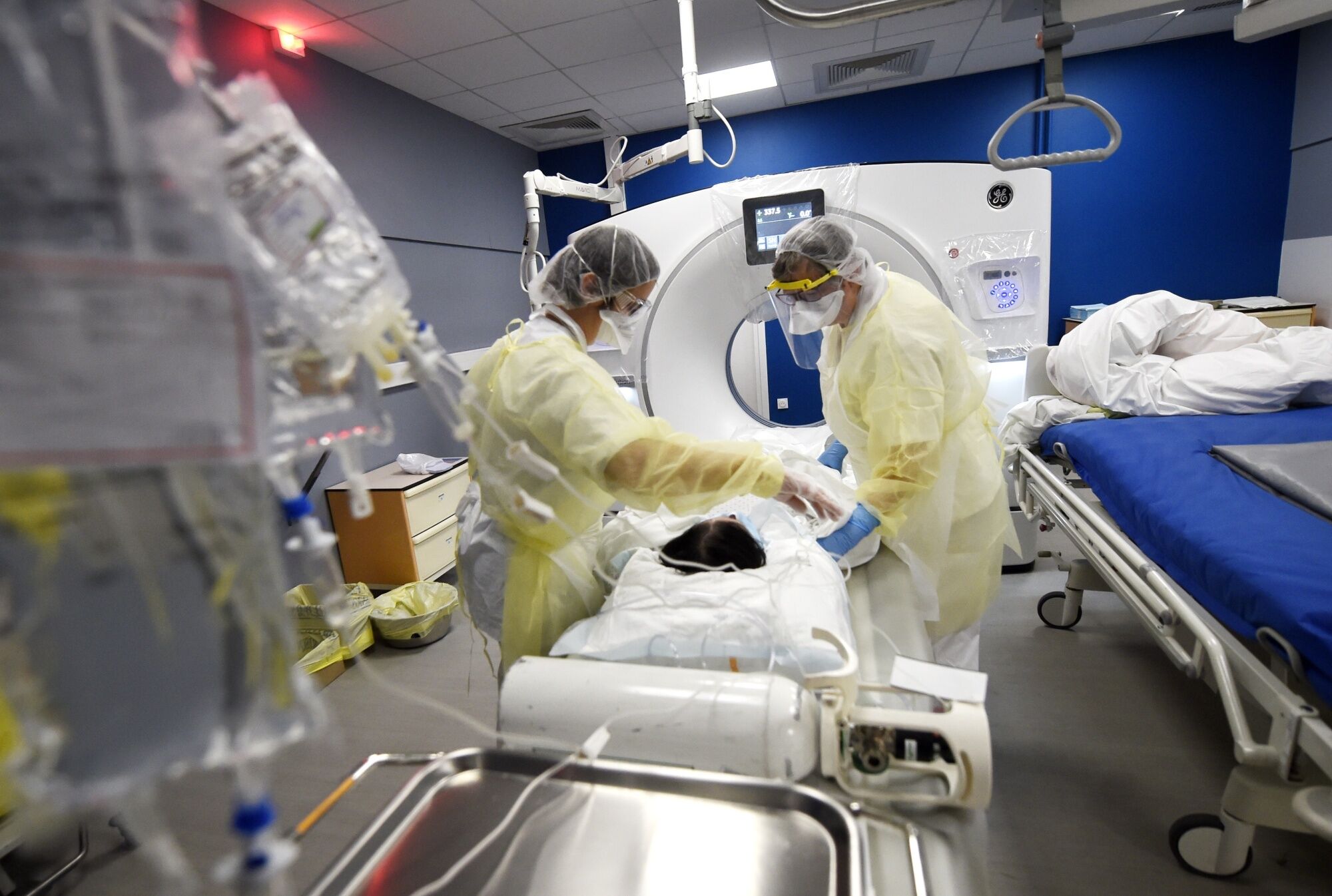
(Bloomberg) — President Donald Trump said Americans should begin returning to their everyday lives even if it leads to more sickness and death. German Chancellor Angela Merkel is set to hold talks on a further easing of restrictions, even as cases rose for the first time in six days.
Drug companies stepped up efforts to tackle the virus. Gilead Sciences said it’s working to ensure access to a treatment drug in Asia, Europe and the developing world and Regeneron Pharmaceuticals said an antibody treatment could be available as soon as this fall.
Insurance giant Axa SA said the health crisis will have a material impact on earnings this year, while UniCredit SpA and Credit Agricole SA joined lenders across the region in setting aside more cash for troubled loans as the economic shock swells defaults.
Key Developments
- Virus Tracker: global cases pass 3.6 million; deaths top 256,000
- China bristles as Trump pushes virus-from-lab theory
- Covid-19 research groups are being attacked by hackers
- Emerging-market survey sees Latin America biggest virus loser
Subscribe to a daily update on the virus from Bloomberg’s Prognosis team here.
Click VRUS on the terminal for news and data on the coronavirus. See this QuickTake on unanswered questions about the virus.
Ocado Revenue Soars (3:10 p.m. HK)
Ocado Group Plc’s retail revenue rose more than 40% in the second quarter as the U. K. online grocer’s sales were boosted by home shopping during the Covid-19 lockdown. The company suspended financial guidance for the year, saying uncertainty around the pandemic made it impossible to predict near-term sales trends.
The second-quarter’s gain was up from a 10% increase in the first quarter.
Novo Nordisk A/S also reported surging sales as patients snapped up medicines ahead of lockdowns.
France to Test Antipsychotic (3:01 p.m. HK)
France’s Sainte-Anne hospital will test the antipsychotic medicine chlorpromazine as a treatment for the new coronavirus after noticing that only 3% of psychiatric patients had been sickened, compared with 19% of hospital personnel who weren’t taking the drug, Le Parisien reported.
Chlorpromazine will be tested on 40 patients with severe forms of Covid-19.
Results of the study will be available in a month and may lead to broader clinical tests
German Factory Orders Slump (2:17 p.m. HK)
German factories saw demand collapse in March, when measures to contain the coronavirus brought the economy to a sudden halt. Orders fell 15.6% from the previous month, the most since data collection started in 1991 and more than economists predicted. While all sectors were affected, investment goods plunged heavily.
The Economy Ministry warned of big declines in production due to the virus.
The larger-than-consensus drop in German factory orders for March illustrates the scale of shutdowns in the euro-area’s biggest economy, writes Bloomberg Economist Jamie Rush.
German New Cases Rise Before Talks on Further Easing (1:46 p.m. HK)
The number of new coronavirus cases in Germany rose for the first time in six days ahead of talks between Chancellor Angela Merkel and regional leaders on a further easing of restrictions on public life.
There were 855 additional infections in the 24 hours through Wednesday morning, up from 488 the previous day and taking the total to 167,007, according to data from Johns Hopkins University.
The tracking tool reported no new fatalities from Tuesday, with the death toll staying at 6,993.
UniCredit Posts $2.9 Billion Loss (1:27 p.m. HK)
UniCredit SpA reported the second loss in a row as provisions related to the coronavirus added to the pain of one off costs for job cuts and the writedown of its Turkish unit.
The net loss totaled 2.71 billion euros ($2.94 billion), as loan-loss provisions climbed to 1.26 billion euros, the Milan-based bank said on Wednesday.
The lender’s main business was resilient in the first quarter, with income from fees and lending beating estimates.
Credit Agricole Sees Provision Surge (1pm HK)
Credit Agricole SA is setting aside almost three times the amount it booked a year ago to cover souring loans because of the impact of the coronavirus, the latest lender to try and estimate the damage to its balance sheet from the outbreak.
Provisions in the first three months of the year jumped to 621 million euros ($673 million) from 225 million euros a year earlier to take account of the worsening economic environment, the bank said in a statement on Wednesday.
China Urges U.
S. to End ‘Blame Game’ (12:18 p.m. HK)
China’s ambassador to Washington called for an end to the “blame game” over the coronavirus, in the country’s most high-profile response since U. S. President Donald Trump escalated his criticism of Beijing.
Ambassador Cui Tiankai said in a column published in the Washington Post that allegations blaming China for the outbreak’s spread risked “decoupling” the world’s two largest economies.
Increased suspicions also threatened to hurt U. S.-China cooperation to fight the disease and restart the global economy.
“It is time to end the blame game,” Cui said. “It is time to focus on the disease and rebuild trust between our two countries.”
India Has Record Virus Deaths (10 a.m. HK)
India’s fatalities due to the coronavirus rose 199 to 1,693, the biggest increase so far, while confirmed cases near 50,000, as the country’s citizens emerge from its strict 40-day, nationwide lockdown.
States are still dealing with pockets of unrest after Prime Minister Narendra Modi on Monday partially eased movement curbs across all but the worst infection-hit areas in an attempt to restart its stalled economy.
The economic crisis looks set to be one of Modi’s most serious challenges since he swept to power in 2014, with fears the nation could be heading for its first full-year contraction in more than four decades.
Latin America Seen as Biggest Loser From Virus (8:47 a.m.
HK)
The allure of Latin American assets has all but evaporated in the past three months, underscoring how portfolio allocations are being reshaped by the coronavirus pandemic that has already caused a $3 trillion loss in emerging markets.
A Bloomberg survey of 61 global investors, strategists and traders conducted last month found Latin America is expected to be the laggard for the second half of 2020 in stocks, currencies and bonds.
Asia regained the top spot for fixed-income securities, meaning it ranked highest in all three categories.
Read the last EM survey here.
Mesoblast Doses Patients in Trial (8:18 a.m. HK)
The first patients have been dosed in the 300-patient randomized placebo-controlled Phase 2/3 trial in the U. S. of Mesoblast’s allogeneic cellular medicine remestemcel-L in Covid-19 infected patients with moderate to severe acute respiratory distress syndrome on ventilator support.
Asia Pacific Firms Raising Capital Amid Virus: Funding Tracker (8 a.m.
HK)
Firms across Asia Pacific are tapping the equity capital markets for more funding as the coronavirus pandemic weighs on the global economy.
Companies in the region have announced or priced a total of $13.3 billion in additional offerings and rights issues of at least $5 million since April 23, according to data compiled by Bloomberg. While Australian firms continue to be the most active, accounting for 15 of the total 34 deals, India’s Reliance Industries Ltd. announced the largest deal: a rights issue of as much as $7 billion.
Sanofi Eyes Early-Stage Vaccine Trials: Reuters (5:51 a.m.
HK)
Sanofi’s Pasteur division hopes to start early-stage trials in September with one covid-19 vaccine candidate and several hundreds of test subjects have been enrolled, Reuters reported, citing executives from the unit. Paring up with GlaxoSmithKline Plc, Sanofi will use a protein antigen based on a platform it uses for its influenza vaccine Flublok
Sanofi is also working with Translate Bio Inc. on another vaccine candidate based on messenger RNA technology, similar to what Pfizer is developing with BioNtech and what Moderna is working on with the U.
S. government, Reuters reported.
Gilead in Talks to Expand Remdesivir Production (5:13 a.m. HK)
Gilead Sciences Inc. is in talks with manufacturers to supply remdesivir, its Covid-19 treatment that’s been cleared by U. S. health regulators for emergency use.
The talks cover production for Europe, Asia and the developing world through 2022, Foster City, California-based Gilead said in a blog post.
It’s also talking with manufacturers in India and Pakistan about manufacturing for developing markets, and about how to license the drug in those markets.
The company promised it will make the compound “accessible and affordable to governments and patients around the world.”
For more articles like this, please visit us at bloomberg.com
©2020 Bloomberg L.
P.